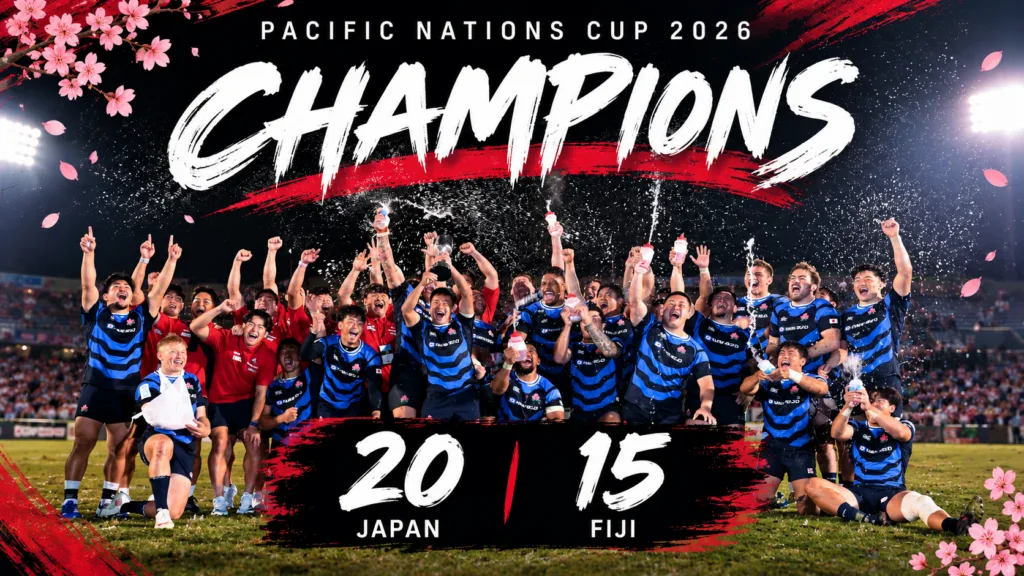
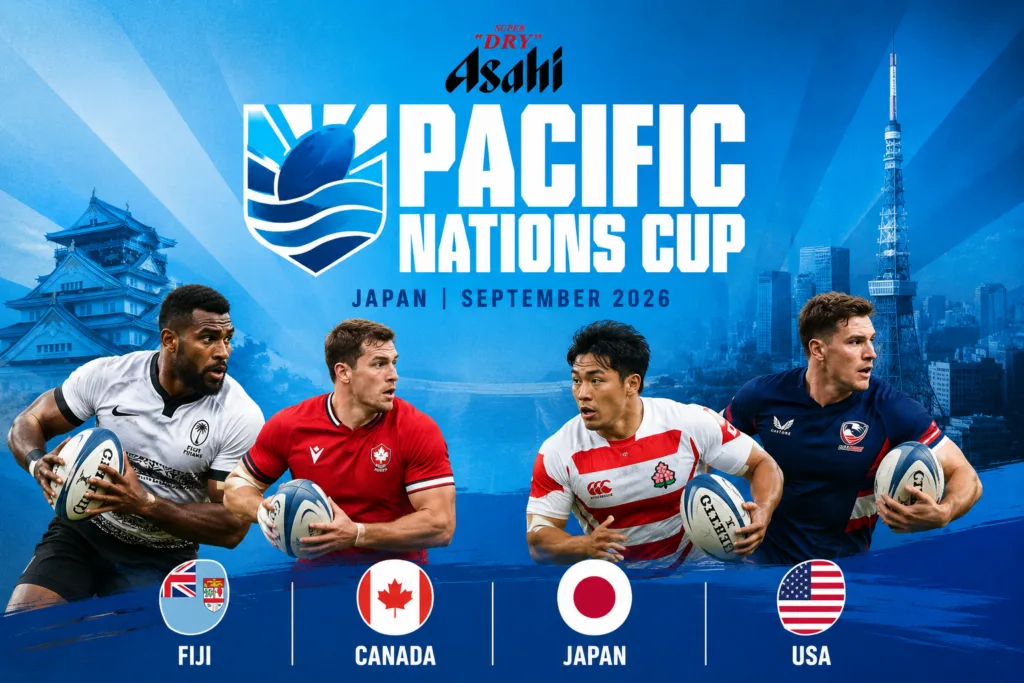
The Pacific Nations Cup will look very different in 2026.
World Rugby has confirmed the dates and format for the 17th edition of the tournament, with Canada, Fiji, Japan and the USA heading to Japan in September for a four-team knockout competition.
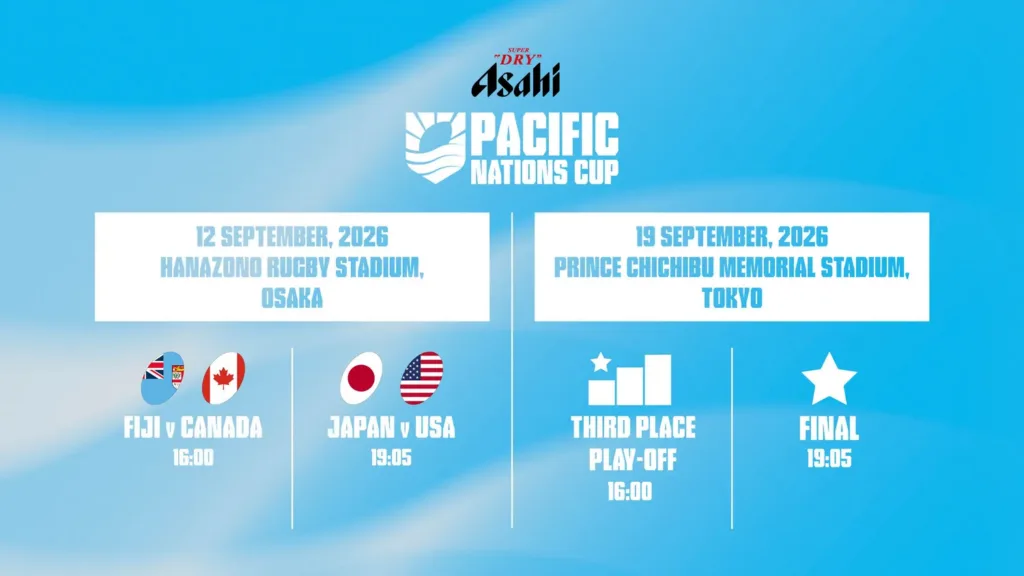
The tournament will be played over two match days. The semifinals take place in Osaka on September 12 before the competition moves to Tokyo for the third-place playoff and final on September 19.
For the USA Eagles, the path is straightforward: beat Japan and play for the Pacific Nations Cup title.
But the smaller field also raises a broader question about the tournament’s place in a rapidly changing international calendar — and what the Pacific Nations Cup is becoming.
A New-Look Pacific Nations Cup
There will be no pool stage in 2026.
All four teams advance directly into the semifinals at Hanazono Rugby Stadium in Osaka, where defending champion Fiji will face Canada before host Japan takes on the USA.
Pacific Nations Cup 2026 Schedule
Saturday, September 12 — Semifinals
Hanazono Rugby Stadium, Osaka
- 4:00 PM local: Fiji vs Canada
- 7:05 PM local: Japan vs USA
Saturday, September 19 — Finals Day
Prince Chichibu Memorial Stadium, Tokyo
- 4:00 PM local: Third-place playoff
- 7:05 PM local: Pacific Nations Cup Final
All kickoff times are Japan local time (GMT+9).
Every team is guaranteed two matches: a semifinal followed by either the final or third-place playoff.
That creates immediate stakes and a simple format, but it also means considerably less rugby than a traditional multi-round tournament.
With Men’s Rugby World Cup 2027 approaching, two matches provide limited opportunity within the competition itself to test squad depth, combinations and tactical adjustments.
The format guarantees meaningful games. Whether two of them are enough to deliver the same high-performance value is a different question.
Follow the Pacific Nations Cup 2026 on Rugby Fan Central
RFC’s Pacific Nations Cup 2026 hub brings together the tournament schedule, participating teams, results and continuing coverage in one place.
Where Are Samoa and Tonga?
Longtime followers will immediately notice two significant absences: Samoa and Tonga.
Both have been closely associated with the Pacific Nations Cup, but neither will participate in the 2026 edition. Instead, they are competing in the inaugural World Rugby Nations Cup.
That distinction matters because World Rugby now has several competitions with similar names operating within its redesigned international calendar.
The Nations Championship is the new top-tier global competition involving leading nations from the Six Nations and SANZAAR.
The World Rugby Nations Cup is a separate competition providing international fixtures for another group of nations, including Samoa and Tonga in its inaugural edition.
The Pacific Nations Cup remains its own tournament. This year it consists of Canada, Fiji, Japan and the USA.
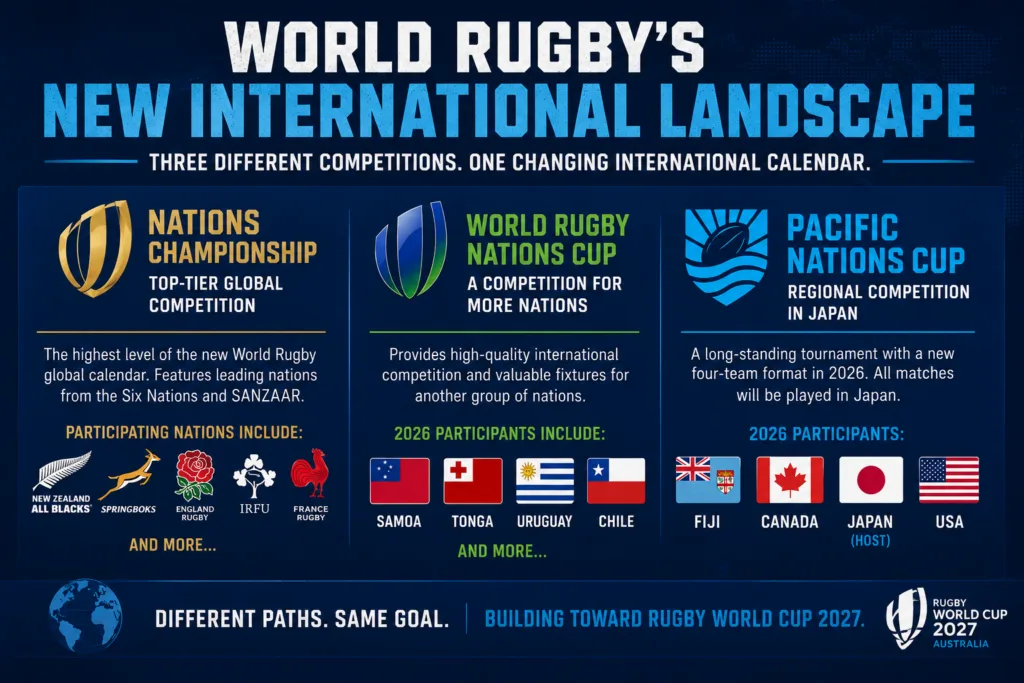
The Pacific Nations Cup has not been replaced by the World Rugby Nations Cup. Instead, the competitions now occupy different places within a broader international structure.
That helps explain why Samoa and Tonga are absent in September. It also creates a new question for the Pacific Nations Cup itself.
What Does “Pacific” Mean in 2026?
Samoa and Tonga’s absence is more than a scheduling change.
In 2026, Fiji will be the only Pacific Island nation competing in a tournament called the Pacific Nations Cup. The rest of the field consists of Japan, Canada and the USA, and every match will be played in Japan.
The competition has never exclusively belonged to the Pacific Islands. Japan, Canada and the USA all have substantial histories in the tournament, and its membership has changed repeatedly since its creation.
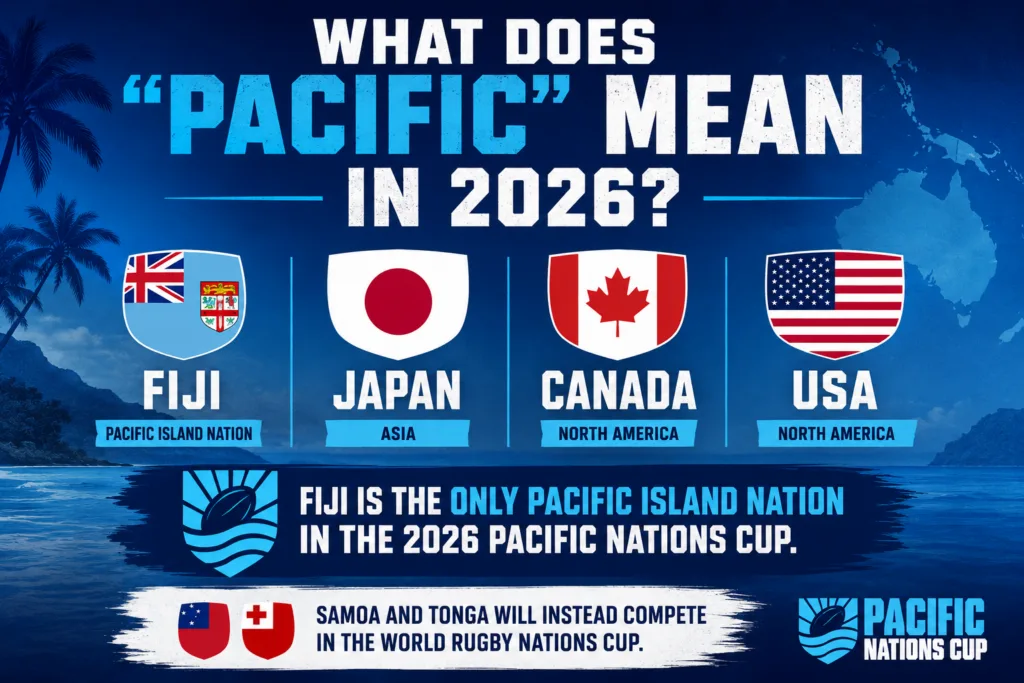
Still, Samoa and Tonga have been central to its Pacific identity.
Their move into the World Rugby Nations Cup leaves the 2026 edition with a different character.
That may simply be a consequence of a transitional year as World Rugby introduces its new international competitions. If the arrangement continues, however, the question becomes more significant: what role is the Pacific Nations Cup intended to serve in the new global calendar?
For now, the name remains the same even as the composition of the tournament changes around it.
USA Has a Direct Shot at the Final
For the Eagles, the new format presents an immediate opportunity.
There is no pool campaign and no qualification calculation. One victory against Japan would put the USA into the Pacific Nations Cup final.
It also gives the Eagles another significant test following their summer World Rugby Nations Cup campaign.
Japan will have home advantage and enters the tournament after finishing runner-up to Fiji in each of the past two Pacific Nations Cups.
Japan head coach Eddie Jones described the competition as an important opportunity for his side to develop against strong opposition while playing in front of its home supporters.
If the USA wins in Osaka, it will face either Fiji or Canada for the championship one week later.
The compressed schedule, however, leaves little opportunity to develop through the tournament. The Eagles will play Japan and then, regardless of the result, one more match.
That places greater importance on the work done before the squad arrives in Japan.
Fiji Chasing Three Straight Titles
Fiji enters as the defending champion and the team to beat.
The Flying Fijians won the Pacific Nations Cup in both 2024 and 2025, defeating Japan in the final on both occasions.
A victory this year would complete a three-peat.
Canada gets the first opportunity to prevent it, facing Fiji in the opening semifinal in Osaka.
For Fiji, the 2026 tournament also carries a different responsibility. As the only Pacific Island nation in the field, the Flying Fijians are the competition’s lone direct connection to the islands that have historically helped define its identity.
Where It Fits on the Road to 2027
All four participating nations are building toward Men’s Rugby World Cup 2027 in Australia.
The Pacific Nations Cup is one part of that preparation rather than a standalone international program.
That context matters when judging its reduced format.
Viewed by itself, two matches make for an unusually short preparation tournament. Viewed alongside the Nations Championship, World Rugby Nations Cup and other international windows, its purpose is easier to understand.
The trade-off is between volume and consequence.
Every Pacific Nations Cup match matters immediately, but teams have little room to experiment, respond to setbacks or build through several rounds of competition.
For developing sides, those are different forms of value.
Asahi Super Dry Continues as Title Partner
World Rugby also confirmed that Asahi Super Dry will remain title partner and official beer of the Pacific Nations Cup for a third year.
The tournament’s full sponsored name will remain the Asahi Super Dry Pacific Nations Cup, with the 2026 edition staged entirely in Japan.
A Tournament in Transition
There is plenty at stake in September.
Fiji can win a third consecutive title. Japan gets another opportunity to turn back-to-back runner-up finishes into a championship. Canada opens against the defending champion. And the USA needs just one victory to reach the final.
The four-team knockout format should ensure that every match carries consequence.
But 2026 may ultimately tell us as much about the future of the Pacific Nations Cup as it does about the four teams competing for it.
World Rugby’s new international structure has given Samoa and Tonga opportunities elsewhere while leaving the Pacific Nations Cup smaller and less distinctly Pacific than in previous editions.
Perhaps that is temporary.
If it is not, World Rugby will eventually need to define what this tournament is supposed to be within its new global calendar.
For now, four teams will head to Japan and play for a trophy with a long history — even as the competition carrying that history enters a very different era.
Follow the full tournament on Rugby Fan Central:
[Pacific Nations Cup 2026 Hub →]