

Dominic Besag has packed a remarkable amount of rugby into the first 21 years of his life.
He started playing at five, captained the USA U20s, became the second-youngest player to debut for the Men’s Eagles and has already accumulated 21 Test caps.
Now comes his biggest step yet.
The USA center is joining the Sharks in Durban for the 2026–27 United Rugby Championship season, moving from Saint Mary’s College into a South African professional environment.
For Besag, it is an opportunity to turn an already impressive international start into a professional career. For the Eagles, it puts one of their young starting backs into exactly the kind of demanding daily environment that could accelerate his development ahead of the 2027 Rugby World Cup.
From Danville to the Eagles
Besag’s path to Durban started long before Saint Mary’s.
Born in Danville, California, he began playing rugby at five with the Danville Oaks before continuing at De La Salle High School. He progressed through the USA age-grade pathway, appearing with the U18s before captaining the USA U20s during the 2023 World Rugby Trophy campaign.
While still with the U20 program, Besag received his first senior call-up from Eagles head coach Scott Lawrence.
He made his Test debut against Georgia in Tbilisi in August 2023 at 19, becoming, according to USA Rugby, the second-youngest player to represent the Men’s Eagles.
Three years later, Besag has become a regular presence at inside center.
That was evident again during the 2026 Nations Cup, when he started at No. 12 throughout the USA’s undefeated campaign against Portugal, Zimbabwe and Spain.
And the tournament data tells us more about his role than the three victories alone.
What the Nations Cup Numbers Show
Across the three matches, Besag played all 240 minutes.
Rugby Fan Central’s tournament data credits him with 31 carries for 82 metres, 14 gain-line successes and five defenders beaten, while he also scored against Portugal in Denver.
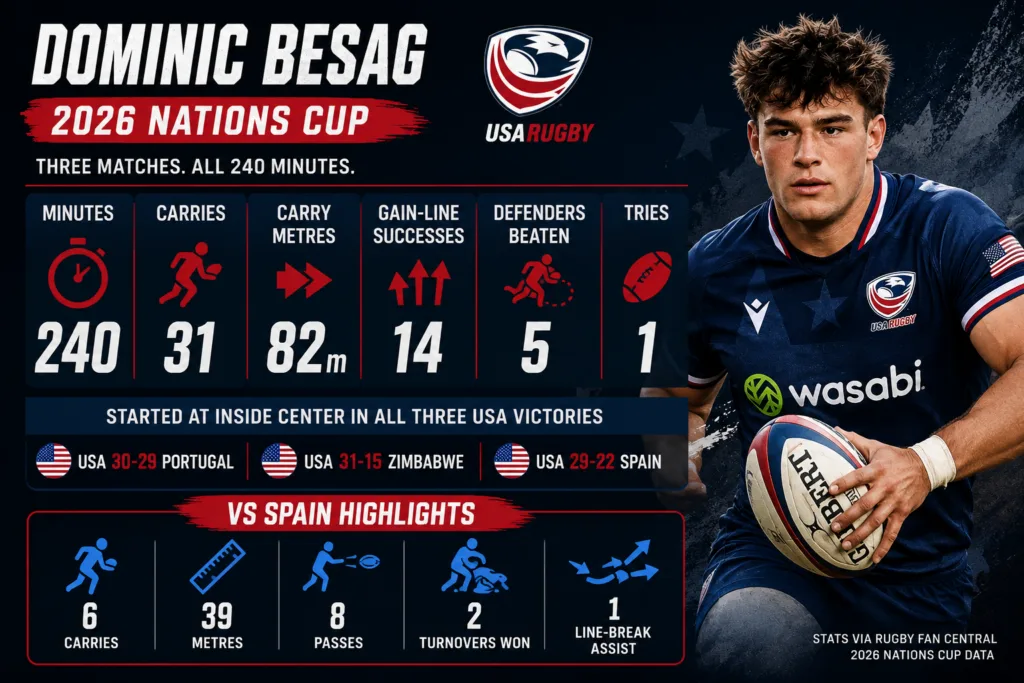
The numbers reinforce what has become an important part of his role for the Eagles. Besag gives the USA a direct option at inside center and can be used to generate momentum through the middle of the field.
But there was an interesting evolution across the three matches.
Against Portugal and Zimbabwe, Besag combined for 25 carries. Against Spain, he carried only six times but produced 39 metres — his highest total of the tournament — while adding a clean break, eight passes, an offload, a line-break assist and two turnovers won.
That final performance is worth noting.
The challenge for Besag’s development isn’t simply becoming a more powerful carrier. Modern inside centers have to recognize space, distribute under pressure and contribute at the breakdown as well as win collisions.
Against Spain, there were signs of that broader game.
Now it will be tested at another level.
A Very Different Challenge in Durban
The Sharks offer opportunity, but they also offer competition.
Besag is entering a midfield environment that includes Springbok André Esterhuizen, an established international inside center whose physical carrying and ability around the gain line provide an obvious benchmark for a young No. 12.

The Sharks also have talented younger backs competing for opportunities, including Ethan Hooker and Jurenzo Julius.
For Besag, that changes the equation.
At international level, the Eagles have already shown considerable trust in him. In Durban, he starts again as a young player trying to earn his place in a professional squad.
That competition could be as valuable as anything else about the move.
Training alongside an experienced Springbok such as Esterhuizen gives Besag an opportunity to see the standards required at the position every day, while competing with South African talent means selection itself becomes part of his development.
The first measure of success, therefore, shouldn’t necessarily be whether Besag immediately starts URC matches.
It should be whether he can adapt quickly enough to push for them.
From Saint Mary’s to Full-Time Professional Rugby
Saint Mary’s has developed Besag into an international player, but the move to Durban changes the rhythm of his rugby life.
The URC brings the Sharks into competition with professional teams from South Africa, Ireland, Scotland, Wales and Italy. The players are stronger, defensive systems more sophisticated and space disappears faster.
For a center, those differences are significant.
Decisions about whether to carry, distribute or attack space have to be made under greater pressure and against defenders accustomed to professional line speed.
There is also everything that happens between matches.
Rugby becomes the full-time job: skills work, strength and conditioning, video analysis, tactical preparation and recovery all become part of the weekly cycle.
For Besag, those additional hours may ultimately be as important as his first URC appearance.
Why the Timing Matters for the USA
Besag’s move comes at an important moment for the Eagles.
The USA’s undefeated Nations Cup campaign was another encouraging step, but closing the gap on higher-ranked nations requires more than successful international windows. The Eagles need players developing year-round in environments that continually challenge them.
Besag now has that opportunity.
By the time the 2027 Rugby World Cup arrives in Australia, he could combine several years of Test experience with a season spent inside one of South Africa’s major professional rugby organizations.
How much he plays will matter.
How much he develops may matter even more.
RFC View
The most interesting part of Dominic Besag’s move isn’t the name of the club he has signed for.
It’s the timing.
USA Rugby identified Besag early. He progressed through the age-grade pathway, captained the U20s, reached the Eagles at 19 and has developed into a regular inside center.
The Nations Cupprovided evidence of the player he is becoming. Besag can carry through traffic and generate gain-line momentum, but his performance against Spain also hinted at a more varied attacking and defensive role.
The Sharks now provide a much tougher laboratory.
Besag won’t need to wait for an international window to be challenged. He will encounter that challenge every week in Durban — in training, in competition for selection and, if he earns the opportunity, in the URC.
That’s why this signing matters beyond the transfer itself.
The Eagles already know what Dominic Besag can do for them today.
What South Africa helps him become next could be considerably more important.