
By The Rugby Fan Central Team
Major League Rugby built its College Draft to solve a simple problem: what happens to talented players after college?
For years, many of the best collegiate rugby players in the United States and Canada had nowhere obvious to go. A few found chances overseas, but many left the sport because they had no clear path into the professional game. The MLR Draft was created to change that.
With registration now open for the 2026 MLR College Draft, eligible players can take another step toward pro rugby. They can register through Major League Rugby’s official draft form.
This year’s draft could be one of the most important yet.
More Than a Draft

Major League Rugby designed the College Draft around four goals.
It aims to support college rugby, create a clearer player pathway, improve transparency, and promote competitive balance.
Those goals mirror what major American sports leagues have long tried to do with their draft systems. In rugby, though, the stakes may be even higher.
The United States will host the Men’s Rugby World Cup in 2031. That makes the need for a strong domestic talent pipeline even more urgent.
The draft is no longer just an off-field process. It now plays a key role in how the league develops players and how the future national team may take shape.
How the Draft Works
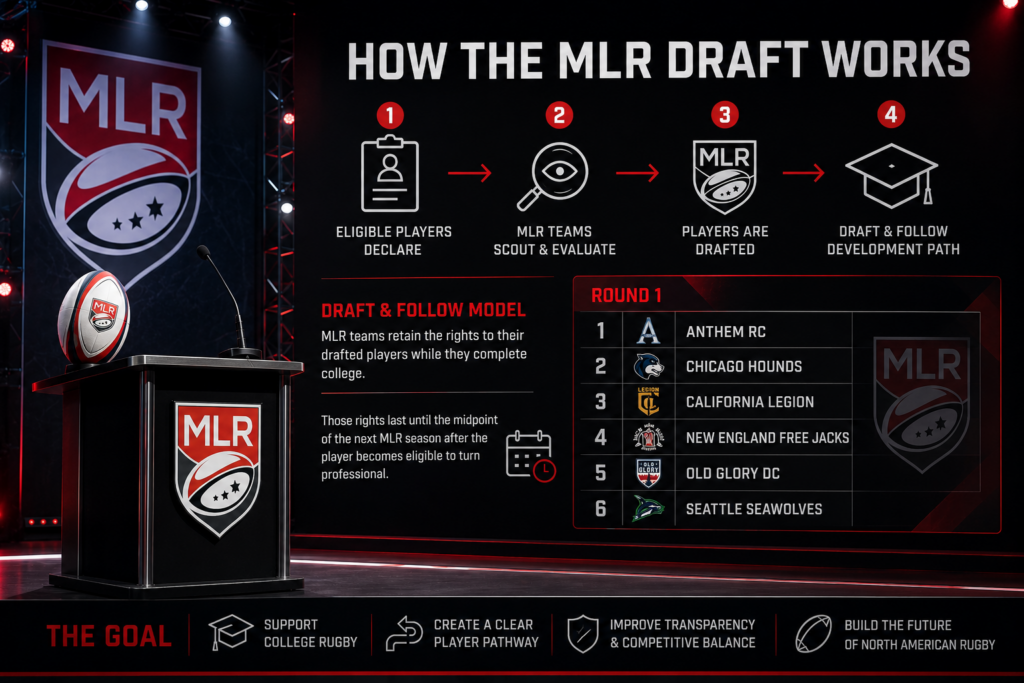
The 2026 MLR College Draft is scheduled for late August and will air on The Rugby Network.
MLR will again use its “Draft and Follow” model. That system allows teams to keep the rights to selected players while they finish college.
A club can hold those rights until the midpoint of the next MLR season after a player becomes eligible to turn professional. That can happen through graduation, the end of college eligibility, or a player choosing to leave school early.
This setup gives teams more time to develop players. It also gives athletes more flexibility to finish their education before turning pro.
According to Major League Rugby’s draft rules, drafted players remain under team control through that midpoint window.
Eligibility Rules
The draft process has become more structured over time.
To enter the 2026 draft, players must meet these requirements:
- Be enrolled at a U.S. or Canadian college during the 2025–26 academic year.
- Have played college rugby during that same period.
- Have completed three years of college or be at least 21 years old.
Players must declare for the draft by June 30, 2026.
Eligible players who do not declare may be temporarily blocked from joining MLR unless the league grants a waiver. That rule makes the draft the main route into the professional game for college players.

Why Domestic Players Matter
The draft is becoming more important as roster rules change.
Under the league’s updated Collective Bargaining Agreement, teams will be limited to six international players in a gameday 23 starting in the 2026–27 season. That gives domestic players more room to earn roster spots.
MLR has relied on experienced international talent for years. That will still matter. But long-term growth depends on developing more homegrown players.
College Rugby → MLR Draft → Professional Rugby → National Team
A decade ago, that pathway barely existed.
Early Signs of Progress

There are already signs the system is working.
Nine of the 26 players selected in the 2025 draft have already appeared in MLR matches this season. Anthem RC rookies Will Sherman and Campbell Robb have played meaningful minutes. Seattle’s Tiai Vavao and DC’s Connor Devos have also contributed.
Some rookies are already producing on the scoreboard. Sherman, Vavao, and Oscar Treacy have all scored tries. Robb has scored five times.
The top of the draft is producing, too. Each of the first six picks in the 2025 draft has already played in MLR competition. That suggests teams are identifying and developing talent well.
Fewer Picks, More Pressure
The 2026 draft will take place in a tighter league structure.
With only six active teams, the draft should include fewer total picks than in previous years. A three-round draft would likely produce 18 selections, down from 26 in 2025.
That makes every pick more valuable.
For players, the number of opportunities is smaller. For teams, the margin for error is thinner. That matters even more now, with domestic roster spots becoming more valuable under the new international player limits.
It also adds pressure to the league’s development system. MLR must do more with less.
A Big Moment for MLR
Major League Rugby still faces real challenges, including financial instability and franchise turnover. Even so, the growth of the College Draft is one of the clearest signs that the league is maturing.
The structure is clearer. The rules are tighter. Teams are scouting more carefully and investing more in development. Most importantly, young players now have a realistic path to a professional career in North American rugby.

With the 2031 Rugby World Cup approaching, the players selected in drafts like this one could help shape the next generation of the sport in the United States.
For Major League Rugby, the College Draft is no longer just an offseason event.
It is a long-term investment in the future of the game.
By The Rugby Fan Central Team
Published May 2026
Some images in this article were created using AI-assisted design tools for illustrative purposes.