Same sport. Some of the same clubs. Increasingly, the same stadiums, supporters and commercial brands.
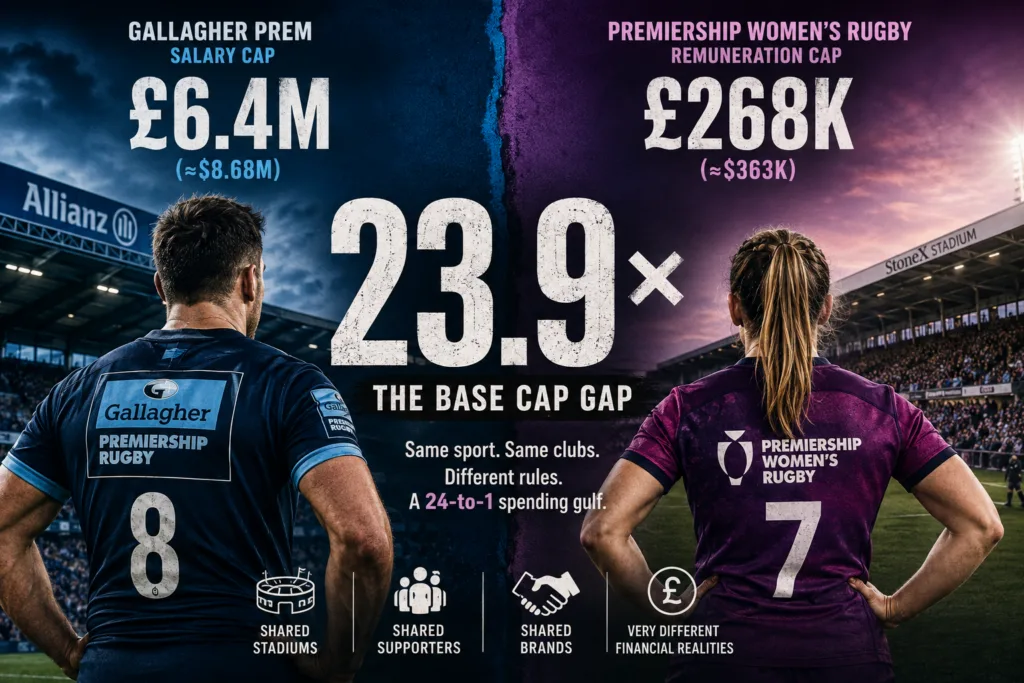
But when it comes to how much England’s leading men’s and women’s rugby clubs are permitted to spend on players, there is a nearly 24-to-1 gap between the two salary caps.
For the 2026/27 season, Premiership Women’s Rugby operates with an official club remuneration cap of £268,000 (approximately $363,000).
In the men’s Gallagher PREM, the senior salary cap is £6.4 million (approximately $8.68 million). Available credits can push permitted spending to £7.8 million (approximately $10.58 million), before the separate treatment of an excluded player.
Put the two base caps side by side:
£6.4 million ($8.68m) vs. £268,000 ($363k).
The men’s base cap is 23.9 times larger.
That is the headline number.
But it is not the same thing as saying men’s players earn 24 times more than women’s players.
Salary caps regulate specified forms of club spending. They do not tell us exactly what individual players earn, and the rules governing what counts toward those caps make the comparison considerably more complicated.
That distinction reveals something bigger about what it means to be a professional rugby player in 2026.
Salary Cap Snapshot
Same sport. Two professional competitions. A dramatically different financial scale.
The men’s base club cap is nearly 24× larger. That does not mean men’s players earn 24× more. These are regulatory spending limits — not average salaries.
The £268,000 ($363,000) Number
The current PWR Remuneration Cap Regulations were updated on July 23, 2026 and apply to the 2026/27 season.
Regulation 7 sets the cap at £268,000 ($363,000) — the maximum total Gross Payments a club, or any connected party, may make directly or indirectly to players during the remuneration-cap year, subject to excluded remuneration.
That makes an important distinction necessary.
Dividing £268,000 by 30 players and declaring an “average PWR salary” of approximately £8,933 ($12,100) would be misleading.
PWR’s definition of remuneration encompasses salaries, match fees, bonuses and other monetary and non-monetary benefits associated with participation in the competition.
And not everything a club provides a player counts toward the £268,000.
Regulatory Fine Print
PWR’s list of excluded remuneration is extensive.
Under specified circumstances, clubs can provide benefits and services without their full value counting toward the cap. Those include certain medical treatment and insurance, sporting equipment and club apparel, reasonable qualifying travel and subsistence, refreshments, educational support, gym membership, approved childcare, visa costs and qualifying pension contributions.
Personal sponsorship adds another layer.
Benefits from a genuinely independent personal sponsor can qualify as excluded remuneration. Certain arrangements involving sponsors that also have a commercial relationship with the club can qualify too, although those arrangements face additional conditions and approval requirements.
Accommodation has its own rules. Qualifying club-provided accommodation used as a player’s main residence is assigned a specified value under the regulations rather than simply being treated as unlimited free housing.
One Player. Multiple Income Streams.
A domestic salary cap does not necessarily tell us a player’s total rugby income.
Central Contract
Elite internationals may receive separate remuneration directly from their national governing body.
Club Remuneration
Salary, match fees, bonuses and other qualifying remuneration can fall within the PWR cap.
Permitted Benefits
Certain qualifying support, benefits and excluded remuneration may be treated separately under the rules.
Dividing the £268,000 ($363,000) PWR cap by the number of players in a squad does not produce a reliable average player salary.
Credits Can Push Spending Higher
Injuries provide another example.
PWR clubs can receive an Injured Player Credit of up to 15% of the remuneration cap when the regulatory requirements are satisfied.
For 2026/27, that means a maximum credit of:
£40,200 (approximately $54,500).
The regulations also contain a separate Maternity Leave Credit covering qualifying replacement-player costs during maternity leave, extended parental leave and specified compassionate or bereavement leave.
There is therefore no simple calculation that turns £268,000 into the total amount a PWR club might ultimately spend supporting its playing squad.
The Men’s £6.4 Million ($8.68 Million) System
The financial scale changes dramatically in the Gallagher PREM.
Men’s clubs have a £6.4 million ($8.68 million) senior squad salary cap, increased from £5 million (approximately $6.78 million) ahead of the 2024/25 season.
But £6.4 million is not necessarily the maximum permitted spend.
The competition operates a credits system.
Clubs can receive up to:
- £600,000 (approximately $814,000) in home-grown player credits;
- £400,000 (approximately $542,000) relating to qualifying international-player absences; and
- £400,000 for qualifying long-term injury replacements.
With the maximum specified credits, permitted spending can reach £7.8 million ($10.58 million).
There is also an excluded-player mechanism.
PREM Rugby itself cites Finn Russell’s move from Racing 92 to Bath Rugby for the 2023/24 season as an example of an excluded player.
That leaves three numbers to remember:
£6.4m ($8.68m) — base senior salary cap
£7.8m ($10.58m) — potential cap with maximum specified credits
plus the excluded-player mechanism
Those are the appropriate figures to put alongside PWR’s £268,000 ($363,000) cap.
The 23.9-to-1 Gap
Compare the base caps:
£6,400,000 ÷ £268,000 = 23.88.
The Gallagher PREM base cap is approximately 23.9 times PWR’s remuneration cap.
Compare £268,000 with the men’s potential £7.8 million after maximum specified credits and the ratio rises to approximately:
29.1 to 1.
Those are extraordinary differences.
But they require an equally important qualification:
They do not mean the average male PREM player earns 24 or 29 times more than the average PWR player.
We are comparing regulatory spending limits, not individual salaries.
Different credits and exclusions apply, individual contracts vary, and for some international players there is another potential source of rugby income altogether.
Why Are the Caps So Far Apart?
The nearly 24-to-1 difference does not exist in isolation.
England’s men’s professional club game has a much larger established commercial economy around it, including broadcast rights, sponsorship, hospitality, matchday income and central distributions. That gives Gallagher PREM clubs a substantially larger revenue base from which to fund their playing squads.
PWR is at a different stage of commercial development.
Women’s professional rugby is growing rapidly, but club rugby still operates within a financial ecosystem that includes support from the RFU, investment from clubs and owners, shared infrastructure and developing commercial revenues.
That helps explain why PWR’s remuneration regulations are built around a dramatically smaller number.
The £268,000 ($363,000) cap is not simply a statement about what women’s rugby players are worth. It is also a financial-control mechanism designed for the current economics of the competition.
That distinction matters because the men’s game provides its own warning about equating revenue growth with financial sustainability.
Gallagher PREM operates on a vastly larger commercial scale than PWR, yet English men’s professional rugby has also faced significant financial pressure in recent years. Wasps, Worcester Warriors and London Irish all entered administration during the 2022–23 period, stark reminders that a larger salary cap and greater revenues do not necessarily translate into financial sustainability.
The Salary-Cap Gap Is Measurable. The Revenue Gap Is Harder to Quantify.
The ten Gallagher PREM clubs generated approximately £182.2 million ($247 million) in combined revenue in 2023/24. Yet they still recorded a combined £34 million ($46.1 million) loss, illustrating that greater revenue does not necessarily mean financial sustainability.
PWR does not currently offer an equivalent publicly accessible league-wide revenue figure that allows a clean comparison. Its commercial position is changing, however: the league’s new JAECOO title sponsorship is worth more than £3 million ($4.07 million) over three years, providing more than £1 million ($1.36 million) per season from that partnership alone.
The salary-cap gap therefore reflects more than gender. It reflects two professional competitions operating at very different stages of commercial scale and financial development.
When the Club Isn’t the Only Payer
Club remuneration is only one part of the professional rugby economy.
Some international players also receive compensation from their national unions.
England’s leading women’s players, for example, can hold RFU contracts while competing for PWR clubs.
That means players sharing a changing room can have very different financial arrangements.
One player’s rugby income may be heavily influenced by a national-team contract. Another may depend more heavily on club remuneration. Other players may operate under different combinations of rugby-related compensation and support.
This is why £268,000 ($363,000) cannot simply be treated as the collective income of every player represented by a PWR squad.
It also leads to one of the most important questions in understanding professional rugby:
Who actually pays the player?
A £268,000 Cap With Teeth
PWR’s cap may be small compared with the men’s competition.
Its enforcement system is not.
Clubs must submit playing contracts, while PWR can request extensive documentation relating to remuneration, including contracts, image-rights arrangements, loans, agent payments and communications concerning financial agreements.
Where the regulations permit, investigations can extend to tax returns and bank statements. PWR can also attend club premises without notice when it considers there is reason to do so.
Overspending carries financial consequences.
PWR operates a progressive Overrun Tax. The first £9,999.99 of an overrun is charged at 25 pence for every £1. The next band rises to £1 for every £1, while the portion at £25,000 and above is charged at £2 for every £1 and triggers referral to the PWR Remuneration Disputes Committee.
Sporting sanctions can be severe as well.
The regulations provide for points deductions reaching 40 league points, while other available sanctions can include financial penalties, removal of titles or trophies and suspension from the competition.
English rugby has already seen how consequential salary-cap enforcement can become. Saracens were sanctioned under the men’s Premiership salary-cap system in 2019, receiving a major points deduction and financial penalty before ultimately being relegated following the salary-cap controversy. The PWR operates under its own remuneration-cap regulations, but the comparison demonstrates that salary-cap rules in English professional rugby are designed to carry meaningful consequences.
The money may be dramatically smaller. The regulatory architecture isn’t.
The Global Transparency Problem
The English regulations expose another issue.
We can establish from official documents that PWR’s 2026/27 remuneration cap is £268,000 ($363,000).
We can establish that Gallagher PREM’s base senior salary cap is £6.4 million ($8.68 million).
We can examine what counts, what doesn’t, which credits are available and how compliance is monitored.
Try answering equivalent questions across professional rugby globally and the picture becomes much less clear.
That is particularly relevant in the United States.
Women’s Elite Rugby is establishing professional women’s 15s rugby in the United States.
And the Men’s and Women’s Eagles introduce another potential layer of national-team compensation.
What Can Fans Actually See?
Public visibility into professional rugby’s compensation systems varies dramatically by competition.
Yet some apparently simple questions are much harder to answer from publicly available information:
What is the current MLR player compensation structure?
What is the player-pay structure in WER?
How are Men’s and Women’s Eagles compensated for representing the United States?
How does national-team compensation interact with domestic or overseas club contracts?
Those aren’t questions about celebrity salaries.
They are questions about how professional rugby itself is financed.
The Transatlantic Transparency Gap
That is what makes England’s 23.9-to-1 comparison significant beyond the size of the gap itself.
PWR’s regulations provide a detailed look inside the financial rules governing a women’s professional competition.
They define remuneration.
They identify exclusions.
They establish credits.
They describe audits.
They specify penalties.
And they put an exact number at the top:
£268,000 ($363,000).
The men’s Gallagher PREM does much the same at a dramatically different financial scale:
£6.4 million ($8.68 million).
As rugby grows commercially — particularly women’s rugby and the emerging professional game in the United States — that level of transparency becomes increasingly important.
Fans are frequently told that a player is “professional.”
But that single word can describe very different financial realities.
Some players receive club salaries. Some receive national-union support. Some combine multiple sources of rugby income. Others may still need employment away from the sport.
So perhaps the most revealing thing about £268,000 vs. £6.4 million isn’t simply that one cap is nearly 24 times larger.
It’s the question the comparison leaves behind:
What does being a professional rugby player actually mean in 2026?
England gives us part of the answer.
Finding the answer across the rest of professional rugby — including the United States — could tell us much more about where the sport is heading.
Official Sources & Further Reading
- PWR Remuneration Cap Regulations 2026/27 — Official RFU regulations covering the £268,000 remuneration cap, exclusions, injury and maternity credits, compliance and sanctions.
- Gallagher PREM — Salary Cap Explained — Official explanation of the £6.4m senior cap, excluded-player mechanism and salary credits.
- MLR — MLR, USRPA Reach Historic CBA for American Rugby — Official MLR announcement confirming the first CBA in American rugby history.
- PWR — JAECOO Announced as Title Partner — Official PWR announcement of the multi-year title partnership. PWR describes the deal officially as a multi-year agreement; its About page calls it a multi-million-pound, multi-year partnership.