
Rugby Fan Central is launching a new way to track the national picture in men’s D1A college rugby.
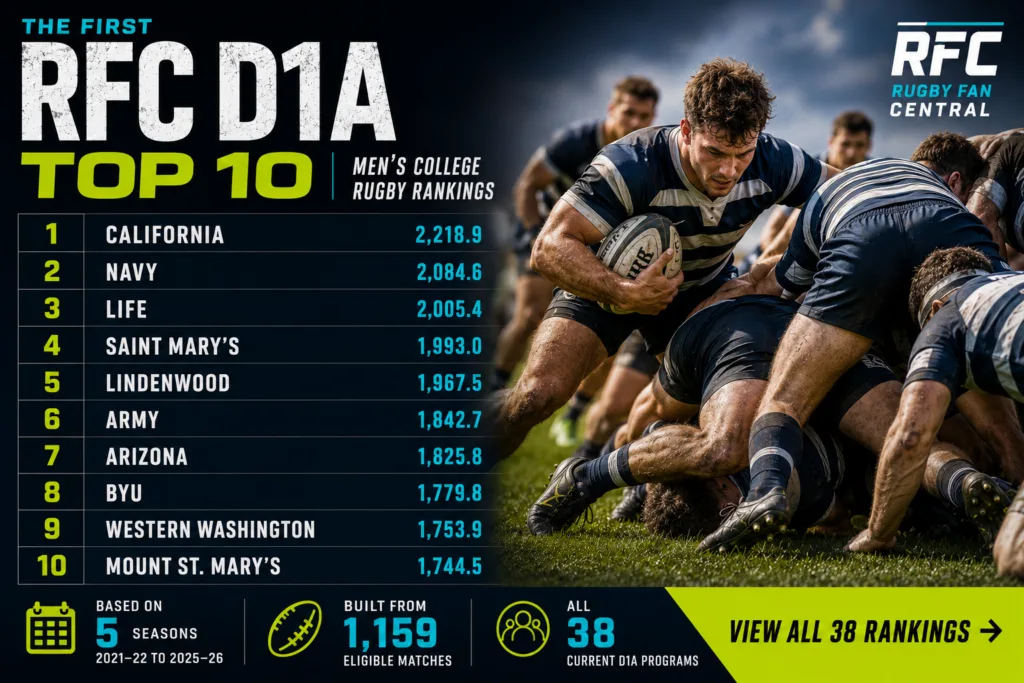
The first RFC D1A Men’s College Rugby Rankings place defending national champion California at No. 1, followed by Navy at No. 2, Life at No. 3, Saint Mary’s at No. 4 and Lindenwood at No. 5.
But these are not another set of opinion-based power rankings.
RFC has built a results-based rating system using five completed seasons of eligible college rugby results. The objective is to create a consistent national ranking driven by what teams have actually done on the field.
The initial dataset contains 1,159 eligible matches spanning the 2021–22 through 2025–26 seasons.
As the 2026–27 season unfolds, new eligible results will be added to that existing rating network and the rankings will update.
The First RFC D1A Top 10
The inaugural RFC D1A Men’s College Rugby Rankings are led by defending national champion California.
California Begins at No. 1
There is little ambiguity at the top of the first RFC rankings.
California enters the new season with an RFC Rating of 2,218.9, the highest in the D1A field.
The Golden Bears went 61–10 across eligible matches in RFC’s five-season dataset, and their position was reinforced by their championship run last spring.
Cal defeated Navy 36–22 in the 2026 D1A National Championship, completing a postseason in which the Bears also beat San Diego 88–5, BYU 96–12 and Saint Mary’s 59–19.
That championship followed a regular season in which Cal had already moved to the top of CRAA’s March power rankings after defeating then-No. 1 Navy 52–45.
The RFC system reaches the same conclusion through a different process: based on the full results network entering 2026–27, California starts as the team to catch.
Navy Is a Clear No. 2
Navy begins at No. 2 with a 2,084.6 RFC Rating.
The Midshipmen’s five-season eligible record stands at 63–8, one of the strongest records anywhere in college rugby.
Navy also reached the 2026 national championship after defeating Mary Washington 40–11, Army 38–10 and Life 35–21 in the postseason.
The championship defeat prevents Navy from beginning the new season at No. 1, but the larger body of results keeps the Midshipmen comfortably inside the national elite.
The gap between Navy and No. 3 Life is more than 79 rating points.
Life, Saint Mary’s and Lindenwood Complete the Top Five
The next three positions demonstrate how tightly packed the national contenders are behind Cal and Navy.
Life is No. 3 at 2,005.4, narrowly ahead of Saint Mary’s at 1,993.0 and Lindenwood at 1,967.5.
All three have produced substantial bodies of high-level results during RFC’s five-season window.
They were also major factors in the 2026 postseason.
Life eliminated Lindenwood 31–24 in the national quarterfinals before falling to Navy in the semifinals.
Saint Mary’s reached the other semifinal after defeating Colorado State 69–10 and Arizona 48–19 before running into eventual champion Cal.
That leaves RFC with a recognizable five-team elite entering the new season:
California. Navy. Life. Saint Mary’s. Lindenwood.
The order can change quickly once meaningful 2026–27 results begin arriving.
Army, Arizona and BYU Lead the Next Group
There is another noticeable break after the first five.
Army sits No. 6, followed by Arizona at No. 7 and BYU at No. 8.
Those placements also align closely with the national picture that emerged late last season.
CRAA’s March 2026 rankings had Army sixth and Arizona seventh, while BYU was ninth.
Army subsequently defeated Arkansas State in the opening round of the D1A playoffs before losing to Navy.
Arizona advanced past Grand Canyon before falling to Saint Mary’s, while BYU defeated Cal Poly before its quarterfinal loss to California.
The RFC model therefore starts 2026–27 with all three immediately behind the five highest-rated programs.
Why Is Western Washington No. 9?
The most immediately noticeable team in the rankings may be Western Washington.
The Vikings enter D1A at No. 9 despite moving up from D1AA for the 2026–27 season.
That is not a mistake.
RFC’s rating network is not restricted to games between teams carrying the D1A label at the time they were played. Eligible cross-division college matches can connect teams across the wider competition network.
Western Washington enters the rankings with a 34–13 eligible record across the five-season dataset and an RFC Rating of 1,753.9.
Most importantly, the Vikings arrive in D1A after winning the 2025–26 D1AA national championship.
Their No. 9 position illustrates one of the fundamental differences between the RFC system and a conventional preseason ranking.
RFC does not manually decide where a newly promoted team “should” begin.
The results determine it.
Long Beach State Is Another Team to Watch
Western Washington is not the only placement that may surprise readers.
Long Beach State begins at No. 13 with an RFC Rating of 1,691.3.
That puts Long Beach ahead of several programs that have received considerably more national attention in recent seasons.
Again, the reason is the length of the evaluation window.
The RFC system isn’t designed simply to reproduce last season’s standings or predict which team has the strongest roster right now. It measures results across a connected multi-season competition network.
A program that has accumulated a strong body of eligible results can therefore rate higher than it might in a traditional preseason poll.
That is intentional.
These Are Not Preseason Predictions
That distinction is important.
The RFC D1A Rankings are not a prediction of who will win the 2027 national championship.
They are also not an attempt to evaluate recruiting classes, returning starters, coaching changes or how strong a team looks on paper.
RFC does not manually move a team because it loses an important player.
It does not give a program additional points because of its reputation.
And it does not begin each season by asking voters to reorder the division.
Instead, every team exists inside the same results network.
Opponent strength matters.
Winning and losing matter.
Margin of victory matters, within controlled limits.
Ratings carry forward rather than resetting each preseason.
And every eligible result is evaluated using the same methodology.
Why Build Another College Rugby Ranking?
College rugby is difficult to compare nationally.
Teams play different schedules, compete in different conferences and don’t face the same level of opposition. Some programs regularly play nationally ranked opponents, while others have far fewer opportunities to face teams outside their region or conference.
That means a simple win-loss record doesn’t tell the whole story.
Traditional power rankings can provide valuable context, but they inevitably involve judgment.
RFC wanted to build something different: a system based on results across a connected college rugby network rather than votes or preseason expectations.
The system considers who a team played, what happened in the match and the margin of the result. Every eligible match is evaluated using the same methodology.
The goal isn’t to predict which team will win the national championship.
It’s to answer a different question:
Based on the results, how do these teams compare?
Built From Five Seasons of Results
The inaugural RFC rankings are built from 1,159 eligible matches across five completed seasons, covering 2021–22 through 2025–26.
RFC reviewed and cleaned the results before they entered the rating network, removing ineligible fixtures and resolving duplicate or conflicting records.
The complete rankings page explains what matches count and how the RFC Rating works.
The Rankings Now Become Live
The launch rankings provide the starting point.
They are not intended to remain frozen.
As eligible 2026–27 matches are completed, those results will enter the RFC rating network.
Teams can move up.
Teams can move down.
Records will change.
Ratings will change.
And because the existing ratings carry forward, every new result becomes another piece of a much larger national picture.
There is no preseason reset and no manual reshuffling.
The teams will decide what happens next.
View the complete RFC D1A Men’s College Rugby Rankings, including all 38 programs, current RFC Ratings and an explanation of the methodology on Rugby Fan Central.