Japan didn’t need overwhelming possession to overwhelm Canada.
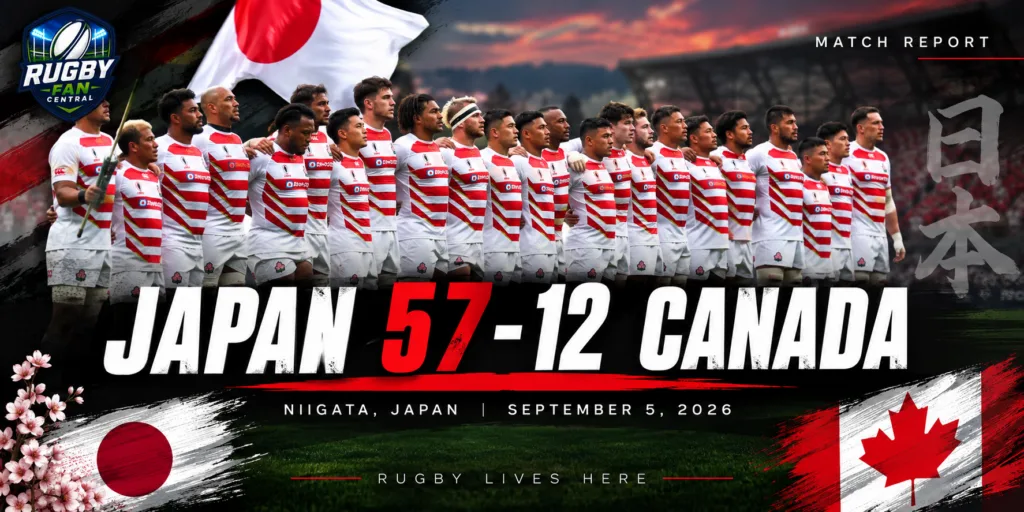
The Brave Blossoms turned a dominant set piece, effective field-position game and explosive carrying into a 57–12 victory Saturday in Niigata, scoring nine tries and pulling away from a Canadian side that spent much of the match trying to escape pressure.
Japan held 55% possession and 53% territory — hardly numbers that would normally suggest a 45-point victory.
What happened with that possession told a very different story.
Japan carried for 572 metres to Canada’s 253, made six clean breaks to Canada’s one and repeatedly used its scrum, maul and kicking game to put Canada back into difficult areas of the field.
Hooker Mamoru Harada scored twice, while seven other Japanese players crossed as the Brave Blossoms turned a 31–7 halftime advantage into an emphatic victory.
Watch Japan vs Canada
Watch the full replay of Japan’s 57–12 victory over Canada from Niigata, Japan.
The Pressure Started Up Front
The pattern that would shape the match appeared almost immediately.
Japan put Canada’s scrum under pressure, won a penalty and went to the corner. From the resulting attacking platform, prop Takato Okabe finished from the maul for the opening try.
The Brave Blossoms returned to the lineout for their second.
This time Harada was the beneficiary, crossing from another drive to give Japan two tries inside the opening 15 minutes.
Canada wasn’t without an answer.
Takoda McMullin produced a superb individual response in the 18th minute, cutting back against the Japanese defense and accelerating through the gap before finishing under the posts.
He converted his own try and suddenly Canada was back within five at 12–7.
For a moment, the scoreboard suggested a competitive contest.
The set piece kept pushing it in the other direction.
Another spell of pressure eventually produced Japan’s third try through Ben Gunter, and as the match opened up, Japan’s backs began finding the space created by the work of the forwards.
Debutant Inoke Burua was at the center of much of it.
Burua broke through once but lost possession before he could finish the opportunity. He soon attacked the Canadian line again, this time helping create the opening for Yuya Hirose to score.
Kanji Shimokawa added another try around halftime and Japan went into the interval leading 31–7.
The scoreboard was beginning to reflect what had been happening around the field: Canada could produce dangerous moments, but Japan was producing pressure far more consistently.
Japan Kept Sending Canada Back
One of the more revealing parts of the performance came away from the try line.
Japan kicked from hand 17 times. Canada kicked 18.
The difference wasn’t that Japan simply kicked more.
It was how the Brave Blossoms combined those kicks with their set-piece advantage to repeatedly reset where the game was being played.
Japan gained 511 metres from its kicks from hand, with flyhalf Ryunosuke Ito responsible for 342 metres from 11 kicks.
Canada generated 468 kicking metres.
Whenever Canada managed to relieve pressure, Japan had the tools to send the game back downfield and start again. And when the resulting exchange produced a scrum, lineout or attacking possession, the Brave Blossoms had the stronger platform from which to attack.
That helps explain why Japan’s 53% territory figure looks relatively ordinary alongside such an extraordinary final score.
The Brave Blossoms did not spend the entire match camped inside Canadian territory.
They repeatedly re-established field position and then did far more with it.
Japan won 12 scrums with a 100% success rate and all six of its mauls. Three of those mauls were recorded as ending in tries.
The kicking game, in other words, wasn’t separate from Japan’s forward dominance.
It helped keep bringing the set piece back into the contest.
Canada Couldn’t Make the Second Half Turn
For Canada, the challenge after halftime was finding a way to interrupt that cycle.
Instead, Japan scored again almost immediately.
Harada crossed for his second try, extending the lead and leaving Canada chasing a match that was increasingly moving beyond reach.
The visitors did manage a better defensive spell as replacements entered, but Japan eventually found another opening when lock Harry Hockings crossed in the 58th minute.
Canada responded with its second try.
Captain Lucas Rumball won a breakdown penalty inside Japanese territory and Canada moved quickly before Ben LeSage finished in the corner.
It was a glimpse of what Canada could do when it created favorable field position.
There simply weren’t enough of those opportunities.
At 43–12, Japan still had two more tries to come.
Replacement prop Takumi Inaba crossed late before Tiennan Costley scored with time expiring. Sam Greene converted both to take Japan to 57.
Why 55% Possession Became 57 Points
The final numbers make the scale of Japan’s efficiency clear. The Brave Blossoms did not dominate possession or territory, but they produced far more from the ball they had.
| STATISTIC | JAPAN | CANADA |
|---|---|---|
| Possession | 55% | 45% |
| Territory | 53% | 47% |
| Carries | 119 | 89 |
| Carry metres | 572 | 253 |
| Clean breaks | 6 | 1 |
| Defenders beaten | 34 | 20 |
| Kicks from hand | 17 | 18 |
| Kick metres | 511 | 468 |
| Tackles | 101 | 153 |
| Turnovers won | 6 | 9 |
| Rucks won | 80 | 60 |
| Scrums won | 12 | 3 |
| Tries | 9 | 2 |
Japan held only a modest advantage in possession and territory. The difference was what happened when the Brave Blossoms had the ball: more than twice Canada’s carry metres, six times the clean breaks and nine tries from 55% possession.
Japan didn’t dominate every category.
Canada actually won more turnovers, 9–6, and retained 97% of its own ruck ball.
But once Japan had possession, the difference was enormous.
The Brave Blossoms averaged substantially more metres from their carries, beat 34 defenders and forced Canada to make 153 tackles.
Canada missed 34.
Japan, meanwhile, needed to make only 101 tackles.
That workload accumulated as the match progressed and helped create the space Japan exploited late.
Burua’s Debut Offered a Glimpse of Another Weapon
Among all the attacking numbers, Burua’s performance stood out.
The winger finished his Japan debut with a match-high 133 metres from 15 carries.
Even more strikingly, he crossed the gain line on 14 of those carries and beat seven defenders.
He didn’t get the debut try that briefly appeared possible, but his ability to generate front-foot ball gave Japan another attacking dimension outside the power of its forwards.
Haruto Kida added 74 metres, while Japan spread its scoring across the lineup.
Harada finished with two tries. Okabe, Gunter, Hirose, Shimokawa, Hockings, Inaba and Costley each scored once.
Nine tries. Eight different scorers.
McMullin Gives Canada Something to Build On
Canada’s best attacking moments frequently involved McMullin.
His first-half try was an outstanding individual finish, and his numbers suggest it wasn’t an isolated contribution.
The fullback carried for 81 metres and beat eight defenders, the highest defenders-beaten total of anyone on the field.
Rumball was another important contributor.
The Canadian captain led the match with 17 carries and was credited with 14 rucks won. His breakdown penalty also helped create the opportunity for LeSage’s second-half try.
Canada’s problem was turning those individual contributions into sustained pressure.
The visitors managed just one clean break as a team and 253 carry metres.
Against a Japanese side capable of repeatedly moving the game back downfield and then applying pressure through the set piece, isolated attacking moments weren’t enough.
Attention Turns to the USA Eagles
Japan now heads to Osaka to face the USA Eagles in the Pacific Nations Cup, while Canada moves on to face Fiji.
For the Eagles, there is plenty in this performance to study.
Japan’s nine tries will attract the attention, as will the 572 carry metres.
But the more important warning may be how those opportunities were created.
Japan didn’t require 65 or 70% possession to take control. The Brave Blossoms used the scrum and maul to establish pressure, Ito’s boot to help reset field position, and their carriers to punish Canada once the opportunities appeared.
Stopping Japan in Osaka may therefore require more than simply defending its attacking phases.
The USA will have to find a way to prevent the Brave Blossoms from repeatedly putting the game back where they want it.
Final: Japan 57–12 Canada
Japan tries: Mamoru Harada (2), Takato Okabe, Ben Gunter, Yuya Hirose, Kanji Shimokawa, Harry Hockings, Takumi Inaba, Tiennan Costley.
Canada tries: Takoda McMullin, Ben LeSage.
Halftime: Japan 31–7 Canada
Go Inside Japan 57–12 Canada
The report tells the story. The Rugby Fan Central Match Centre lets you explore the match in detail.