A Six Nations match in Boston or New York? Nothing has been agreed, but World Rugby says it would help a union take a championship fixture to the United States — and Saturday’s sold-out Springboks-All Blacks Test in Baltimore is showing why the idea is being discussed.
One of rugby’s most historic competitions could eventually bring a championship match to the United States as the sport accelerates its American push ahead of Rugby World Cup 2031.
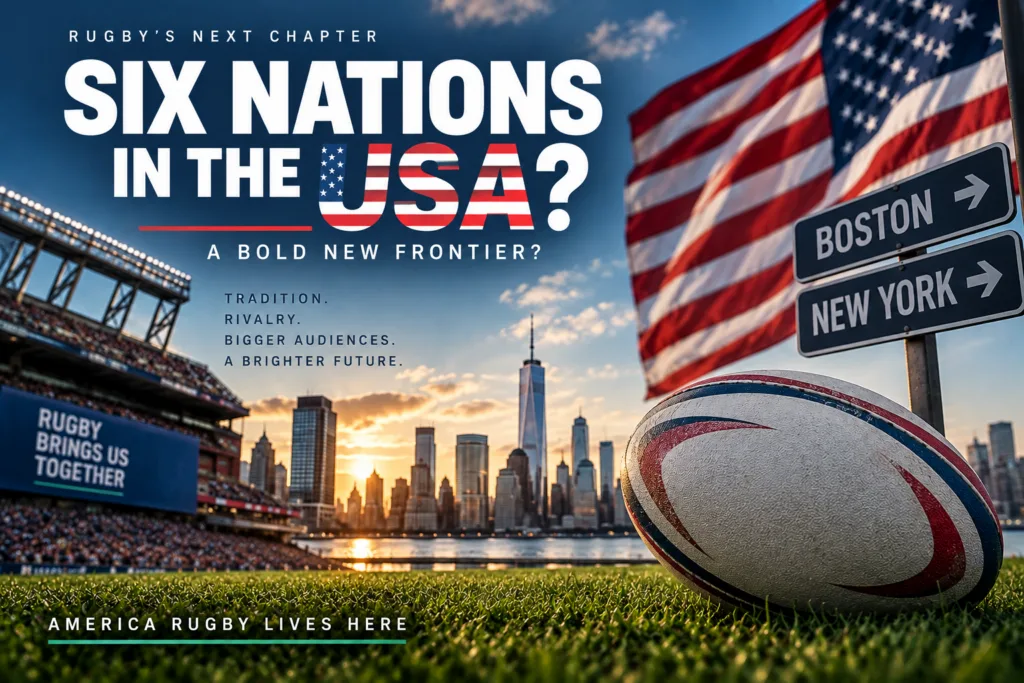
World Rugby chief executive Alan Gilpin has opened the door to helping a Six Nations union stage a future championship fixture in the U.S., with Boston and New York discussed as examples of markets capable of hosting such an event.
But there is an important distinction for American rugby fans.
WHAT WE KNOW
No Six Nations Match in the USA Has Been Announced
There is no confirmed fixture, opponent, city or date. Ireland vs. Italy has been discussed as an example of the type of matchup that could work in the American market, but Gilpin has made clear that it is not a live fixture discussion.
The conversation comes at a significant moment for rugby in America.
On Saturday, September 12, South Africa and New Zealand will bring one of international rugby’s greatest rivalries to M&T Bank Stadium in Baltimore for the fourth and final Test of their 2026 series.
The match has sold out, with approximately 71,000 spectators expected for one of the biggest rugby occasions ever staged in the United States.
For World Rugby, Baltimore is about more than one enormous Test match.
It is another demonstration of what major international rugby could become in the American market.
Why Baltimore Matters
World Rugby has made bringing elite international rugby to major American cities part of its strategy ahead of the 2031 Men’s Rugby World Cup and 2033 Women’s Rugby World Cup in the United States.
Saturday’s Springboks-All Blacks Test is one of the most ambitious examples yet.
Gilpin has said the match-day economics surrounding the Baltimore event are comparable to those of a Six Nations fixture.
That is significant because one of the biggest obstacles to moving a championship home match overseas is financial.
A union giving up a traditional home fixture would need a compelling reason to do so. If staging that match in America could match or improve the economics of playing at home, the conversation changes considerably.
World Rugby has indicated that it would be willing to work with unions interested in taking major fixtures to the United States.
By the Numbers
~71,000 — Expected sellout crowd for Springboks vs. All Blacks in Baltimore.
2031 — Men’s Rugby World Cup in the United States.
2033 — Women’s Rugby World Cup in the United States.
2–1 — South Africa’s series lead entering the Baltimore finale.
Why Ireland vs. Italy Keeps Coming Up
One hypothetical matchup has emerged in discussion around the idea: Ireland vs. Italy.
The logic behind the example is straightforward.
Both countries have significant cultural connections and established communities in the northeastern United States. A match involving Ireland and Italy in a market such as Boston or New York could tap into those communities while also attracting American rugby supporters and general sports fans.
But there is currently no Ireland vs. Italy Six Nations match scheduled for America.
Ireland Says There Are No Current Plans
Any suggestion that Ireland is already preparing to move a Six Nations match to America would be premature.
The Irish Rugby Football Union has described the United States as an important growth market for rugby and welcomed initiatives capable of introducing the sport to new audiences and generating additional revenue.
However, the union has also made its present position clear: there are currently no plans or discussions from the IRFU’s perspective about playing a Six Nations match in the United States.
That distinction matters.
World Rugby is demonstrating that it wants more major rugby content in America and is willing to help make the economics work.
That is very different from a Six Nations fixture already being agreed.
Major International Rugby Has Worked in America Before
Baltimore is not the first indication that major international rugby can attract American crowds.
One of the most famous examples came at Soldier Field in Chicago in 2016, when Ireland defeated New Zealand 40–29 to record its first victory over the All Blacks.
Ireland and New Zealand returned to Soldier Field in November 2025, with the All Blacks winning the rematch 26–13.
New Zealand has also played international matches in other major U.S. markets, providing further tests of American demand for elite international rugby.
What makes Baltimore particularly significant is the scale and status of the event.
South Africa and New Zealand are taking the fourth and final Test of a dedicated four-match rivalry series into a sold-out NFL stadium.
It provides World Rugby and the participating unions with another real-world test of demand for elite rugby in the American market.
Why Moving a Six Nations Match Would Be Controversial
The commercial opportunity in America is obvious.
The sporting and cultural argument is considerably more complicated.
The Six Nations is built around home fixtures in England, France, Ireland, Italy, Scotland and Wales. Those matches are major sporting occasions for supporters and significant sources of revenue for the participating unions and surrounding economies.
Moving a championship fixture to America would mean taking that match away from its traditional home audience.
There are also significant financial differences between the Six Nations unions.
For unions that generate substantial revenue from their home internationals, surrendering a championship fixture would require a particularly strong financial and strategic case.
Other unions could reach different conclusions if an American event were capable of matching or exceeding the financial return of playing at home.
Any eventual move would therefore have to balance commercial growth in America against the traditions, supporters and economics that make the Six Nations one of rugby’s most valuable competitions.
America Is Becoming Part of Rugby’s Long-Term Strategy
The larger story is not necessarily whether Ireland and Italy eventually meet in Boston.
It is that conversations about taking established championship rugby to the United States are becoming increasingly realistic.
The United States will host the Men’s Rugby World Cup for the first time in 2031, followed by the Women’s Rugby World Cup in 2033.
World Rugby therefore has several years to expand the sport’s American audience, develop commercial partnerships and establish major-event markets before those tournaments arrive.
Bringing established international rugby properties to American cities is part of that wider strategy.
Saturday’s Springboks-All Blacks Test is perhaps the clearest example yet.
The match takes one of international rugby’s defining rivalries and places it inside a sold-out NFL stadium in Baltimore.
If the event delivers commercially as well as at the turnstiles, other unions and competitions will be paying attention.
Could Rugby Follow the NFL’s International Playbook?
There is already a powerful example of a major sports competition taking meaningful games beyond its traditional borders: the NFL.
The American football league has spent years developing its international series, taking regular-season games — not exhibitions — into overseas markets.
That strategy has expanded significantly.
In 2026, the NFL is staging a record nine regular-season international games across four continents, seven countries and eight stadiums.
The schedule includes games in Australia, Brazil, England, France, Germany, Mexico and Spain, demonstrating how aggressively the league is using meaningful competition to reach audiences beyond the United States.
London, in particular, has developed from an experiment into an established part of the NFL calendar, while the league continues to enter additional international markets.
The comparison with rugby is not exact.
The Six Nations is built around national teams, historic rivalries and home fixtures that carry enormous cultural importance for supporters.
But the underlying strategy offers an interesting comparison.
The NFL has demonstrated that taking games that actually count to another country can do more than generate a one-day crowd. It can help establish a competition in a new market, attract commercial partners and give overseas supporters a direct connection to the league.
That distinction matters.
Springboks vs. All Blacks in Baltimore already carries considerably more sporting weight than an exhibition.
Taking an actual Six Nations championship fixture to Boston, New York or another American city would move the concept another step further.
American supporters would not simply be watching international rugby staged for the U.S. market. They would be watching a match whose result directly affects one of rugby’s most important championships.
Two Sports, Two New Markets
Rugby Heads to an NFL Stadium as the NFL Expands Overseas
The timing provides an interesting contrast. As South Africa and New Zealand bring elite international rugby to an NFL stadium in Baltimore, the NFL is continuing its own expansion into major sporting markets overseas.
The direction of travel is opposite, but the objective is similar: use meaningful games and recognizable teams to turn international interest into a larger, more established audience.
RFC Analysis: The Question Is Beginning to Change
For years, one of the biggest questions surrounding elite rugby in America was whether enough fans would show up.
A sold-out crowd of approximately 71,000 for Springboks vs. All Blacks provides another powerful data point.
One match cannot prove that every major international rugby event will succeed in the United States. But it can demonstrate what is possible when the teams, city, venue and event are right.
The NFL comparison provides another lesson.
Building an international market is unlikely to happen through a single blockbuster event. The NFL has returned to international markets repeatedly, gradually making overseas regular-season games part of its calendar.
Rugby faces a similar challenge in the United States.
A Six Nations match in America would still represent an enormous break with tradition, and there is no guarantee one will happen.
But the fact that World Rugby is openly discussing how the economics could work — and is prepared to help unions interested in bringing major fixtures to the U.S. — shows how seriously the American market is now being considered.
The road to Rugby World Cup 2031 will not be built by the World Cup alone.
Major Tests, domestic rugby, college rugby, club rugby and events capable of introducing new audiences to the sport will all have a role to play.
If rugby eventually adopts even part of the NFL’s international playbook, Baltimore could look less like a one-off spectacle and more like another step toward making major international rugby a recurring part of the American sports calendar.
First, There Is a Series to Decide
Before attention moves to hypothetical Six Nations matches, South Africa and New Zealand have unfinished business.
The Springboks arrive in Baltimore with a 2–1 lead in the four-Test Rugby’s Greatest Rivalry series.
New Zealand won the opener 33–16 at Ellis Park before South Africa responded with a 33–26 victory in Cape Town.
The Springboks then edged the All Blacks 29–24 at FNB Stadium in Soweto on September 5 to move ahead in the series.
That makes Saturday’s sold-out Baltimore Test the fourth and final match of the series, with New Zealand attempting to level the series at 2–2 and South Africa looking to finish with a 3–1 series victory.
The result on the field will determine how Rugby’s Greatest Rivalry ends.
What happens around the field could have implications beyond this series.
If Baltimore demonstrates that a marquee international rugby event can generate Six Nations-level match-day economics in the United States, the discussion about bringing more of the sport’s biggest occasions across the Atlantic is unlikely to disappear.
RFC Accuracy Note
No Six Nations match in the United States has been announced or agreed. Ireland vs. Italy and potential markets such as Boston and New York have been discussed as examples of how a future U.S. fixture could work. The IRFU says there are currently no plans or discussions from its perspective about staging a Six Nations match in the United States.