

Fiji are one victory away from a third consecutive Pacific Nations Cup title after defeating a spirited Canada 45–29 in a seven-try performance at Hanazono Rugby Stadium in Osaka.
The final score tells only part of the story.
Fiji had just 38% territory. Canada carried more often, spent considerably more time playing in Fiji’s end and won more turnovers. Yet when Fiji found space, the defending champions were devastating.
Seven tries, 606 metres carried and 10 clean breaks ultimately separated the teams as Fiji advanced to the 2026 Pacific Nations Cup final.
For Canada, defeat came with something considerably more encouraging than the 57–12 loss to Japan seven days earlier.
The Canadians scored four tries, repeatedly challenged Fiji’s defense and continued attacking after falling well behind. Contemporary reports described it as an ambitious Canadian performance, while reaction among supporters was notably more positive than after the Japan defeat.
Watch: Fiji 45–29 Canada
Watch the highlights from Fiji’s Pacific Nations Cup semifinal victory over Canada.
Fiji strike almost immediately
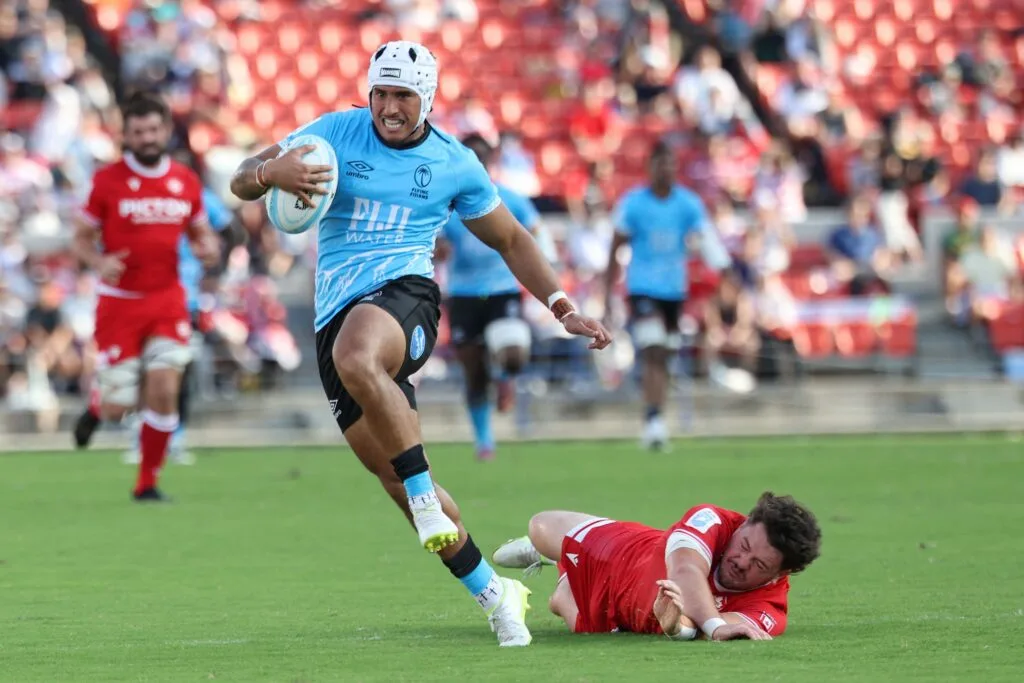
Canada’s first problem was that the game had barely begun before Fiji showed exactly how dangerous they could be.
Kitione Salawa crossed after only 21 seconds, and Isaiah Armstrong-Ravula converted. Less than five minutes into the match, Frank Lomani added Fiji’s second try.
It was 14–0 almost before Canada had settled into the semifinal.
That blistering opening was particularly significant given the circumstances surrounding Fiji.
The defending champions entered the Pacific Nations Cup after three consecutive defeats in the Nations Championship and had not won since beating Spain in November 2025. At the same time, Fiji arrived in Japan chasing a third consecutive PNC crown.
Head coach Senirusi Seruvakula had characterized this tournament as a new campaign following the disappointment of the Nations Championship.
Fiji certainly played the opening minutes like a team eager for a reset.
Canada refuse to disappear
A two-try deficit against Fiji can quickly become an avalanche.
Canada prevented that from happening.
Mason Flesch scored in the eighth minute, with Takoda McMullin converting, cutting the deficit to 14–7.
Fiji responded through Armstrong-Ravula, who scored his team’s third try in the 23rd minute, before McMullin kicked a Canadian penalty.
Then Peni Ravai crossed around the half-hour mark.
Fiji were again threatening to pull away.
Canada answered again.
Siôn Parry’s 35th-minute try, converted by McMullin, ensured the semifinal remained competitive heading toward halftime.
That resilience matters when evaluating Canada’s performance.
A year earlier, Fiji had demolished Canada 63–10 in the Pacific Nations Cup semifinal. Fiji produced nine tries in that encounter and accumulated 1,129 carry metres.
Canada were not going to reverse that result in Osaka, but this was a dramatically different contest.
Fiji find another gear
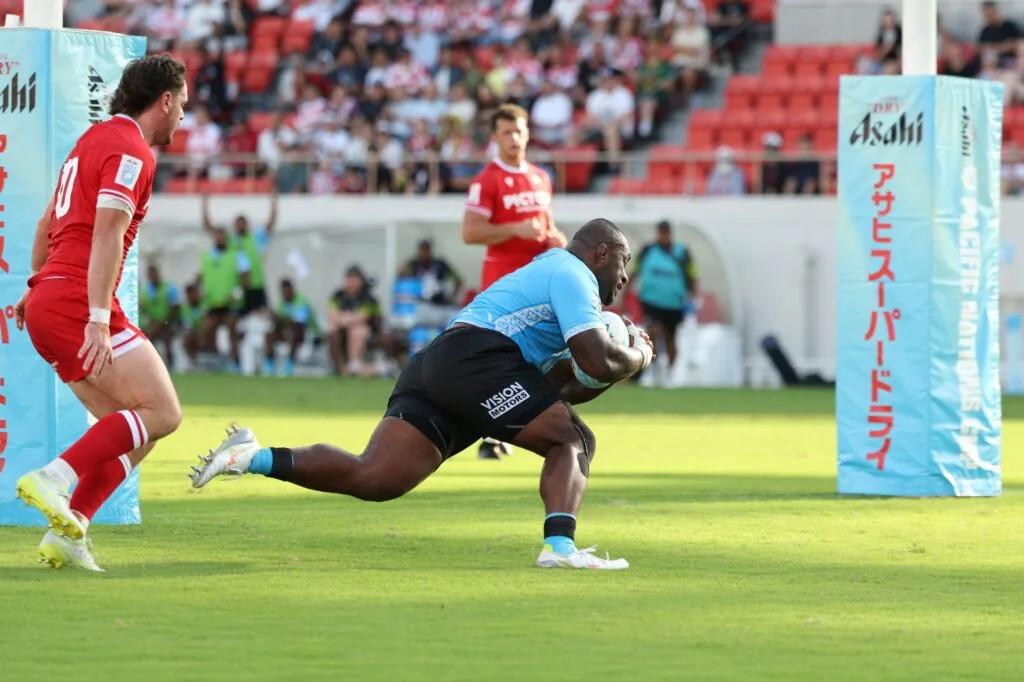
Canada had survived the opening assault.
The next one proved decisive.
Captain Tevita Ikanivere scored shortly after halftime and Armstrong-Ravula converted.
Then Motikiai Murray took over.
The Fiji flanker crossed in the 51st minute and struck again in the 61st, completing his double and giving Fiji the cushion they needed.
Murray finished with two tries, while Ikanivere, Salawa, Lomani, Armstrong-Ravula and Ravai accounted for Fiji’s other five.
Armstrong-Ravula added five conversions and finished with 15 points.
By that stage, Fiji had demonstrated the fundamental difference between the sides.
Canada could generate possession.
Fiji could turn opportunities into damage.
The statistic that explains the match
Canada controlled where much of the match was played. Fiji did far more damage with the ball it had.
Canada had more territory and more carries. Fiji had the cutting edge. That difference in attacking efficiency is perhaps the clearest explanation for the 45–29 final score.
Canada had the ball in useful parts of the field. Fiji did more with theirs.
And when Fiji broke the defensive line, their combination of support running, pace and offloading repeatedly transformed promising possession into points.
Canada finish fighting

What happened next may ultimately be the most encouraging part of Canada’s performance.
They didn’t fold.
Kyle Tremblay scored in the 66th minute.
Then Flesch crossed again in the 69th, completing his own two-try performance. McMullin converted the latter.
Canada had four tries against the two-time defending Pacific Nations Cup champions.
That was not cosmetic scoring after an entirely one-sided match. Canada had already scored twice in the first half and continued making Fiji defend deep into the contest.
Americas Rugby News similarly characterized Canada’s performance as ambitious and noted that the four-try showing represented something the team could take from the defeat.
Supporter reaction during and immediately after the match reflected the same impression, with comments describing Canada as increasingly impressive as the game developed and calling it one of their better recent performances. That is anecdotal rather than statistical evidence, but it matches what the match numbers show.
Fiji’s discipline leaves a warning
The semifinal wasn’t entirely comfortable for Fiji.
Isoa Nasilasila was shown a red card in the 74th minute, and Terio Tamani Veilawa received a yellow in the 78th.
Fiji therefore finished with 13 players.
Combined with Canada controlling 62% of the territory, it gives the Flying Fijians plenty to examine before the final.
Fiji won comfortably enough, but this wasn’t a flawless championship performance.
Even some immediate Fijian supporter reaction was critical of the defensive performance and handling while expressing concern about what a stronger opponent might do with the same opportunities.
That distinction is important.
Fiji were clearly the more dangerous team. They were not clearly the more controlled team.
Joji Nasova provides the cutting edge
The score sheet alone also misses one of Fiji’s most influential attacking performances.
Joji Nasova didn’t score, but he led all players with 113 metres carried and produced a match-high four clean breaks.
Isaiah Armstrong-Ravula followed with 87 metres, while Manasa Mataele accumulated 83.
Nasova’s performance continued a pattern established during Fiji’s 2025 Pacific Nations Cup title run. The pre-match Opta report noted that he led the entire 2025 tournament with 223 metres and 22 defenders beaten.
Fiji’s threat is therefore much deeper than its try scorers.
Give their backs space and a possession that appears relatively harmless can become a scoring opportunity within seconds.
Lucas Rumball leads Canada’s resistance
Canada had an equally notable performance in its pack.
No player carried more often than Lucas Rumball.
The Canadian No. 8 made 19 carries, crossed the gain line 17 times, beat seven defenders and made 15 tackles.
Flesch supplied the scoreboard impact with his two tries and finished with 10 points.
Tremblay was another major attacking threat, beating six defenders and making three clean breaks.
Those individual performances help explain why Canada were able to stay involved despite Fiji’s superior strike power.
By the Numbers
A very different Canada from 2025
Perhaps the strongest measure of Canada’s progress comes from comparing this match with the same opponent almost exactly one year earlier.
On September 15, 2025:
Fiji 63–10 Canada.
On September 12, 2026:
Fiji 45–29 Canada.
Fiji had won 10 of the 13 meetings between the countries before Saturday and all seven of their previous neutral-site encounters following Canada’s victory at the 1991 Rugby World Cup.
So this result wasn’t an upset.
But neither was it a repeat of 2025.
After losing 57–12 to Japan just a week earlier, Canada needed evidence that it could compete more effectively against one of the Pacific’s strongest sides.
They got some.
Not enough to reach the final, but enough to make the performance meaningful.
What comes next
Fiji advance to the Pacific Nations Cup final on September 19 at Prince Chichibu Memorial Stadium in Tokyo, where they will meet the winner of Japan-USA.
Canada will face the loser in the third-place playoff on the same final day.
For Fiji, the objective hasn’t changed.
The Flying Fijians won the Pacific Nations Cup in 2024 and successfully defended it in 2025. They now stand one victory from making it three consecutive championships.
For Canada, the scoreboard says defeat.
The performance says something more complicated.
Canada controlled territory, generated 125 carries, scored four tries and forced Fiji to keep playing deep into the second half. But Fiji demonstrated why they remain such a dangerous tournament team: fewer attacking opportunities were required to produce far greater damage.
Canada made Fiji work. Fiji made Canada pay.
And after 80 eventful minutes in Osaka, the defending champions are headed back to the Pacific Nations Cup final.