
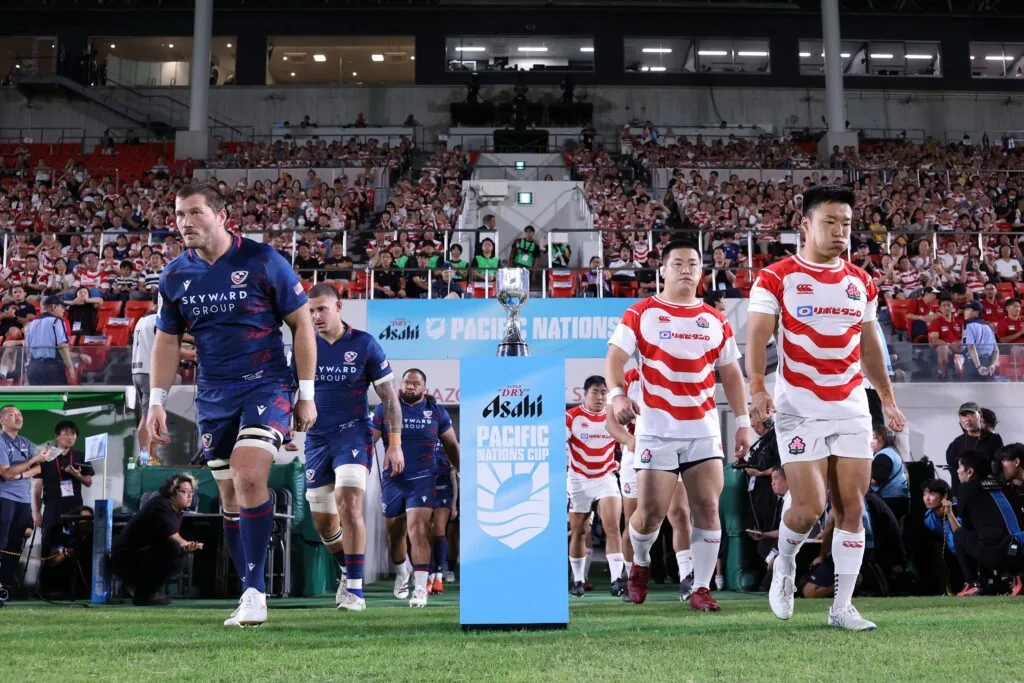
The score told us what happened in Osaka.
After watching the match again and going through the numbers, the bigger story is why it happened — and what it tells us about where the Eagles stand.
Japan’s 63–14 victory over the United States in Saturday’s Pacific Nations Cup semifinal was comprehensive. But one statistic makes the result particularly revealing:
The USA had 54% territory in both halves.
The Eagles weren’t starved of field position. They had opportunities to play in Japan’s half.
They simply couldn’t turn enough of them into points.
Japan carried for 584 meters to the USA’s 317, crossed the gain line on 89 carries to 49, made eight clean breaks to four and scored nine tries to the Eagles’ two.
That’s the central lesson from a second look at Osaka.
Japan vs USA
Watch the extended highlights from Japan against the USA Men’s Eagles in the Pacific Nations Cup semifinal.
The USA had opportunities. Japan did far more with them.
1. Territory Without Threat
The USA could get into useful areas of the field. It struggled to become dangerous once it got there.
Japan generated 584 carrying meters from 127 carries. The USA managed 317 from 86.
That’s roughly 4.6 meters per carry for Japan compared with 3.7 for the Eagles.
Japan also crossed the gain line on 89 carries — about 70% of its total — compared with 49 of 86 for the USA, or roughly 57%.
The difference wasn’t simply who had the ball.
It was what happened once they carried it.
For an Eagles side trying to become competitive against teams above it internationally, that’s significant.
Territory is valuable only when it becomes pressure, and pressure ultimately has to become points.
Against Japan, too often it became neither.
2. The Eagles Looked Tired
This stood out even more on a second viewing.
As the match progressed, the Eagles looked tired.
That’s an observation, not a medical or conditioning conclusion. RFC does not have access to the players’ GPS data, physical-performance information or other internal measurements that could establish fatigue as the cause.
But what was visible on the field is worth discussing.
Japan continued to look capable of accelerating as the match progressed. The Eagles increasingly appeared to be working just to stay with them.
The numbers provide some context.
The USA attempted 162 tackles during the match compared with Japan’s 121 — a difference of 41 tackle attempts.
And after going into halftime down 35–14, the Eagles were outscored 28–0 in the second half.
That happened despite the USA still recording 54% territory after halftime.
The Eagles weren’t simply pinned inside their own end. They had field position but increasingly struggled to turn it into dangerous attacking rugby.
There are several possible explanations.
Japan’s tempo, the accumulated defensive workload, repeatedly having to reorganize, chasing the scoreboard and physical fatigue could all have played a role.
We cannot determine the cause from outside the team.
But the contrast was noticeable.
Japan maintained its attacking sharpness.
The USA did not.
For a team preparing for Rugby World Cup 2027, the challenge isn’t matching a side such as Japan for 20 or 40 minutes.
It’s doing it for 80.
3. The Set Piece Made It Harder
The Eagles also made an already difficult assignment harder at the set piece.
The USA’s lineout finished at 64% success, with five lineouts lost.
The scrum operated at 82%, with two lost, while Japan was perfect on its recorded scrum opportunities.
Those aren’t insignificant details in a match like this.
What makes them particularly interesting is another number: the Eagles retained 96% of their rucks.
Once the USA established possession, it generally protected the ball.
The difficulty was getting enough clean possession from the set piece and then turning possession into something threatening.
Against a team already generating substantially more meters and clean breaks in open play, surrendering possession before an attack properly develops only increases the pressure.
The Eagles cannot afford to give a team such as Japan additional opportunities.
4. Tackle Percentage Doesn’t Tell the Story
Here’s another statistic that deserves a closer look.
USA tackle success: 80%.
Japan tackle success: 79%.
Look only at those percentages and you might conclude there wasn’t much difference defensively.
There clearly was.
The Eagles attempted 162 tackles and missed 23. Japan attempted 121 and missed 19.
But the more revealing numbers are what happened before and around those tackles.
Japan crossed the gain line on 89 carries and accumulated 584 carrying meters.
A completed tackle doesn’t necessarily mean a successful defensive sequence.
If the ball carrier gets beyond the gain line before being brought down, the attacking team can still generate quick possession while forcing the defense to retreat and reorganize.
That’s where Japan repeatedly hurt the Eagles.
So the lesson isn’t simply make more tackles.
The USA needs to prevent opponents from generating so much momentum through and around contact.
That requires more than a good-looking tackle percentage.
5. Japan Is Waiting Again
This is where the result becomes more significant than a single Pacific Nations Cup defeat.
The USA and Japan will meet again at Rugby World Cup 2027.
That makes 63–14 a measuring point.
USA captain Jason Damm acknowledged the gap afterward:
“We knew Japan are a great side and we’re trying to catch them up, but we saw the gap today so we know we’ve got a lot of work to do.”
That may be the most useful way to view Osaka.
The Eagles don’t need to pretend the performance was better than the scoreboard suggests.
Nor does one heavy defeat mean everything being built under Scott Lawrence is heading in the wrong direction.
It tells the USA where the standard currently sits.
The Eagles had territory.
They retained their ruck ball.
They scored twice.
And Japan still beat them by 49 points.
That’s the uncomfortable part.
With the teams scheduled to meet again at the World Cup, the question is no longer whether a gap exists.
We saw it.
The question is how much of it the USA can close over the next year.
Now Show Us the Response
The Eagles don’t have to wait until Rugby World Cup 2027 to show they’ve learned something.
They have another game Saturday.
The USA faces Canada on September 19 at Prince Chichibu Memorial Stadium in Tokyo. USA Rugby’s Pacific Nations Cup media guide confirms the September 19 final-round fixture at the venue.
Canada is an appropriate opponent for what comes next.
The Canadians beat the USA 34–20 in Calgary in August 2025 and arrive in Tokyo after losing their Pacific Nations Cup semifinal to Fiji 45–29.
Forget, for a moment, about whether the prize is third place.
Watch the performance.
Does the USA produce cleaner set-piece ball?
Does it turn territory into genuine scoring pressure?
Does it limit easy gain-line success?
Can the Eagles stay sharp late in the match?
And after being outscored 28–0 after halftime by Japan, can they produce something much closer to an 80-minute performance?
Those are measurable questions.
They may tell us more than the final score.
Because the ambitions of this program extend well beyond the Pacific Nations Cup.
Rugby World Cup 2027 is just over a year away. Four years later, the United States will host the Men’s Rugby World Cup in 2031. USA Rugby’s tournament media guide identifies the 2031 men’s and 2033 women’s Rugby World Cups as landmark home events for the organization.
Progress cannot ultimately be measured only by victories against teams the Eagles are already capable of beating.
At some point, it has to become visible against the teams they’re trying to catch.
Japan showed the Eagles the gap.
Canada gives them the first opportunity to show how they intend to close it.
Keep following the Eagles through the Pacific Nations Cup
From the full Japan match report to the tournament hub and the Eagles’ next match against Canada.
USA vs Japan — Match Report
Go back through the scoring, key moments and final from Osaka.
READ MATCH REPORT →TOURNAMENT HUBPacific Nations Cup 2026
Results, standings, schedule and complete RFC tournament coverage.
OPEN PNC HUB →NEXT FOR THE EAGLESUSA vs Canada
September 19 · Prince Chichibu Memorial Stadium · Tokyo
OPEN MATCH CENTRE →