
Rugby union can look chaotic at first—but the jersey numbers tell a clear story. Each number corresponds to a specific position and role on the field.
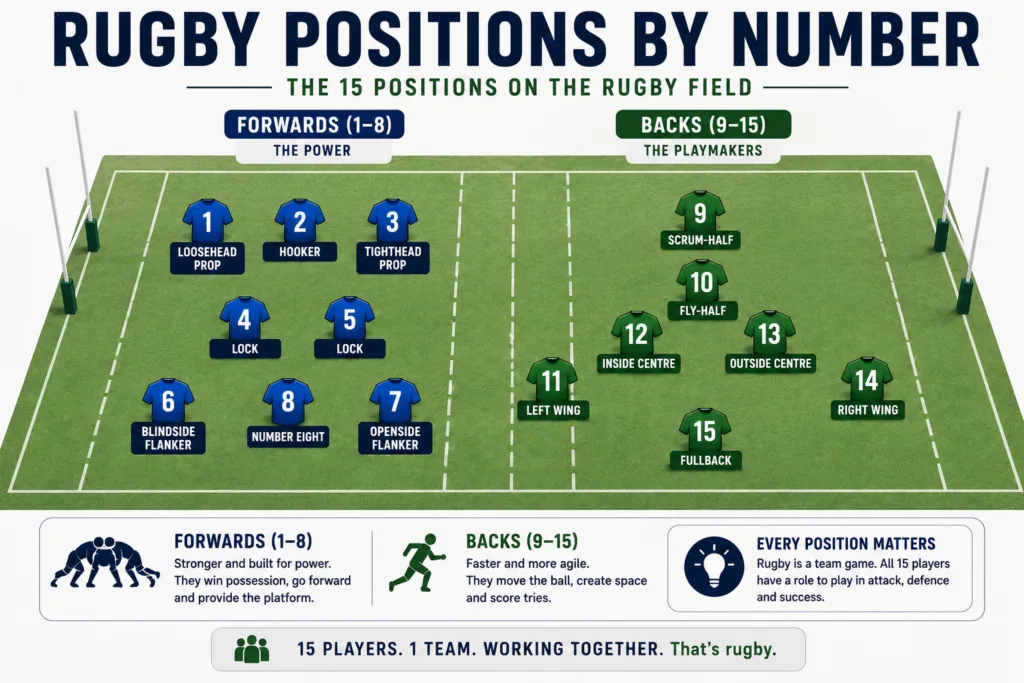
A rugby union team consists of 15 players, divided into two groups:
Before looking at each position individually, it helps to understand rugby’s two main groups. Forwards provide the physical platform by winning possession and competing at set pieces, while backs use speed, skill, and creativity to move the ball and create scoring opportunities.
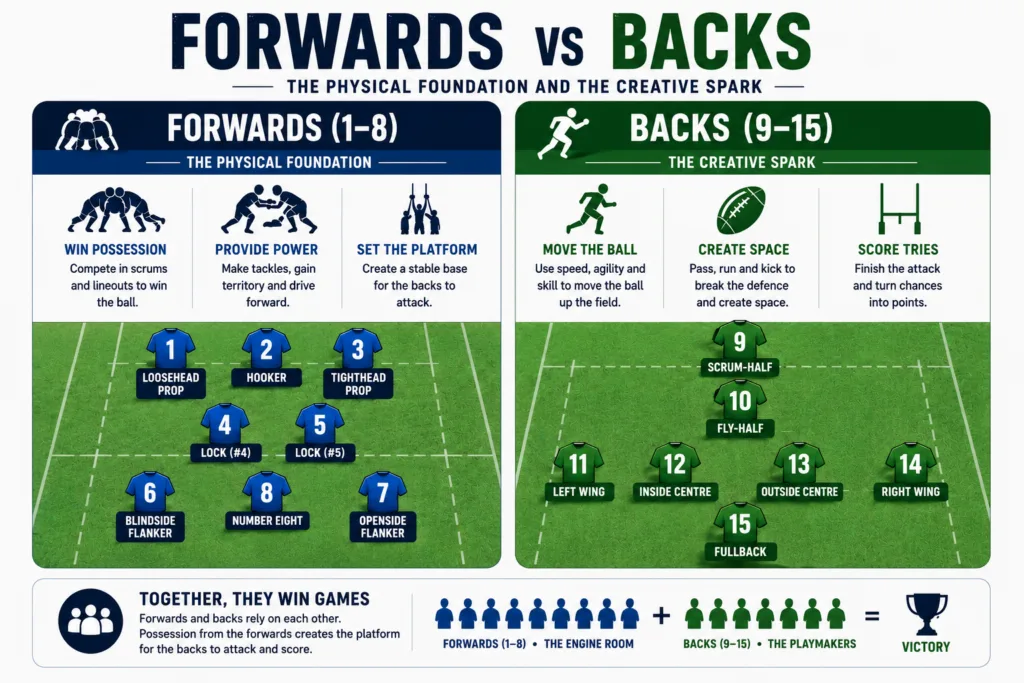
- Forwards (1–8) – The bigger, more physical players who compete for possession and do much of the close-contact work.
- Backs (9–15) – The faster, more creative players who move the ball, create opportunities, and score tries.
A match is played through phases of tackles, rucks, scrums, and lineouts. After a tackle, forwards work to secure possession, the scrum-half passes to the fly-half, and the backs look to move the ball into space.
One of rugby’s most important rules is that teams can only pass the ball backward. That’s why players stay close in support and work together to move the ball up the field.
Unlike many sports, rugby players traditionally wear numbers based on their position, making it easy to identify where they play.
Players line up in a standard formation, but quickly reposition as play develops. Forwards pack into scrums, while backs spread across the field behind them.
The Forwards (1–8)
Forwards are responsible for winning possession, competing at set pieces, and providing the platform for attacks.
1. Loosehead Prop
The loosehead prop packs down on the left side of the front row.
Key responsibilities:
- Generate power in scrums
- Support carriers at close range
- Defend in tight play
- Lift jumpers in lineouts
Typical traits: Strength, power, low body position
What to watch for: Loosehead props are usually involved in the physical battles around scrums and rucks.
2. Hooker
Positioned between the two props, the hooker is one of the most specialized players on the field.
Key responsibilities:
- Hook the ball during scrums
- Throw accurately into lineouts
- Carry in short-range attacks
- Defend actively around the breakdown
Typical traits: Toughness, mobility, throwing accuracy
What to watch for: The hooker throws the ball into every lineout and is often easy to spot wearing number 2.
3. Tighthead Prop
The tighthead prop packs on the right side of the scrum and anchors the front row.
Key responsibilities:
- Anchor the scrum
- Secure and clear rucks
- Absorb pressure at set pieces
- Help secure possession in contact areas
Typical traits: Strength, balance, technical skill
What to watch for: Tighthead props often take on the toughest scrummaging responsibilities.
4. Lock
Locks form the second row of the scrum and are usually among the tallest players on the team.
Key responsibilities:
- Win possession at lineouts
- Provide height at set pieces
- Drive mauls forward
- Help secure possession after contact
Typical traits: Height, athleticism, aerial ability
What to watch for: Number 4 is often a primary target when the team throws into a lineout. While both locks perform similar duties, teams often use one lock as a primary lineout jumper and the other as a scrummaging specialist.
5. Lock
The second lock performs many of the same duties but often provides additional scrummaging power and work rate.
Key responsibilities:
- Add power in scrums
- Support lineout contests
- Carry through heavy traffic
- Contribute across multiple phases
Typical traits: Endurance, strength, work rate
What to watch for: Locks are often called the “engine room” of the forward pack.
6. Blindside Flanker
The blindside flanker specializes in physical confrontations and defensive pressure.
Key responsibilities:
- Deliver dominant tackles
- Pressure opposing runners
- Carry through contact
- Disrupt attacking momentum
Typical traits: Physicality, aggression, strength
What to watch for: Blindside flankers often make some of the biggest tackles in a match.
7. Openside Flanker
Openside flankers are relentless around the field and are often involved in more phases than any other player.
Key responsibilities:
- Contest possession at rucks
- Force turnovers
- Chase play across the field
- Disrupt opposition possession
Typical traits: Speed, endurance, competitiveness
What to watch for: If someone constantly seems to be around the ball, it’s often the openside flanker.
8. Number Eight
The number eight controls the ball at the back of the scrum and links the forwards with the backs.
Key responsibilities:
- Pick up and run from scrums
- Gain ground through powerful carries
- Provide clean support lines
- Defend in midfield channels
Typical traits: Power, athleticism, ball-handling ability
What to watch for: Number eights are often among the most dynamic forwards on the field.
The Backs (9–15)
Backs generally operate in more space and are responsible for creating and finishing attacking opportunities.
9. Scrum-Half
The scrum-half connects the forwards and backs and controls the speed of play.
Key responsibilities:
- Pass from rucks, scrums, and mauls
- Organize attacking phases
- Provide tactical kicking options
- Communicate with teammates
Typical traits: Speed, passing ability, awareness
What to watch for: The scrum-half is usually the first player to handle the ball after a ruck.
10. Fly-Half
The fly-half is the team’s chief playmaker and decision-maker.
Key responsibilities:
- Direct the attack
- Choose when to pass, run, or kick
- Control territory
- Create scoring opportunities
Typical traits: Vision, decision-making, kicking skill
What to watch for: Most attacking moves flow through the fly-half.
11. Left Wing
The left wing operates on the edge of the field and looks to finish scoring chances.
Key responsibilities:
- Finish attacking moves
- Exploit space out wide
- Chase tactical kicks
- Defend the touchline
Typical traits: Speed, agility, finishing ability
What to watch for: Wingers are often the fastest players on the team.
12. Inside Centre
The inside centre combines physicality with creativity and often operates in heavy traffic.
Key responsibilities:
- Carry directly into defensive lines
- Distribute under pressure
- Generate momentum through midfield
- Defend against powerful runners
Typical traits: Strength, ball skills, toughness
What to watch for: Depending on a team’s style, an inside centre may be a powerful ball carrier who attacks defenders directly or a creative playmaker who helps direct the attack alongside the fly-half.
13. Outside Centre
The outside centre focuses on finding space and creating opportunities for teammates.
Key responsibilities:
- Attack gaps in the defensive line
- Create chances for wingers
- Support counterattacks
- Mark dangerous opposition backs
Typical traits: Pace, awareness, evasiveness
What to watch for: Outside centres often make line breaks that lead directly to tries.
14. Right Wing
The right wing performs a role similar to the left wing, although teams may use each side differently depending on tactics.
Key responsibilities:
- Convert opportunities into tries
- Challenge defenders in open space
- Contest kicks
- Cover wide defensive areas
Typical traits: Acceleration, agility, finishing ability
What to watch for: Give a winger even a small amount of space and they can change a game in seconds.
15. Fullback
The fullback is the team’s last line of defense and often launches counterattacks from deep.
Key responsibilities:
- Field high kicks
- Organize the backfield defense
- Launch counterattacks
- Join attacking movements
Typical traits: Positioning, composure, kicking ability
What to watch for: Fullbacks are often involved whenever the opposition kicks the ball deep.
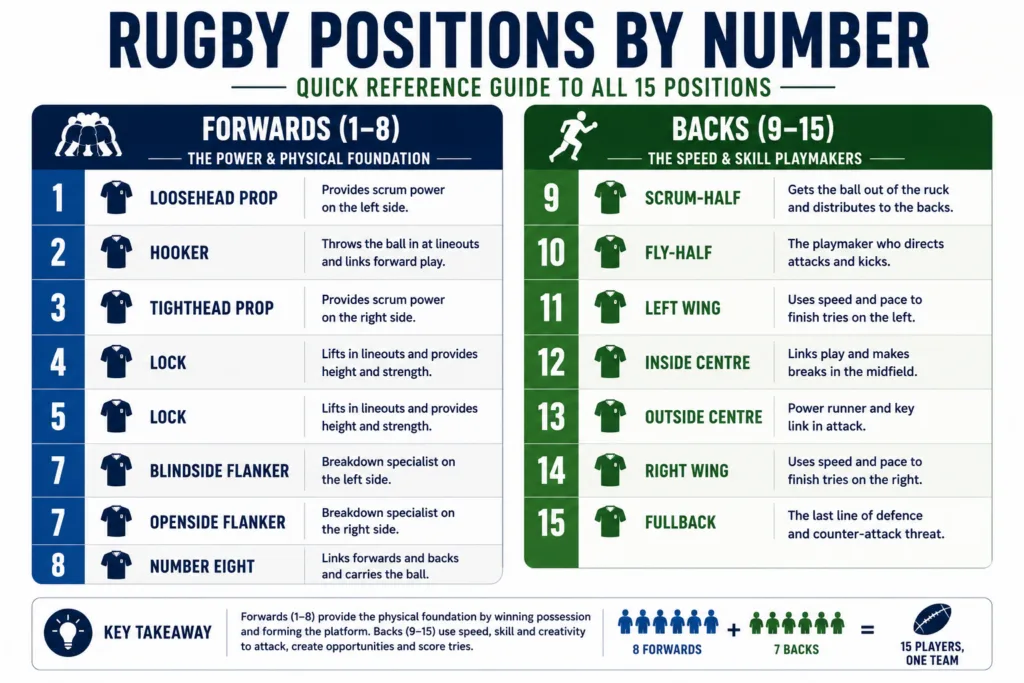
Quick Position Summary
How the Positions Work Together
Although every position has a specific role, rugby is a team game where all 15 players must work together.
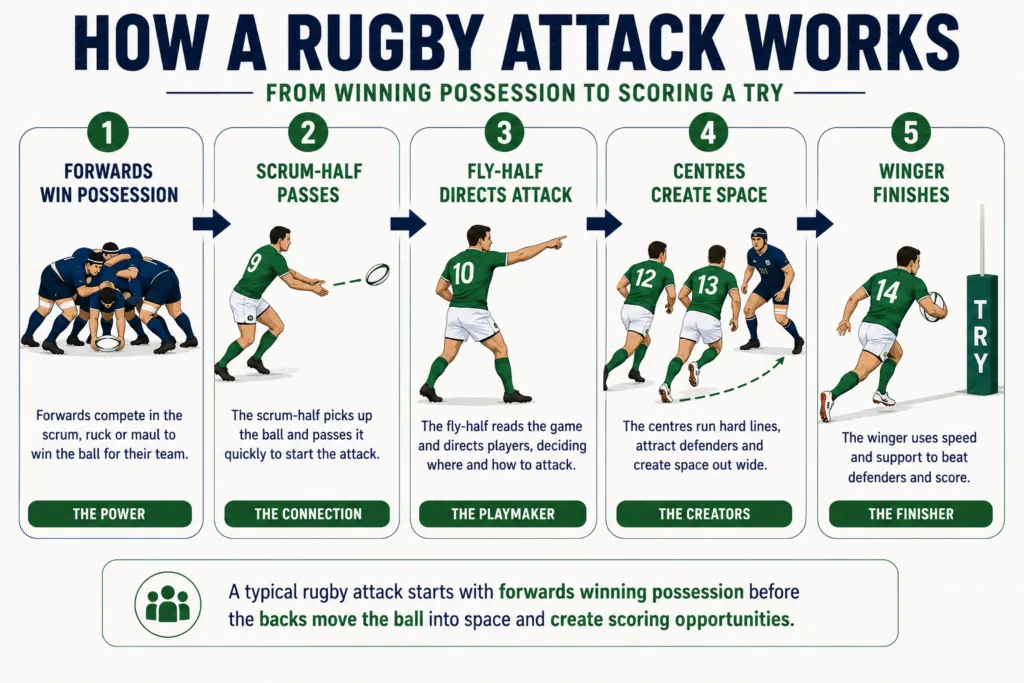
A typical attack follows a simple pattern:
- Win possession through scrums, lineouts, or breakdowns.
- Secure quick ball through forward play at rucks and mauls.
- Move the ball through the scrum-half and fly-half.
- Create space through centres and support runners.
- Finish attacks through the wings or fullback.
Understanding this sequence makes rugby much easier to follow when you’re watching a match.
Watching Your First Rugby Match?
Try focusing on these players:
- Watch the scrum-half (9) whenever the ball emerges from a ruck.
- Watch the fly-half (10) to see who is directing the attack.
- Watch the openside flanker (7) around tackles and turnovers.
- Watch the fullback (15) when the opposition kicks deep.
- Watch the wingers (11 and 14) whenever the ball reaches open space.
Following these positions will help you understand how teams build attacks and defend the field.
Final Thoughts
Once you understand what each number does, rugby becomes far easier to follow—and far more enjoyable to watch. Whether you’re tuning in for your first match or thinking about playing the sport yourself, learning the positions is one of the quickest ways to appreciate the strategy, skill, and teamwork that make rugby union so exciting.