
By The Rugby Fan Central
Rugby is one of the world’s most exciting sports, combining speed, strength, strategy, and teamwork into 80 minutes of nonstop action. If you’ve recently started watching rugby or want to learn the game, understanding the basics will make every match far easier to follow.
This guide covers rugby rules explained in simple language, including scoring, gameplay, positions, and the rugby basics every new fan should know.
What Is Rugby?
Rugby is a team sport played between two teams of 15 players in Rugby Union, the most popular version of the game worldwide. The objective is simple: score more points than your opponent by carrying, passing, and kicking the ball into scoring positions.
Unlike many American sports, rugby features continuous play with relatively few stoppages, creating a fast-paced game that rewards teamwork and endurance.

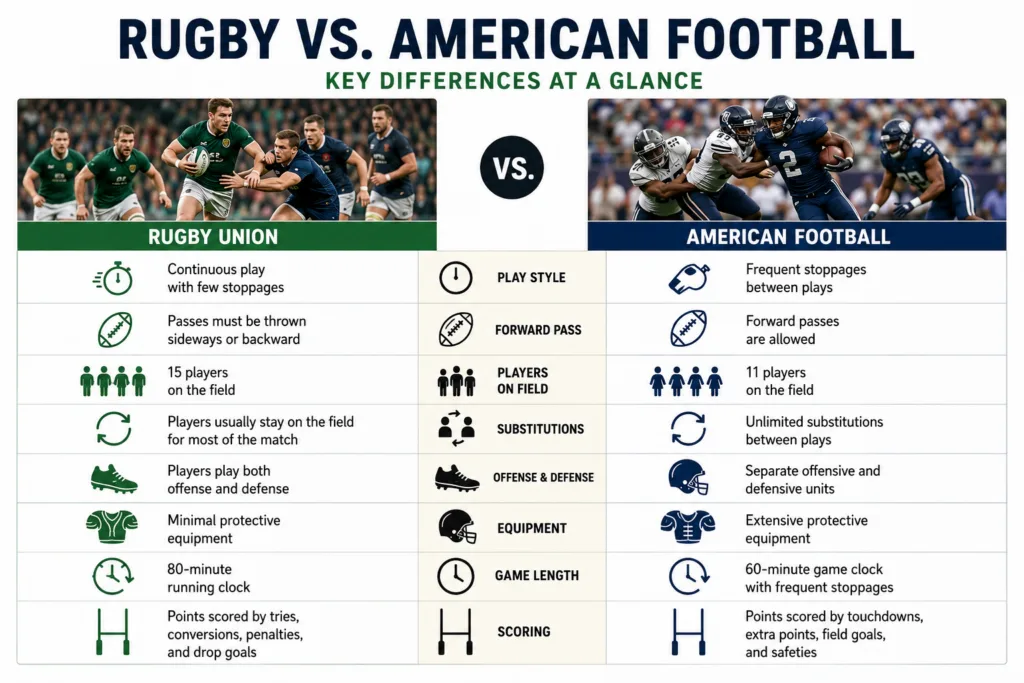
Rugby vs. American Football: What’s the Difference?
Many new fans first compare rugby to American football. While the sports share some similarities, they are played very differently.
| Rugby Union | American Football |
|---|---|
| Continuous play with few stoppages | Frequent stoppages between plays |
| Passes must be thrown sideways or backward | Forward passes are allowed |
| 15 players on the field | 11 players on the field |
| Players usually stay on the field for most of the match | Unlimited substitutions between plays |
| Players play both offense and defense | Separate offensive and defensive units |
| Minimal protective equipment | Extensive protective equipment |
| 80-minute running clock | 60-minute game clock with frequent stoppages |
Understanding these differences helps explain why rugby feels faster and more fluid than American football.
Rugby Basics: The Goal of the Game
The objective of rugby is to move the ball into the opposition’s territory and score points.
Teams can score through:
- Tries
- Conversion kicks
- Penalty goals
- Drop goals
A standard Rugby Union match consists of:
- Two 40-minute halves
- A 10-15 minute halftime break
- 15 players per team
The team with the most points at the end wins.
How to Play Rugby
If you’re wondering how to play rugby, the core principle is advancing the ball while maintaining possession.
Players can:
- Run with the ball
- Pass the ball sideways or backward
- Kick the ball forward
- Tackle opponents carrying the ball
Players cannot:
- Pass the ball forward
- Obstruct opponents illegally
- Make dangerous tackles
- Knock the ball forward with their hands or arms
Because forward passing is not allowed, successful teams rely heavily on support runners, quick passing, tactical kicking, and teamwork.
What Is a Knock-On?
A knock-on occurs when a player loses possession and the ball travels forward off their hands or arms.
Most knock-ons are accidental, but they are still considered infringements.
When a knock-on occurs, the referee usually awards a scrum to the opposing team.
Rugby Rules Explained: Passing
One of the most important rugby rules is that players cannot throw the ball forward.
A legal pass must leave the player’s hands traveling:
- Sideways
- Backward
Because players are often running at full speed, a pass may appear to travel forward through the air. What matters is the direction the ball travels when it leaves the passer’s hands.
If a player throws a forward pass, play stops and the opposing team is awarded a scrum.
How Scoring Works in Rugby
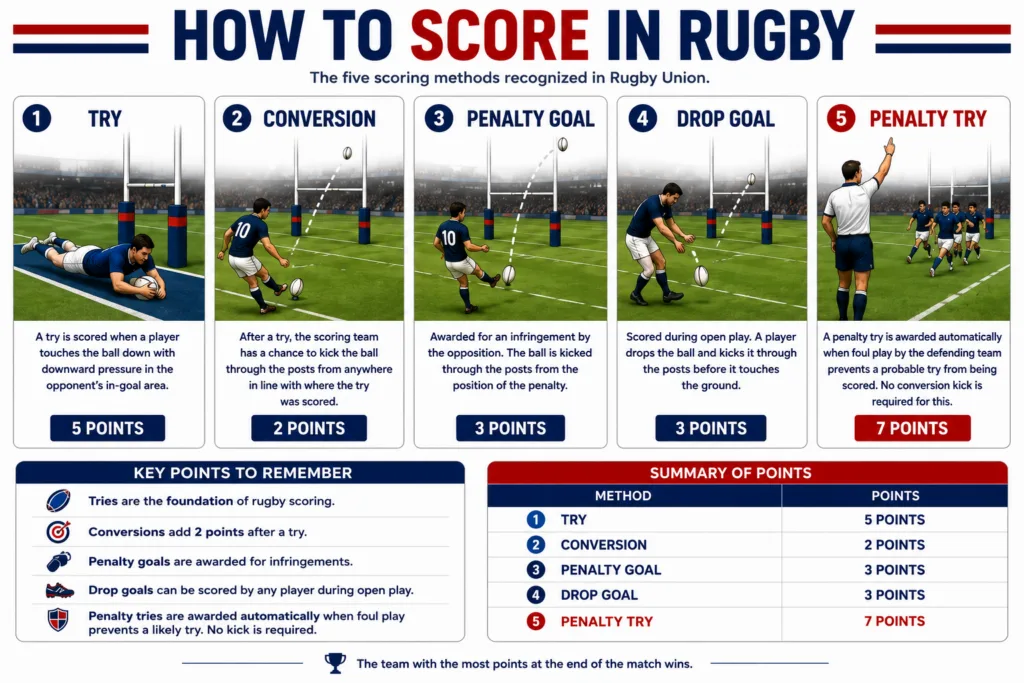
🏉 Try | 5 Points
A try is scored when a player grounds the ball with downward pressure in the opponent’s in-goal area behind the try line.
🎯 Conversion | 2 Points
After scoring a try, the team receives a conversion attempt. The kick is taken from a line directly back from where the try was scored.
⚖️ Penalty Goal | 3 Points
Following certain penalties, a team may choose to kick at goal instead of continuing play.
👟 Drop Goal | 3 Points
A player may score during open play by dropping the ball onto the ground and kicking it immediately after it bounces.
[IMAGE: Player grounding the ball for a try]
Caption: To score a try, a player must apply downward pressure to the ball in the opponent’s in-goal area.
Tackling Rules
Tackling is a key part of rugby, but strict safety rules apply.
A legal tackle must:
- Be below the shoulders
- Use the arms to wrap the opponent
- Avoid dangerous contact with the head or neck
After a tackle:
- The tackler must release the ball carrier
- The tackler must move away from the tackle area
- The ball carrier must release the ball once brought to ground
The ball carrier releases the ball so players who remain on their feet can compete for possession. This contest often creates a ruck.
What Is a Ruck?
A ruck forms after a tackle when players from both teams compete for possession while remaining on their feet.
Key ruck rules include:
- Players must enter through the back of the ruck
- Players must stay on their feet
- Hands generally cannot be used once the ruck has formed
Rucks are one of the most common phases of rugby and are crucial for maintaining possession.
What Is a Scrum?
A scrum restarts play after certain minor infringements.
Common reasons for a scrum include:
- Forward passes
- Accidental knock-ons
During a scrum:
- Eight forwards from each team bind together
- The ball is fed into the middle
- Teams compete for possession
While scrums may seem complicated at first, they are simply a structured restart and contest for possession.
What Is a Lineout?
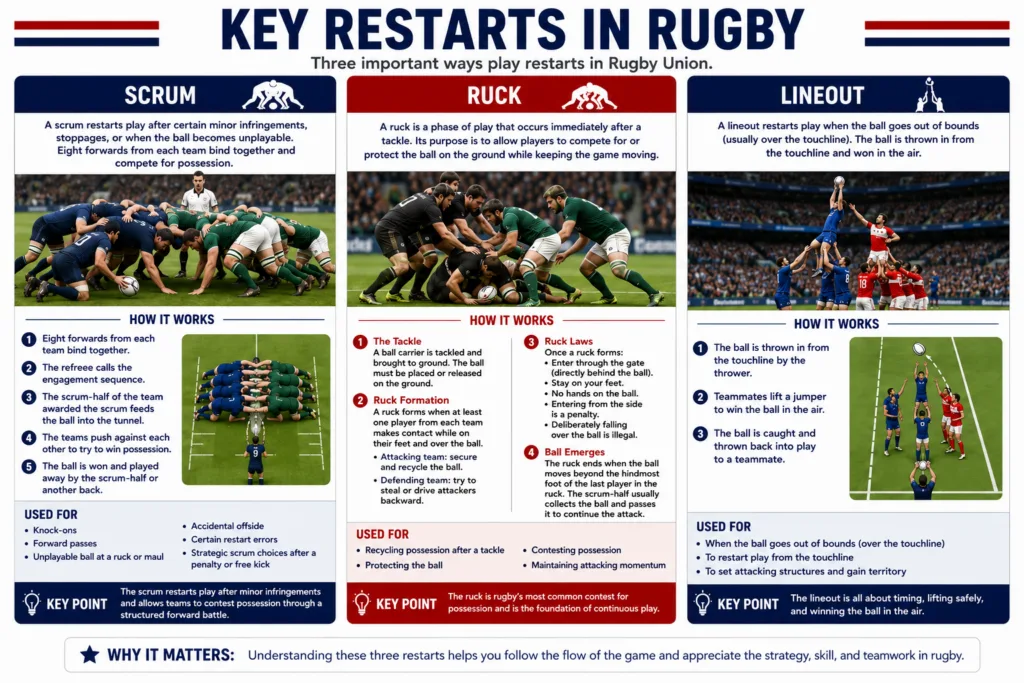
When the ball goes out of bounds, play restarts with a lineout.
During a lineout:
- Players line up opposite each other
- The ball is thrown between the teams
- Teammates often lift jumpers into the air
Lineouts are important opportunities to regain possession and launch attacks.
[IMAGE TRIO: Scrum | Ruck | Lineout]
Caption: Three of rugby’s most important contests for possession: the scrum, ruck, and lineout.
Understanding Offside in Rugby
Offside is one of the most frequently penalized offences in rugby.
In general, players must stay behind the ball during play.
A player is offside if they:
- Are in front of a teammate who last played the ball
- Interfere with play from that position
Offside offences often result in penalties and can quickly shift momentum.
Rugby Positions Explained
A Rugby Union team consists of 15 players.
Forwards (Numbers 1-8)
The forwards focus on:
- Scrums
- Lineouts
- Winning possession
- Physical contests
Backs (Numbers 9-15)
The backs focus on:
- Speed
- Passing
- Creating attacking opportunities
- Scoring tries
The Jersey Number Trick
Unlike American football, jersey numbers in rugby are tied directly to positions rather than individual players.
Numbers 1 through 15 identify the exact role a player is performing on the field that day.
For example:
- Number 9 = Scrum-Half
- Number 10 = Fly-Half
- Number 15 = Fullback
If a player starts at scrum-half, they will wear number 9 regardless of who they are.
This makes team sheets and television commentary much easier to follow once you know the numbering system.
Common Infringements in Rugby
Understanding the difference between scrums and penalties helps new fans follow matches more easily.
Scrum Offences
These usually result in a scrum:
- Forward passes
- Accidental knock-ons
Penalty Offences
These result in penalties:
- Offside
- High tackles
- Dangerous play
- Not releasing the ball
- Entering a ruck from the side
- Deliberately collapsing a scrum
When awarded a penalty, teams may:
- Kick for goal
- Kick for territory
- Tap and run
- Kick to touch and set up a lineout
💡 Fan Tip: Watch the Referee’s Arm
If you see a knock-on, forward pass, or penalty but the referee doesn’t immediately stop play, they may be playing advantage.
When advantage is being played, the referee extends an arm toward the non-offending team and allows play to continue.
The referee is essentially saying:
“You were fouled, but let’s see if you can get an even better opportunity by continuing.”
If the team gains a tactical benefit, play continues normally. If they do not, the referee will stop play and return to the original infringement.
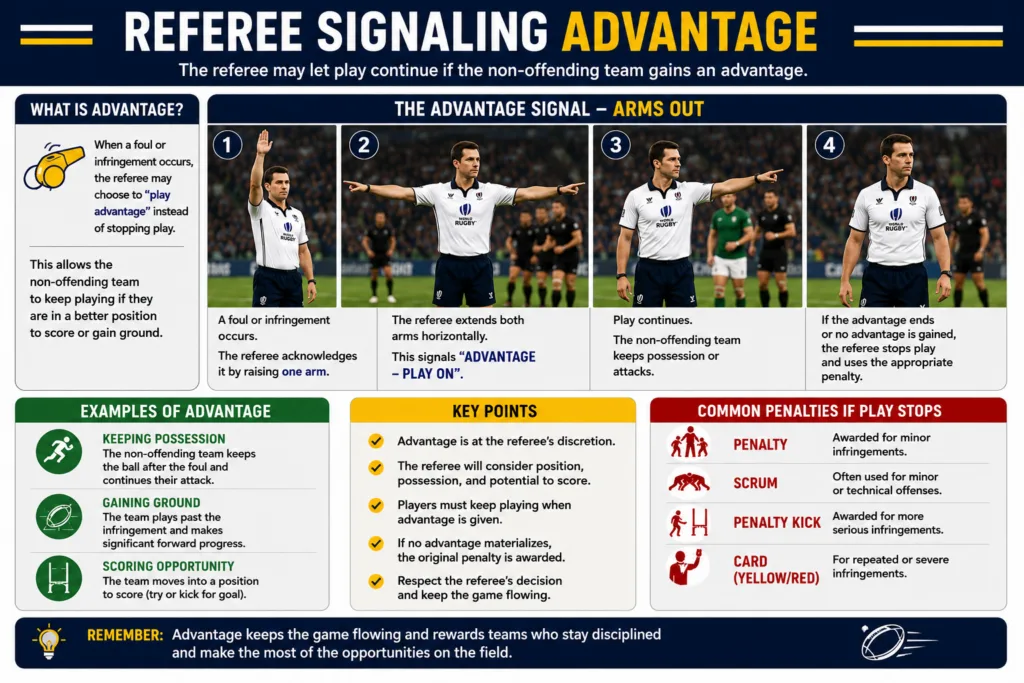
Caption: When a referee extends an arm, they may be playing advantage rather than stopping play immediately.
Rugby Discipline: Yellow and Red Cards
When players commit dangerous or repeated offences, referees can issue cards.
🟨 Yellow Card (Sin Bin)
A yellow card temporarily removes a player from the match for 10 minutes.
During this period:
- The player cannot participate.
- Their team must play with one fewer player.
Because rugby is played with only 15 players, a yellow card can dramatically change a match.
🟥 Red Card
A red card permanently removes a player from the game.
The player cannot return, and their team must continue with one fewer player for the remainder of the match.
Some professional competitions now use a modified “20-minute red card” rule, but the traditional red card remains the standard law of the game.
What to Watch For During a Rugby Match
New fans often understand the basic rules but still feel lost when watching a live game. Here are a few things to focus on.
Knock-On or Clean Pickup?
Watch the direction of the ball.
If it travels forward off a player’s hands or arms, it is usually a knock-on.
If the player keeps control or the ball moves backward, play continues.
Scrum or Penalty?
A simple rule of thumb:
- Minor mistakes usually result in scrums.
- More serious offences usually result in penalties.
Why Do Teams Kick the Ball Away?
New fans often wonder why teams voluntarily give up possession.
The answer is territory.
A well-placed kick can force the opposition deep into their own half, making it easier to apply pressure and create scoring opportunities.
Watch the Referee
When the whistle blows, immediately look at the referee.
The referee’s signals often tell you exactly what happened before the commentators explain it.
Common signals indicate:
- Scrum
- Penalty
- Offside
- Knock-on
- Forward pass
- Lineout
Understanding the Rugby Field
Before watching your first rugby match, it helps to understand the major areas of the field. Commentators frequently refer to the 22, touchline, in-goal area, and halfway line when discussing tactics and field position.
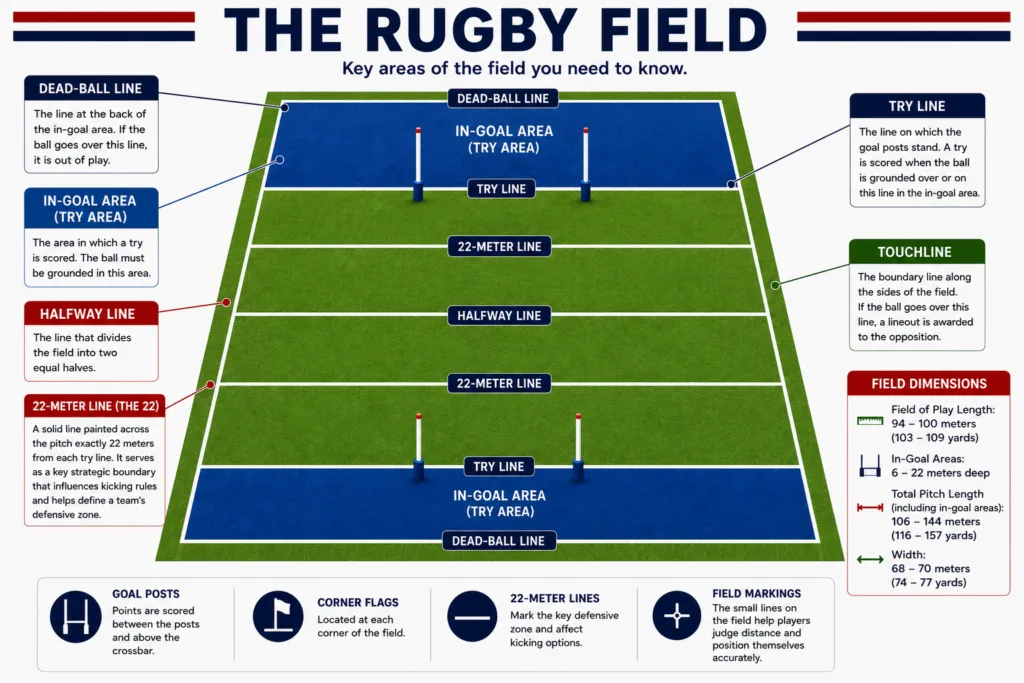
Figure: Key areas of a rugby field, including the try line, in-goal area, 22-meter lines, touchlines, halfway line, and goal posts.
Rugby Basics Every New Fan Should Remember
If you remember only a few things, make them these:
- The ball cannot be passed forward.
- A try is worth 5 points.
- Conversions are worth 2 points.
- Penalty goals and drop goals are worth 3 points.
- Tackles must be below the shoulders.
- Players must release the ball after a tackle.
- Rucks form after most tackles.
- Scrums restart play after minor infringements.
- Offside is one of the most common penalties.
- Territory is often just as important as possession.
Final Thoughts
At first glance, rugby can seem complex, but the fundamentals are surprisingly simple. Once you understand how scoring works, why forward passes are illegal, and how rucks, scrums, and lineouts function, the game becomes much easier to follow.
Whether you’re watching your first international match, a professional club game, or your local rugby team, these rugby basics will help you appreciate the strategy, athleticism, and excitement that make rugby one of the world’s most popular sports.
Now that you understand the rugby rules explained in this guide, you’ll be ready to enjoy every tackle, turnover, and try with confidence.