New Zealand negotiated a sodden Kings Park and an energetic opening from the Sharks before producing a devastating second half to win 54–0 and make it two victories from two on their South African tour.
For 40 minutes, this didn’t look anything like a 54-point game.
The Sharks attacked New Zealand’s line, challenged their maul defence and reached halftime only 14–0 behind.
Then the match changed.
New Zealand scored 40 unanswered points after the break, but the most striking part of the performance wasn’t simply the eight tries.
It was the rugby that produced them.
On a pitch soaked by heavy rain before kickoff, New Zealand continued to move the ball through hands, attack space and keep plays alive with support runners and offloads.
The conditions invited conservative rugby.
The All Blacks refused to play it.
A very different night at Kings Park
The occasion began with one of the more unusual sights of New Zealand’s South African tour.
Ruben Love led the All Blacks’ pre-match haka before Ma’a Nonu, the 44-year-old former New Zealand centre now representing the Sharks, responded with a solo haka of his own.
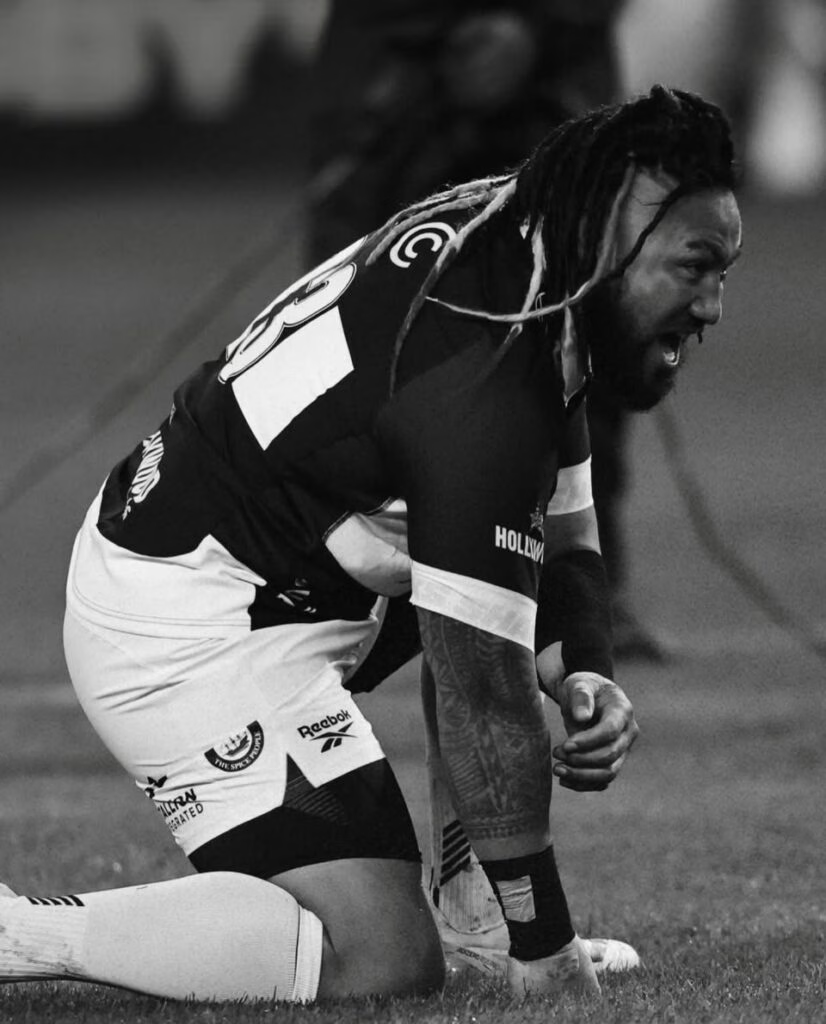
Nonu had only joined the Sharks a week earlier and was facing New Zealand for the first time.
Then attention turned to the rugby.
The Sharks started aggressively.
They drove from attacking lineouts close to the New Zealand line and were also held up over the try line during a period when the visitors had to defend far more than the eventual scoreline suggests.
There was significance in that early resistance.
New Zealand had conceded 16 penalties in their 38–21 victory over the Stormers four days earlier.
Against the Sharks, their discipline improved significantly.
The maul defence also stood up to the early pressure, stopping two Sharks drives from close range.
That prevented the home side from turning its strongest spell into points.
Fineanganofo finds the opening
New Zealand finally broke through in the 18th minute.
Jordie Barrett put the Sharks defence under pressure with a high kick before the ball was moved into space for Fehi Fineanganofo, who finished on the right.
Ruben Love converted.
7–0.
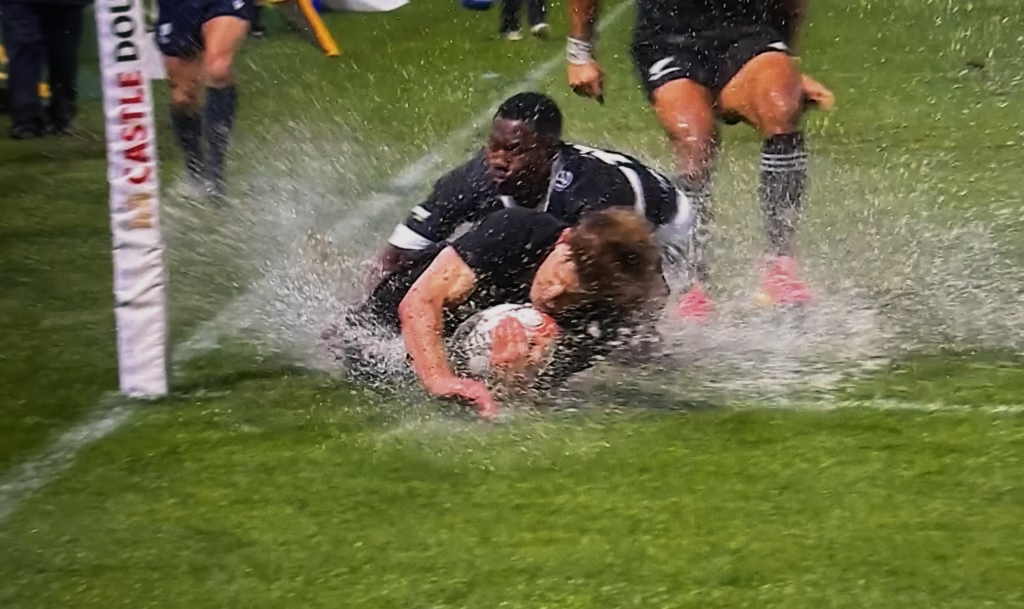
Damian McKenzie appeared to double the advantage moments later when he gathered a kick and slid across the try line.
But after the conversion had already been taken, the TMO intervened.
McKenzie had knocked the ball on.
No try.
Five minutes later, New Zealand attacked the same side again.
Barrett kicked across field towards Fineanganofo, who moved the ball inside for McKenzie.
The fullback dived towards the corner as the Sharks defence carried him towards touch.
This time the TMO examined the grounding, but the spray coming off the soaked surface made the available pictures inconclusive.
The original decision stood.
Try.
Love converted and New Zealand reached halftime 14–0 ahead.
McKenzie injury brings an early exit
McKenzie’s evening ended shortly afterwards.
He had twisted his left ankle earlier in the match while landing after taking a mark and was eventually withdrawn as a precaution.
With the first Test against South Africa only 11 days away, New Zealand were taking no chances.
Coach Dave Rennie said afterwards that the injury was not considered serious and that McKenzie was expected to be fine.
His departure did little to slow the attack.
If anything, New Zealand became more dangerous after halftime.
New Zealand find another gear
The third try demonstrated exactly what was beginning to separate the teams.
No. 8 Wallace Sititi threw a huge miss-out pass that bypassed defenders and put Caleb Clarke into space.
Clarke finished.
Then the winger became the provider.
Another New Zealand attack stretched the Sharks defence before Clarke supplied the final offload for Fineanganofo to score his second.
The ball was moving faster than the defence could reorganize.
Jordie Barrett was next.
First-time New Zealand captain Luke Jacobson created the opening and released the centre for the fifth try.
By then, the Sharks were struggling to stop attacks even when they made the initial tackle.
New Zealand kept producing another runner, another pass or another offload.
Attacking through the rain
Kings Park was soaked, but New Zealand continued to attack through hands and keep the ball alive.
The Sharks’ early attacking opportunities make the final zero on the scoreboard particularly striking.
They weren’t completely starved of field position.
In fact, they finished with 53% territory and retained 97% of their attacking rucks.
They also had opportunities from the lineout close to New Zealand’s line.
But their attacks repeatedly stalled.
New Zealand’s maul defence stopped two early drives from five metres out, denying one of the Sharks’ most obvious routes to points.
Once play moved away from the set piece, the Sharks struggled to generate the same momentum.
Only 31 of their 71 carries crossed the gain line.
Handling errors also hurt them, with seven knock-ons recorded across the match.
The Sharks could reach promising areas.
They couldn’t stay there long enough to turn pressure into points.
The black wave keeps coming
New Zealand’s sixth try came from another line-breaking attack.
Quinn Tupaea burst through the Sharks defence before scrumhalf Kyle Preston finished the move in the 62nd minute.
Love converted.
42–0.
That was the score when Nonu entered from the Sharks bench.
His appearance generated one of the loudest reactions from the crowd, and the former All Black quickly made his presence felt by putting a heavy tackle on Love.
It was a memorable moment.
It couldn’t change the direction of the game.
Replacement centre Timoci Tavatavanawai crossed in the 69th minute before lock Sam Darry added the eighth and final try in the 74th.
Love converted Darry’s score to complete a superb night from the tee.
Seven conversions.
Four from the sideline.
Fourteen points.
And a 54–0 New Zealand victory.
Fineanganofo leads a dangerous backline
Fineanganofo’s two tries made him one of the obvious standouts.
But his contribution went well beyond the scoreboard.
He made three clean breaks, beat six defenders and was repeatedly involved when New Zealand found space on the outside.
Clarke supplied the power on the opposite wing.
He carried 16 times for a match-high 91 metres, crossing the gain line on 13 occasions.
Tupaea offered another threat through the middle, while Preston’s pace around the breakdown helped maintain New Zealand’s tempo.
It meant the Sharks rarely had only one problem to solve.
Stop the first carrier and another appeared.
Close the outside channel and New Zealand could attack through the middle.
Commit defenders to the tackle and an offload could keep the attack alive.
Where the match really changed
The halftime score was 14–0.
The possession numbers explain what happened next.
The Sharks had 56% possession in the first half.
In the second half, they had just 26%.
New Zealand had 74%.
Once that happened, the defensive workload became enormous.
The Sharks eventually had to make 148 tackles, missing 25.
They were no longer simply trying to build their own attacks.
They were spending increasingly long periods trying to survive New Zealand’s.
Where the match changed
The Sharks competed with the ball in the opening half. After the break, possession swung decisively toward New Zealand.
The Sharks applied early pressure and reached halftime still within two converted tries.
New Zealand took 74% of the ball after halftime and scored 40 unanswered points.
A step forward from Cape Town
The result also matters in the context of New Zealand’s tour.
Their 38–21 victory over the Stormers had exposed issues with discipline and maul defence.
Against the Sharks, both areas improved.
New Zealand conceded only eight penalties and received no yellow cards, while their maul defence survived the Sharks’ strongest early attacks.
The opposition will become considerably tougher.
New Zealand next travel to Pretoria to face the Bulls before attention turns toward the Test series against the Springboks.
There are personnel questions too.
Cam Roigard was withdrawn from the Sharks match because of a tight calf, while Codie Taylor, Will Jordan and Tyrel Lomax had also yet to appear on tour because of minor injury concerns.
Billy Proctor’s shoulder-blade injury has created another selection decision in midfield.
But in Durban, New Zealand took an important step forward.
More than a 54–0 scoreline
The final numbers are emphatic.
New Zealand carried for 579 metres and made 15 clean breaks.
The Sharks managed 180 metres and one clean break.
But the first half showed that the match wasn’t always the procession the final score suggests.
The Sharks had pressure.
They had territory.
They had attacking opportunities.
New Zealand absorbed them.
Then they accelerated.
What followed was a display of handling, support play and decision-making that was even more impressive because of the conditions.
The pitch was soaked.
The ball was wet.
And New Zealand still played as though neither mattered.
On a night designed for survival rugby, the All Blacks attacked.
THE FINAL WHISTLE ISN’T THE END OF THE STORY. GO BEYOND THE SCORE →
Go beyond the result with player stats, team data, the match timeline and full lineups.