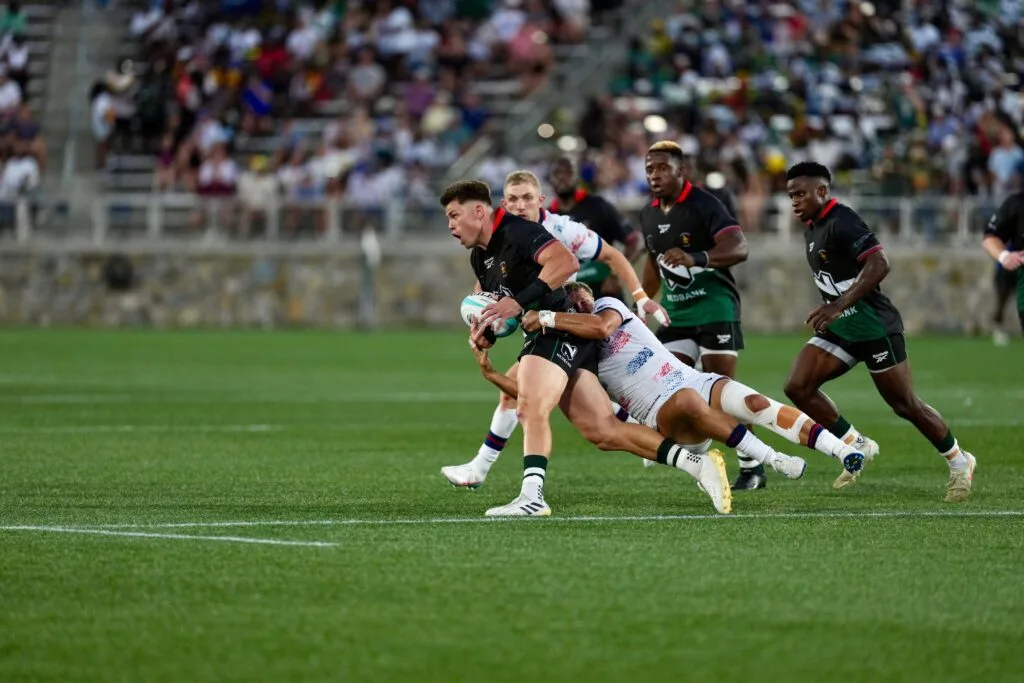

New Zealand scored five second-half tries at Eden Park, turning a three-point half-time lead into a commanding victory and extending its unbeaten run at the Auckland venue to 54 Tests.
AUCKLAND, New Zealand — October 10, 2026 — New Zealand retained the Bledisloe Cup for the 24th consecutive year with a 50–19 victory over Australia at Eden Park, transforming a competitive opening half into a seven-try triumph.
Australia trailed just 17–14 at halftime after tries from Tom Wright and captain Harry Wilson. But the All Blacks took control after the interval, outscoring the Wallabies 33–5 in the second half.
A key difference was where the rugby was played.
New Zealand’s territorial share climbed from 45% in the first half to 70% in the second, even though its possession remained at 57% in both periods. The All Blacks used their possession in more threatening areas of the field, placing Australia’s defence under increasing pressure.
Cam Roigard scored New Zealand’s first try after halftime and finished the match with two try assists. Codie Taylor, Leroy Carter, Josh Moorby and Will Jordan also crossed after the break.
The victory secured the Bledisloe Cup with one Test remaining.
Watch: New Zealand vs Australia — Bledisloe Cup 2026
Watch the match video below, or open it directly on YouTube.
Australia Strike First in Competitive Opening Half
The Wallabies made an encouraging start, with fullback Tom Wright crossing in the eighth minute. Ryan Lonergan converted to give Australia a 7–0 lead.
New Zealand responded through Peter Lakai in the 12th minute before Tupou Vaa’i crossed in the 16th minute to put the All Blacks ahead.
Damian McKenzie converted both tries and added a penalty in the 33rd minute, extending New Zealand’s advantage to 17–7.
Australia responded before halftime. Captain Harry Wilson crossed in the 37th minute, and Lonergan’s conversion brought the Wallabies within three points.
Halftime: New Zealand 17–14 Australia.
Australia had enjoyed 55% of the territory during the opening half despite having only 43% possession. That field position helped the Wallabies remain competitive and create opportunities against the All Blacks’ defence.
The territorial balance changed dramatically after the interval.
The Decisive Difference: New Zealand’s Second-Half Territory
New Zealand controlled 57% possession in each half, but its territorial advantage increased sharply.
| Period | New Zealand territory | Australia territory |
|---|---|---|
| First half | 45% | 55% |
| Second half | 70% | 30% |
The figures show that New Zealand played substantially more of the second half in Australia’s territory, putting the Wallabies under sustained pressure and limiting their opportunities to establish attacks in favorable positions.
New Zealand’s first score after the break came in the 49th minute, when Cam Roigard crossed for the All Blacks’ third try.
McKenzie converted to make it 24–14.
Codie Taylor followed in the 55th minute, extending the lead to 31–14 after another successful conversion.
The All Blacks had scored 14 unanswered points in less than six minutes.
Leroy Carter added a try in the 66th minute, Josh Moorby crossed in the 73rd, and Will Jordan completed New Zealand’s scoring in the 80th minute.
Australia replacement hooker Josh Nasser scored in the 76th minute, but the Wallabies could not halt New Zealand’s attacking momentum.
Final score: New Zealand 50–19 Australia.
The All Blacks’ five second-half tries reflected a substantial change in territorial control and attacking efficiency.
By the Numbers
New Zealand 50–19 Australia | Bledisloe Cup 2026
| Match statistic | New Zealand | Australia |
|---|---|---|
| Tries | 7 | 3 |
| Possession | 57% | 43% |
| Territory | 58% | 42% |
| Carries | 160 | 105 |
| Carrying metres | 470 | 328 |
| Clean breaks | 10 | 4 |
| Defenders beaten | 30 | 23 |
| Tackles made | 144 | 200 |
| Missed tackles | 23 | 30 |
| Rucks won | 124 | 84 |
| Ruck success | 99% | 95% |
| Lineout success | 80% | 92% |
| Penalties conceded | 7 | 10 |
New Zealand made 55 more carries than Australia, generating 142 additional carrying metres and producing 10 clean breaks to the Wallabies’ four.
Australia’s defensive workload was considerable. The Wallabies completed 200 tackles compared with New Zealand’s 144, while missing 30 tackles.
The lineout provided one positive for Australia. The Wallabies won 12 of 13 lineouts, a 92% success rate, while New Zealand secured 12 of 15, or 80%.
Both teams therefore won the same number of lineouts, but Australia was more efficient from fewer opportunities.
That set-piece advantage could not compensate for New Zealand’s greater attacking production and second-half territorial dominance.
Player Performances: Roigard Leads the All Blacks’ Attack
Cam Roigard — A Try and Two Assists
Roigard was central to New Zealand’s attacking performance, scoring in the 49th minute and finishing with two try assists across the match.
His score was the All Blacks’ first after halftime and helped establish the advantage they maintained through the closing stages.
Replacement scrumhalf Kyle Preston also recorded a try assist, reflecting the contributions New Zealand received from both its starting and replacement players.
With seven different try scorers, the All Blacks demonstrated the breadth of their attacking options rather than relying on one individual to finish their opportunities.
Damian McKenzie — 15 Points
McKenzie contributed 15 points through six conversions and a penalty.
His goal-kicking helped New Zealand capitalize on its seven tries, while his attacking distribution provided another threat to Australia’s defensive line.
Wallace Sititi — New Zealand’s Leading Forward Carrier
Wallace Sititi made 18 carries for 58 metres, leading New Zealand in carries.
Scott Barrett recorded 17 carries for 12 metres, illustrating the different returns achieved by two heavily involved forwards.
Tupou Vaa’i added 14 carries, two clean breaks and a try, while Peter Lakai contributed 43 carrying metres and a first-half score.
Will Jordan — New Zealand’s Leading Metre-Maker
Jordan led the All Blacks with 64 carrying metres and recorded two clean breaks.
His final-minute try completed New Zealand’s seven-try performance.
Beauden Barrett also beat five defenders, matching the highest individual total recorded in the match.
Harry Wilson — 28 Tackles and a Try
Australia captain Harry Wilson finished with 28 tackles, the highest individual total recorded by either team.
He also scored the Wallabies’ second try, bringing Australia within three points before halftime.
Fraser McReight contributed 17 tackles, while Angus Bell added 16.
Their performances reflected the physical demands placed on Australia’s forwards, particularly as New Zealand established territorial control after halftime.
Tom Wright and Max Jorgensen — Australia’s Attacking Standouts
Tom Wright finished as the match’s leading metre-maker with 76 carrying metres, five defenders beaten and a try.
Max Jorgensen added two clean breaks and four defenders beaten, providing another attacking threat for the Wallabies.
Those individual contributions demonstrated Australia’s ability to challenge New Zealand’s defence, but the Wallabies could not sustain enough attacking pressure to remain competitive in the second half.
Bledisloe Cup Remains in New Zealand
New Zealand’s victory ensured the Bledisloe Cup remained with the All Blacks for the 24th consecutive year, continuing a run that began in 2003.
With only two Tests scheduled in 2026, Australia needed to win both matches to reclaim the trophy. Even a Wallabies victory in Sydney would leave the series tied, allowing New Zealand to retain the Cup as the existing holder.
The result also extended the All Blacks’ unbeaten run at Eden Park to 54 Tests, dating back to 1994.
Australia has not beaten New Zealand at the Auckland venue since 1986.
The defeat was Australia’s first under coach Les Kiss, whose Wallabies had entered the match with four victories and a draw from his first five Tests in charge.
The result also carried a personal dimension for All Blacks coach Dave Rennie.
It was Rennie’s first match as All Blacks coach against the side he led from 2020 until January 2023, when Rugby Australia replaced him with Eddie Jones.
The 50–19 victory added another chapter to his international coaching career, this time on the opposite side of the trans-Tasman rivalry.
What’s Next? Australia vs New Zealand in Sydney
Australia hosts New Zealand on Saturday, October 17, 2026, at Stadium Australia, also known as Accor Stadium, in Sydney.
The match is part of an international rugby quadruple-header featuring the Wallaroos against Scotland, Australia’s men’s sevens team against Fiji, and Australia’s women’s sevens team against New Zealand.
How to Watch Australia vs New Zealand in the USA
Second Bledisloe Cup Test — Saturday, October 17, 2026
| US time zone | Kickoff |
|---|---|
| Eastern | 12:45 a.m. Saturday, October 17 |
| Central | 11:45 p.m. Friday, October 16 |
| Mountain | 10:45 p.m. Friday, October 16 |
| Pacific | 9:45 p.m. Friday, October 16 |
Venue: Stadium Australia (Accor Stadium), Sydney.
USA streaming: RugbyPass TV — free live coverage.
RugbyPass confirms that both 2026 Bledisloe Cup Tests are available to watch live and free in the United States.
The scheduled kickoff is 3:45 p.m. Sydney time. RugbyPass’s stream may begin earlier to include pre-match coverage, so viewers should check the broadcaster’s latest listing for the streaming start time.
RugbyPass — How to Watch the Bledisloe Cup in the USA
New Zealand has already retained the trophy and will be seeking a series sweep. Australia will have home advantage as it attempts to finish the two-Test series with a victory.
FULL RFC COVERAGE
New Zealand 50–19 Australia — Bledisloe Cup 2026
Explore the complete match statistics, scoring timeline, player performances and detailed match information in Rugby Fan Central’s dedicated match centre.
VIEW THE FULL RFC MATCH CENTRE →