
South Africa recovered from a fast Argentina start to claim a 17–10 victory in Buenos Aires, turning a match filled with dangerous Pumas attacks into a contest increasingly played on Springbok terms.
Argentina raced into a 10–3 lead inside the opening 10 minutes and produced many of the game’s most explosive attacking moments. They made eight clean breaks, beat 30 defenders and repeatedly threatened when they found space.
Then the scoreboard stopped moving.
Argentina did not score another point after Santiago Carreras converted Benjamin Grondona’s ninth-minute try.
South Africa gradually took control of where the match was played, levelled through Edwill van der Merwe immediately before halftime and eventually found the decisive score through Cameron Hanekom in the 62nd minute.
The final numbers tell the story of two very different performances.
Argentina were more dangerous when they broke the defensive line.
South Africa were better at making sure the game was played where they wanted it.
Final Score
August 8, 2026
Argentina Land the First Blow
Argentina could hardly have asked for a better opening.
Carreras put the Pumas ahead with a penalty after just over two minutes. Sacha Feinberg-Mngomezulu answered for South Africa shortly afterwards, but Argentina soon found the first try of the afternoon.
Grondona crossed in the ninth minute and Carreras converted.
Argentina 10, South Africa 3.
The Pumas had their reward for an aggressive opening and, more importantly, were finding ways through South Africa’s defence.
That ability to create remained evident throughout the match. Argentina would eventually finish with eight clean breaks and 30 defenders beaten, both comfortably more than South Africa.
What Argentina couldn’t do was turn those opportunities into more points.
After Carreras’ conversion, they would not score again.
South Africa began to establish field position and force Argentina into longer periods without the ball. The Pumas were still dangerous when opportunities appeared, but increasingly those opportunities were coming from areas of the field where South Africa could absorb them.
Just before halftime, the pressure finally produced points.
Edwill van der Merwe crossed in the 39th minute and Feinberg-Mngomezulu converted.
A match Argentina had led 10–3 was suddenly level 10–10 at halftime.
The Game Moves South Africa’s Way
The scoreboard was level.
The match itself was beginning to tilt.
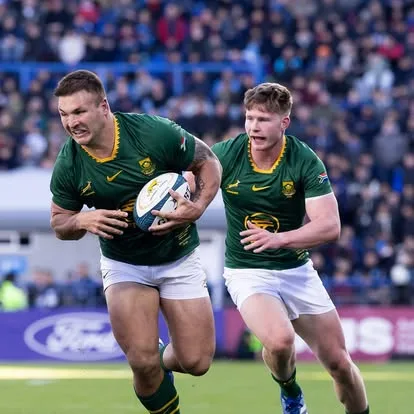
South Africa increasingly dictated territory after the break and made Argentina work for almost every opportunity to get back downfield.
By full time, the Springboks had controlled 62% of the territory.
They also carried 148 times for 556 metres, while Argentina’s 129 carries produced 298 metres. South Africa won 114 of their 115 rucks and repeatedly recycled possession into another phase.
Argentina kept answering defensively.
And answering.
And answering.
By the end of the match, the Pumas had been forced to attempt 188 tackles.
They completed them at an impressive 87% success rate, but the number itself reveals the pressure Argentina were absorbing.
By the Numbers
Argentina's Numbers Tell an Unusual Story
A team that makes eight clean breaks, beats 30 defenders and completes 12 offloads would normally expect to score considerably more than 10 points.
Argentina did all three, while South Africa finished behind the Pumas in each category.
But the Springboks had more possession, significantly more territory, more carries and almost twice as many carry metres. They also won the turnover battle 5–2.
The Pumas could hurt South Africa when they found space. The problem was how rarely they were able to dictate where those opportunities began.
Hanekom Finds the Decisive Score
For all South Africa's territorial control, the match remained tied.
One score could still decide it.
Cameron Hanekom had already become central to the Springboks' ability to generate forward momentum. The No. 8 finished with 82 metres from 13 carries, and 10 of those carries crossed the gain line — the most in the match.
Edwill van der Merwe was even more productive in open space, leading all players with 101 carry metres after scoring the try that brought South Africa level.
Aphelele Fassi added another 79 metres.
Those contributions were important because South Africa were not repeatedly slicing Argentina open. They made only four clean breaks.
Instead, they kept winning enough ground to reset the pressure.
Eventually Hanekom turned that pressure into the decisive moment.
In the 62nd minute, he crossed for South Africa's second try.
Handré Pollard converted.
Argentina 10, South Africa 17.
South Africa had spent much of the second half building territorial pressure. Hanekom finally converted it into points, crossing for the try that broke the 10–10 deadlock before Handré Pollard's conversion established the decisive seven-point margin.
The Pumas Refuse to Break
The result would have been settled much earlier without an enormous Argentine defensive effort.
Ignacio Ruiz made 24 tackles.
Joaquin Moro made 24 tackles.
Both shared the match lead.
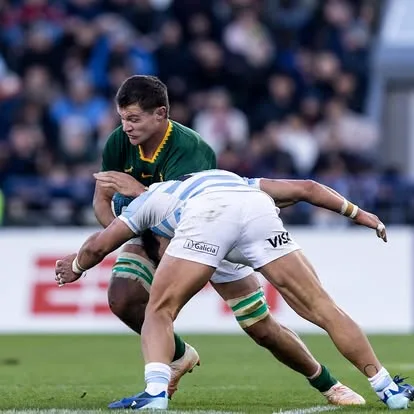
Argentina as a team made 188 tackles and missed only 16, while South Africa made 157 and missed 30.
Those numbers are impressive.
They are also exhausting.
Every tackle kept Argentina alive, but every additional defensive set represented another period in which the Pumas weren't dictating the game themselves.
Argentina still found moments of attacking danger. Ignacio Mendy finished with a match-high four clean breaks, while Pablo Matera beat eight defenders.
Watch Argentina vs South Africa Highlights
A Different Kind of Springbok Victory
South Africa did not run away with this one.
Argentina made sure of that.
The Pumas produced the more spectacular attacking numbers, defended through an enormous workload and remained within one score until the end.
But the most important statistic may be the simplest one.
Argentina scored their 10th point after 9:51.
They never scored again.
South Africa didn't eliminate Argentina's threat. They gradually restricted where that threat could come from, kept returning the Pumas to defensive work and waited for the opportunity that Hanekom eventually supplied.
Argentina created the more spectacular moments. South Africa controlled where the game was played.
After the 10th minute, that was decisive.
Go Deeper: RFC Match Centre