
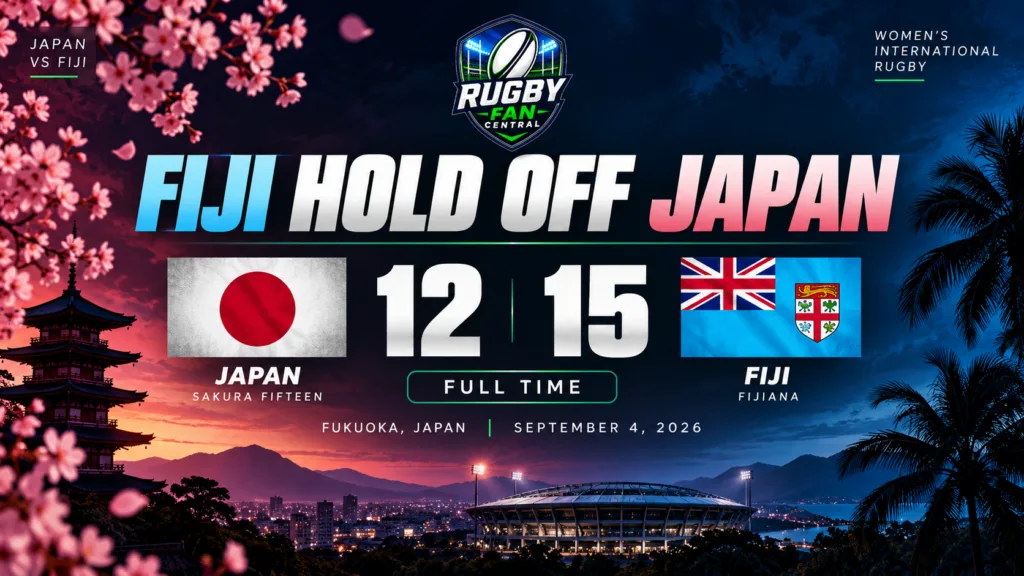
Fiji defeated Japan for the second consecutive meeting, holding off a second-half Sakura Fifteen comeback to claim a 15–12 victory at JAPAN BASE in Fukuoka on Friday.
Three tries were enough for the Fijiana, with Ivamere Nabura Rokowati, Varanisese Qoro and Aqela Raitubu crossing as Fiji repeatedly threatened Japan’s defense with their carrying and offloading game.
Japan responded through Nami Asari and Asuka Kuge, but could not find the go-ahead score after closing to within three points during the second half.
The final margin was narrow.
The underlying numbers were much less so.
Fiji finished with 58% possession, 163 carries, 646 carry metres, 13 clean breaks and 31 defenders beaten. Japan finished with 63% territory and was forced into an enormous defensive workload, making 206 tackles.
For Japan, one of the biggest individual stories came from 18-year-old Nami Asari, who marked her Test debut with a try and a match-high 26 tackles.
Watch: Japan 12–15 Fiji
Watch the key moments from Fiji’s three-point victory over Japan in Fukuoka, including all five tries and Japan’s late push for the lead.
Fiji’s Offloading Game Strikes Early
Fiji immediately put Japan’s defense under pressure.
The Sakura Fifteen spent much of the opening minutes defending deep inside their own territory before Fiji’s ability to keep the ball alive eventually created the breakthrough.
A sequence of offloads opened the Japanese defense and fullback Ivamere Nabura Rokowati finished the attack for the opening try in the ninth minute.
Fiji struck again in the 21st minute.
Japan was punished after a kicking error, with Fiji maintaining its attacking momentum and Varanisese Qoro finishing for the visitors’ second try.
Neither try was converted, but Fiji had established a 10–0 lead.
Asari Scores on Her Japan Debut
Japan needed a response and found one before halftime.
Captain Moe Tsukui won possession at a ruck deep inside Fiji territory as the Sakura Fifteen began to generate attacking pressure.
Japan eventually turned that pressure into points, with Nami Asari forcing her way over for a try on her Test debut.
Fellow debutant Maiko Nishi converted, reducing Fiji’s advantage to 10–7.
Japan continued to create opportunities late in the half. A well-placed Tsukui kick and pressure at the lineout helped the Sakura Fifteen establish field position, and Japan had an opportunity from the kicking tee in the 39th minute.
The penalty attempt was unsuccessful.
Fiji therefore carried a three-point advantage into halftime.
The Numbers Show Fiji’s Attacking Threat
Fiji’s ability to carry, break the line and keep the ball alive forced Japan into an enormous defensive workload.
Despite Fiji’s attacking advantage, Japan controlled 63% of territory and remained within one score.
Japan were forced to keep tackling.
Raitubu Finds Space Out Wide
Fiji struck again early in the second half.
The Fijiana moved the attack toward the outside, where Aqela Raitubu found space and broke through the Japanese defense.
The wing crossed in the 51st minute to extend Fiji’s advantage to 15–7.
Once again, the conversion was unsuccessful.
All three of Fiji’s tries went unconverted, leaving Japan within striking distance despite the Fijiana’s considerable advantage in attacking production.
The match then changed again.
Fiji No. 8 Alfreda Fisher was shown a yellow card in the 55th minute, reducing the visitors to 14 players.
Japan responded almost immediately.
Japan’s Driving Maul Makes It 15–12
Japan turned to its set piece near the Fiji line.
From a lineout, the Sakura Fifteen established a powerful driving maul and pushed toward the try line.
Hooker Asuka Kuge finished the move, scoring Japan’s second try in the 57th minute.
Suddenly it was 15–12.
Japan continued to apply territorial pressure during the closing stages.
The Sakura Fifteen repeatedly worked their way into attacking positions and spent significant periods inside Fiji territory, but the Fijiana refused to concede the go-ahead score.
Japan entered the Fiji 22 several times without finding the breakthrough.
Fiji survived the late pressure and eventually closed out the three-point victory.
Atelaite Buna Ralivanawa Leads Fiji’s Attack
While Fiji’s three tries came from three different players, Atelaite Buna Ralivanawa produced one of the standout attacking performances.
The wing carried for a match-high 108 metres and recorded five clean breaks.
Nabura Rokowati added 87 carry metres, while Raitubu finished with 74.
Fiji’s ability to threaten throughout the backline was reflected across the match statistics.
The Fijiana finished with 13 clean breaks and beat 31 defenders, while Japan recorded only one clean break and eight defenders beaten.
That attacking production forced Japan into its huge defensive workload and was ultimately enough to give Fiji the victory.
A Memorable Test Debut for Nami Asari
Japan may have lost, but Asari produced an impressive first appearance for the Sakura Fifteen.
The 18-year-old Hosei University student entered the match with zero Test caps and was selected at blindside flanker for Toshizumi Kitagawa’s first match as Japan’s permanent head coach.
She responded with Japan’s opening try and a match-high 26 tackles.
Kitagawa had highlighted Asari before the match, praising her athletic ability, rugby knowledge and desire to improve.
Her performance against Fiji provided an immediate glimpse of that potential.
Asari was not Japan’s only debutant.
Wing Maiko Nishi also earned her first cap and converted Asari’s first-half try.
Japan Could Not Turn Territory Into Enough Points
Japan’s ability to remain in the match despite Fiji’s attacking numbers was one of the defining features of the contest.
The Sakura Fifteen finished with 63% territory and applied significant pressure during the closing stages.
But territory did not translate into enough attacking breakthroughs.
Japan recorded only one clean break, compared with Fiji’s 13.
Kitagawa said after the match that Japan had used the wind and its kicking game effectively during the first half, but acknowledged that set-piece errors close to the Fiji goal line during the second half prevented his team from finishing opportunities with tries.
That combination — territory without enough points — ultimately separated Japan’s late pressure from a comeback victory.
Fiji Make It Two Straight Against Japan
The result continues a notable change in the history between the two teams.
Japan won the first five meetings between the countries.
That run included a 24–15 Japan victory in Suva in June 2024, but Fiji responded six days later with a 24–15 victory in Lautoka — their first win over the Sakura Fifteen.
Now the Fijiana have done it again.
Fiji have won two consecutive matches against Japan after losing the first five meetings in the series.
This victory came despite leaving points on the field.
Fiji scored three tries but converted none of them, conceded 15 penalties and played part of the second half with 14 players following Fisher’s yellow card.
Japan’s territorial advantage, defensive effort and late pressure kept the Sakura Fifteen within striking distance.
Fiji’s ability to break the defensive line and generate metres with ball in hand ultimately proved enough.
First Test as Permanent Head Coach for Kitagawa
The match represented the beginning of a new chapter for the Sakura Fifteen.
Kitagawa was formally appointed Japan women’s national team head coach effective August 25, having served as acting head coach earlier in 2026.
Ahead of the Fiji match, Kitagawa spoke about developing a “fast rugby” approach, with Japan looking to play with greater width and speed.
There were encouraging moments in Fukuoka, but the first match of his permanent tenure also demonstrated where Japan needs to improve.
The Sakura Fifteen generated territory and stayed within one score despite Fiji’s attacking superiority, but struggled to consistently convert field position into line breaks and points.
Japan and Fiji Will Meet Again
Japan will not have to wait long for another opportunity against the Fijiana.
The teams are scheduled to meet again on September 19 in Pordenone, Italy, as part of the WXV Global Series.
Japan then faces Ireland in Galway on September 27 and again in Cork on October 3 before two October meetings with Wales.
That makes the next Japan–Fiji encounter particularly intriguing.
Fiji have now won two straight against the Sakura Fifteen.
Japan will have just two weeks to determine how to turn Friday’s territorial pressure into more points — and how to contain a Fiji attack that produced 646 carry metres, 13 clean breaks and 31 defenders beaten in Fukuoka.
The scoreboard said 15–12.
The numbers showed how dangerous Fiji could be with ball in hand.
And for Japan, a 206-tackle afternoon provided both evidence of their resilience and a clear picture of the work ahead under Kitagawa.
Go Deeper Into Japan vs Fiji
The final score only tells part of the story. Explore the full Rugby Fan Central Match Centre for detailed team statistics, player leaders, the match timeline and complete lineups.
Full match data powered by the Rugby Fan Central match database.