The USA Men’s Eagles came to Hanazono looking for a place in the Pacific Nations Cup final.
Instead, Japan delivered a clear reminder of the level the United States is still trying to reach.
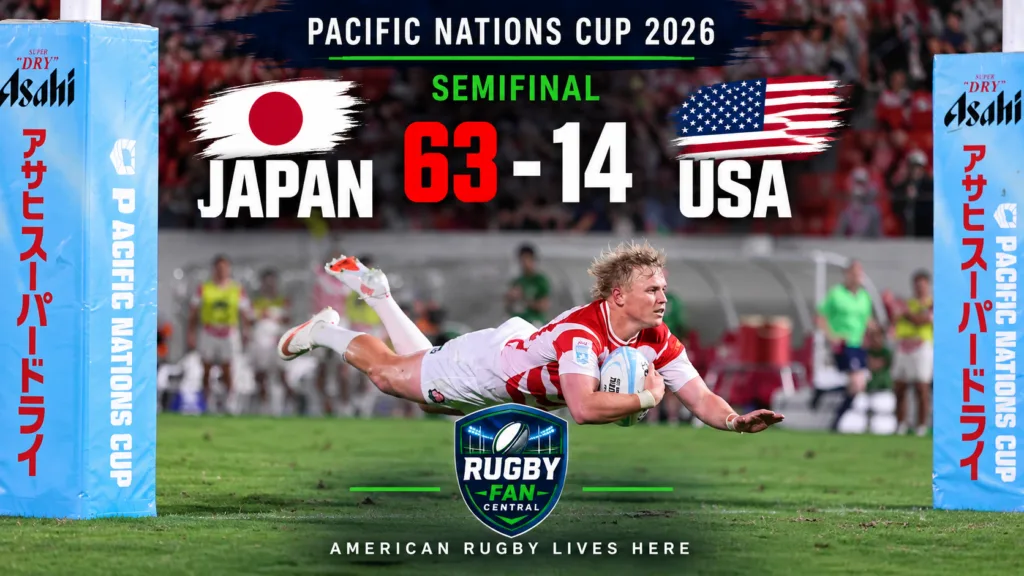
The Brave Blossoms defeated the Eagles 63–14 on Saturday in Osaka, scoring nine tries to two and turning an essentially even territorial contest into a one-sided semifinal through superior carrying, cleaner attacking execution and repeated line breaks.
The result sends Japan into the Pacific Nations Cup final in Tokyo on September 19. The USA will instead play in the third-place match. The tournament’s revised four-team knockout format sends all four sides to Prince Chichibu Memorial Stadium for finals day.
For the Eagles, the most troubling part was not simply the final score.
It was how quickly the match got away from them.
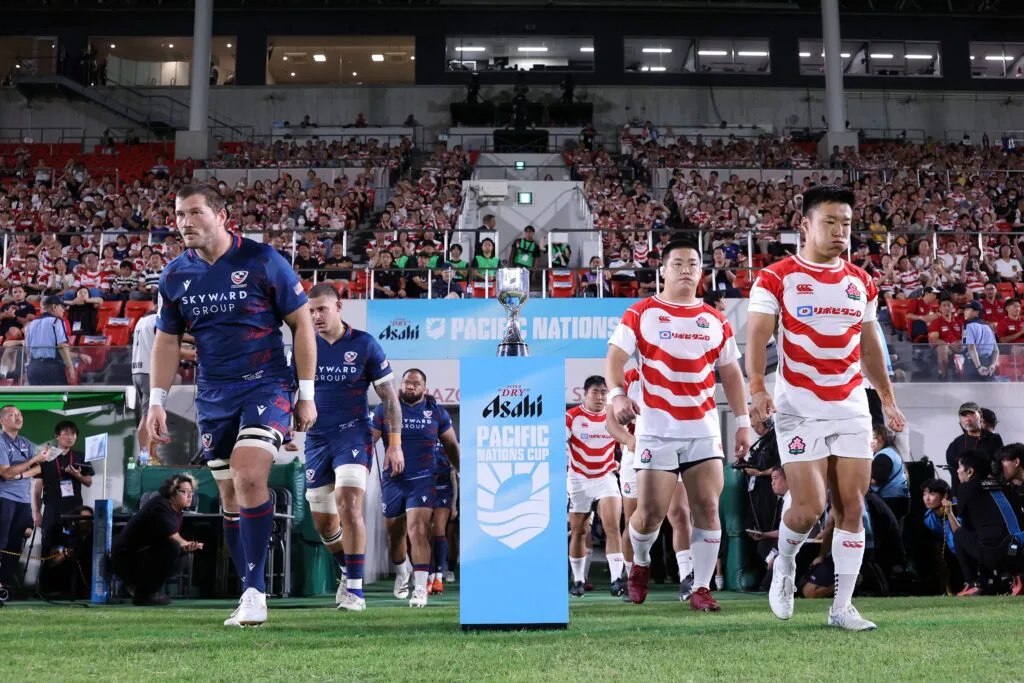
Japan vs. USA: Pacific Nations Cup Semi-Final Highlights
Watch the extended highlights from Japan against the USA Men’s Eagles in the Pacific Nations Cup semi-final.
Video highlights provided through YouTube.
Japan strike four times in the opening 16 minutes
Japan needed less than two minutes to score.
Yuya Hirose crossed at 1:34, Sam Greene converted, and Michael Stolberg followed with another try only minutes later. Dylan Riley then added Japan’s third before Mamoru Harada made it four tries inside the opening 16 minutes.
That left the USA chasing the match almost immediately.
The Eagles had entered the semifinal knowing Japan’s speed of play and attacking accuracy would be a major test. Before kickoff, Scott Lawrence described the match as an opportunity to “stress test” the standards the USA had been building under pressure.
Japan supplied exactly that pressure.
The Eagles could not absorb it early enough.
USA find a response
To their credit, the USA did not disappear after the opening barrage.
Shilo Klein scored in the 24th minute, with Chris Hilsenbeck converting, before Tavite Lopeti added a second American try nine minutes later.
Hilsenbeck converted again, and suddenly the Eagles had cut into what had looked like a runaway start.
Those two tries represented the USA’s best stretch of the match.
For a period, the Eagles were carrying with greater purpose, retaining possession and forcing Japan to defend rather than simply attack.
But the comeback never truly changed control of the contest.
Japan scored again through Sojiro Otsuka just after the 40-minute mark, then Riley struck again moments into the second half.
From there, the separation became decisive.
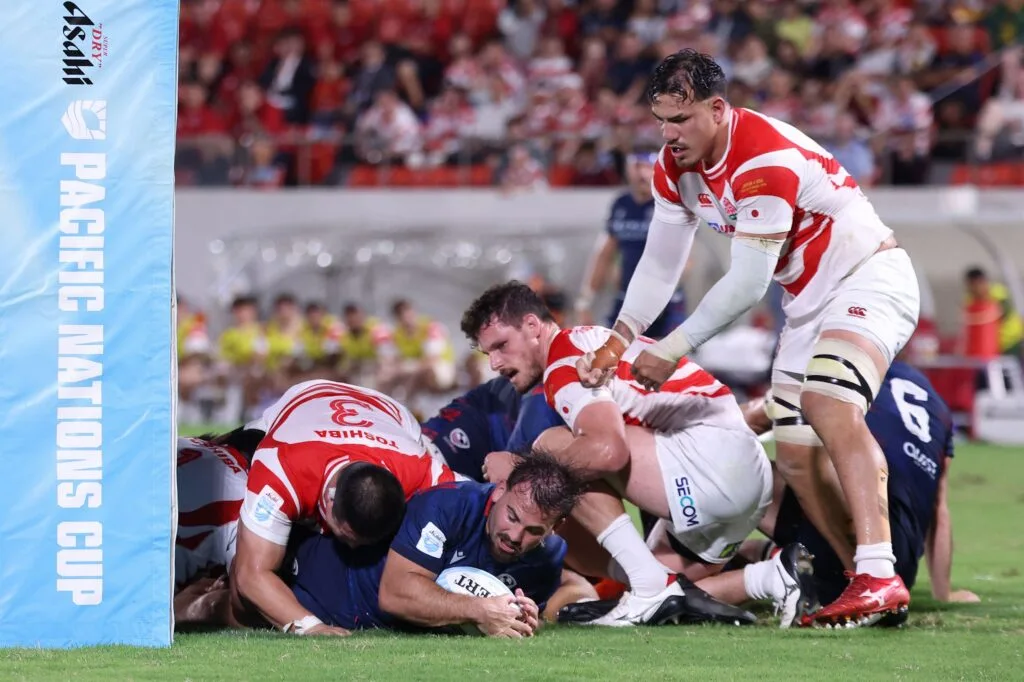
The statistic that explains the match
Territory was even.
Japan 50%
USA 50%
Possession was also close, with Japan holding only a 52–48 advantage.
But everything changed once the teams carried the ball.
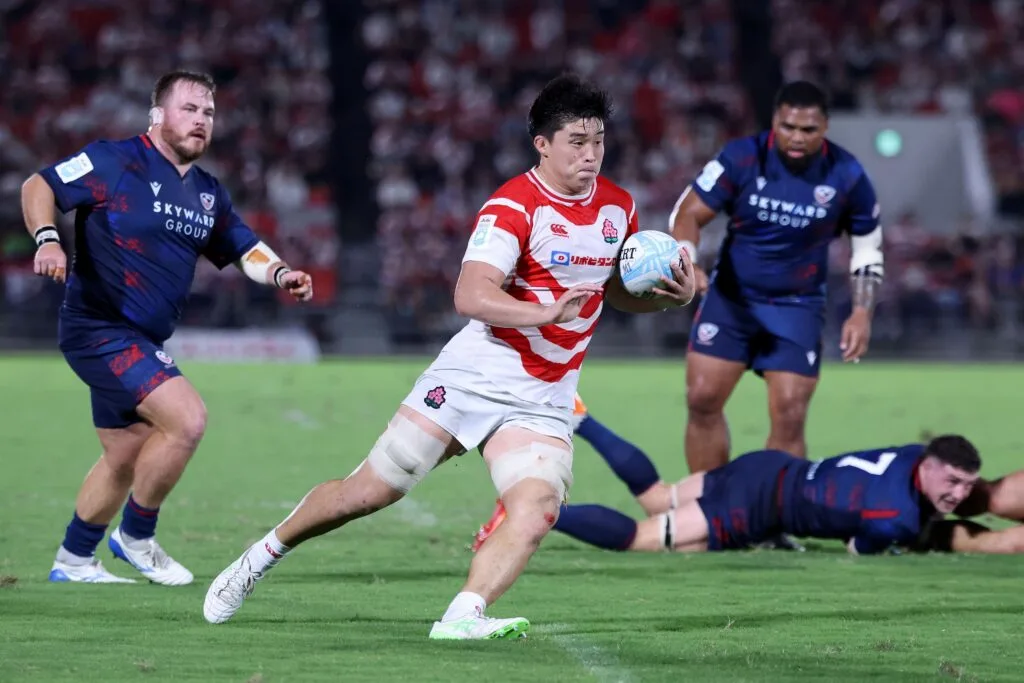
Japan made 125 carries for 587 metres.
The USA made only 85 carries for 306 metres.
That works out to roughly:
Japan: 4.7 metres per carry
USA: 3.6 metres per carry
Japan also led 8–3 in clean breaks and beat 24 defenders to 19.
That is the central explanation for 63–14.
The teams spent roughly the same amount of time in each other’s territory.
Japan simply did far more damage when it had the ball.
Japan’s Attack Keeps Finding Space
Japan’s ability to win the gain line repeatedly forced the Eagles into a punishing defensive workload.
Greene was at the center of Japan’s attacking performance, scoring a try and converting all nine Japanese tries.
Another major contributor to Japan’s ability to keep the USA defense moving backward.
USA Forced Into 167 Tackles
Japan’s forward momentum meant the Eagles spent long stretches defending on the retreat. The USA was forced to make 167 tackles, compared with just 119 for Japan.
That is an enormous defensive burden in a match played at Japan’s preferred pace.
Set piece pressure hurts the Eagles
The USA did win nine scrums, but their scrum success finished at 82%, compared with Japan’s perfect 100%.
The bigger concern came at lineout time.
Both teams won nine lineouts, but the USA finished with only 64% success, compared with 75% for Japan.
Japan also stole four American lineouts.
Jack Cornelsen was responsible for three of those steals, with Harry Hockings adding another.
Against a side as efficient as Japan, those lost possessions become more than isolated mistakes.
They become extra attacking opportunities.
The second half gets away from the USA
Jason Damm received a yellow card in the 50th minute.
Japan immediately took advantage.
Cornelsen scored three minutes later, Esei Haangana followed in the 60th minute, and Greene crossed again three minutes after that.
By then, the semifinal had become a procession.
Japan’s nine tries came from Hirose, Stolberg, Riley twice, Harada, Otsuka, Cornelsen, Haangana and Greene.
The Eagles did not score again after Lopeti’s 33rd-minute try.
By the Numbers
The key figures behind Japan’s Pacific Nations Cup semifinal victory.
Japan’s efficiency was the difference
The most revealing thing about this match is that the USA was not completely starved of possession or territory.
That would have made the explanation simple.
Instead, the Eagles had enough ball and enough field position to make the match competitive.
They just did far less with it.
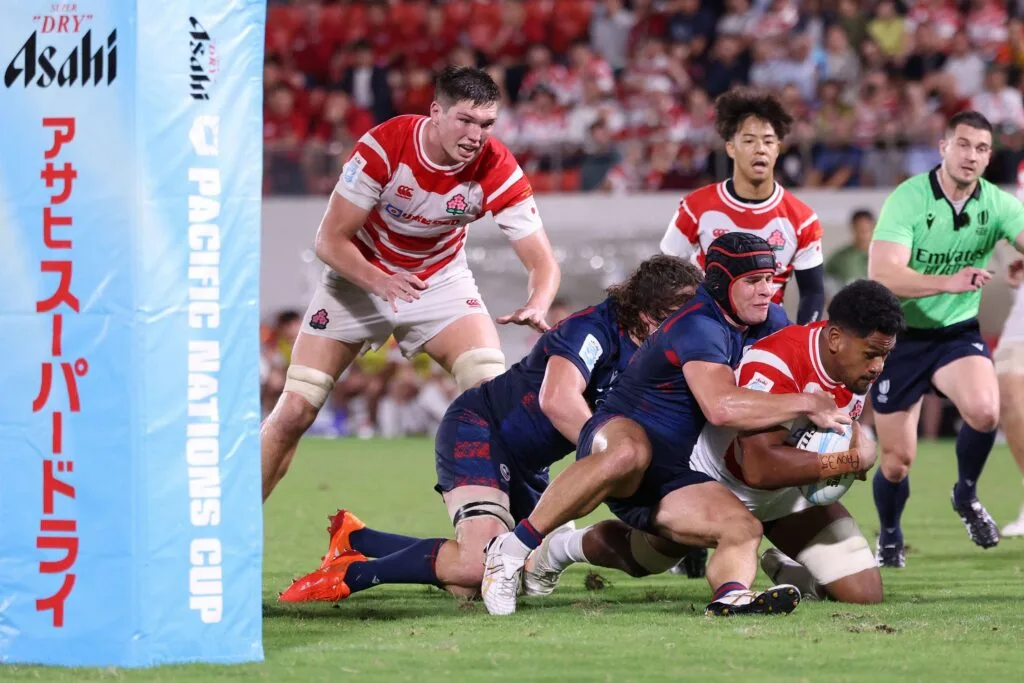
Japan’s ruck efficiency was 99%, the USA’s 96%, and the Brave Blossoms repeatedly turned stable possession into forward momentum.
Japan also reached the gain line with greater consistency. Eighty-seven of its 125 carries crossed the gain line, while the USA managed 49 from 85 carries.
That difference compounds over 80 minutes.
One extra metre becomes two.
One defensive retreat becomes another.
Eventually, gaps appear.
Japan exploited them relentlessly.
What this says about the Eagles
This was a difficult result, but it was also useful information.
The USA entered the tournament emphasizing development and squad depth. World Rugby’s tournament guide quoted Lawrence saying every player had an opportunity to grow and demonstrate that they could perform at this level.
Against Japan, the Eagles discovered how high that level currently is.
There were positives.
Klein and Lopeti finished good attacking movements. Alikhan and Ryan produced major defensive workloads. Besag beat three defenders. Luke Carty contributed 186 kick metres after entering from the bench.
But the broader picture is harder to avoid.
The USA was beaten badly in attacking efficiency, line-breaking ability and defensive workload.
That is the gap that needs to close.
What comes next
Japan advances to the Pacific Nations Cup final in Tokyo.
The USA moves into the third-place match at Prince Chichibu Memorial Stadium on September 19.
For the Eagles, the next match becomes important for a different reason.
The semifinal opportunity is gone.
What remains is the chance to respond.
A strong third-place performance would not erase 63–14, but it would show whether this group can absorb a difficult defeat, make corrections and produce something better one week later.
That may be the most useful test left in the tournament.
Japan showed the Eagles exactly where the standard is. Now the USA has one more match to show how quickly it can respond.