
National Collegiate Rugby opened the 2026–27 season with an unusually detailed assessment of the health of college rugby in the United States, pointing to growing participation, new programs, expanding championships and a more diversified financial model.
But NCR’s September 1 State of College Rugby message also does something more.
It lays out an increasingly ambitious vision of NCR’s place within American rugby at a time when NCR, USA Rugby, Collegiate Rugby Association of America and the growing varsity women’s game continue to occupy different and sometimes overlapping parts of the collegiate landscape.
NCR CEO Jeremy Treece declared that “the state of collegiate rugby has never been stronger.”
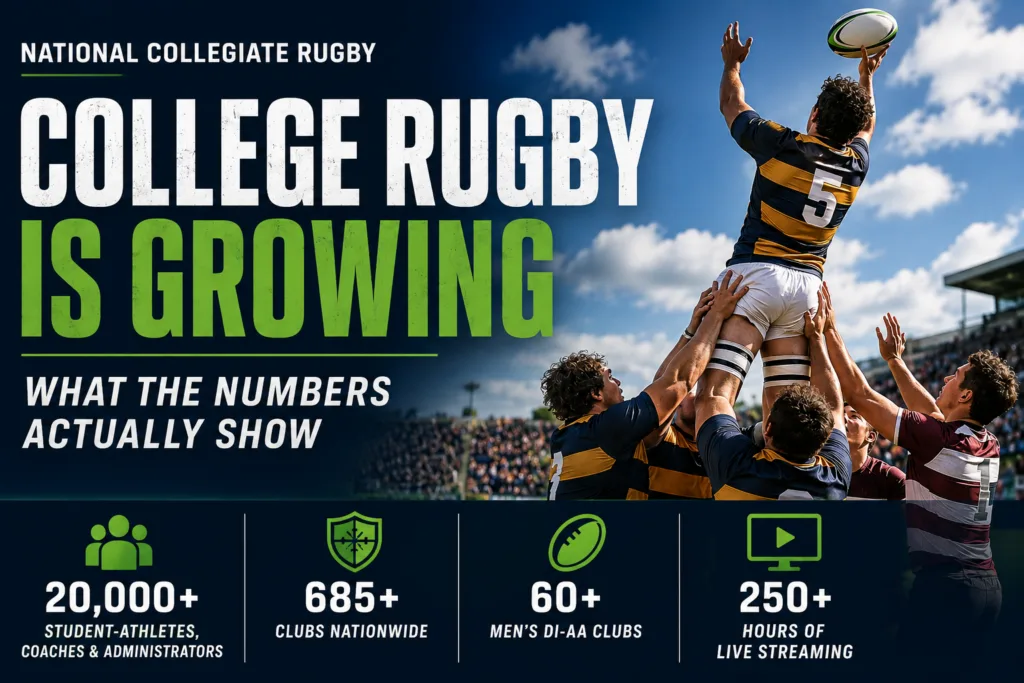
NCR says it now serves more than 20,000 student-athletes, coaches and administrators across more than 685 clubs nationwide.
Those figures are not appearing for the first time.
NCR reported more than 20,000 student-athletes and coaches across 685-plus clubs when registration opened August 1 and repeated those numbers when announcing its 2026–27 competition calendar five days later.
The more important question is what the organization’s continuing growth means for the structure of American college rugby.
NCR By The Numbers
About the numbers: Several of these figures are NCR-reported measurements rather than independently audited national data. Where appropriate, Rugby Fan Central distinguishes between NCR’s claims and figures that can be independently established.
NCR Says Nine Men’s Programs Are Joining Its New Alignment
Among the biggest developments highlighted by NCR is the arrival of nine men’s programs in a new Division I and Division I-AA alignment:
UCLA, Michigan State, Arkansas, Kansas, Kansas State, Missouri, Nebraska, Oklahoma and Oklahoma State.
NCR said their addition would push its men’s Division I-AA competition beyond 60 clubs.
UCLA’s move was announced separately in May.
The Bruins said they would join NCR beginning with the 2026–27 academic year after evaluating what the program described as the evolving collegiate rugby landscape.
Michigan State is included by NCR among the nine programs entering the new alignment in its September 1 statement.
Taken together, the additions bring another collection of recognizable universities into NCR’s championship structure.
UCLA Shows How Complicated the Landscape Has Become
UCLA may be the most revealing example of how American college rugby currently operates.
Joining NCR has not meant leaving USA Rugby.
UCLA’s official club-sports announcement says the 2026 season marks its first as a dual-registered member of both NCR and USA Rugby.
That structure allows UCLA to pursue NCR national championships in XVs and 7s while continuing to schedule traditional fixtures against USA Rugby member institutions.
The distinction is visible on UCLA’s fall schedule.
Michigan, Brown, Notre Dame, Dartmouth, Southern Nazarene and Texas A&M are listed as NCR Premier XVs opponents.
Fresno State and USC are separately listed as USA Rugby friendlies.
UCLA also says its leadership met with USA Rugby CEO Bill Goren and reaffirmed its USA Rugby membership while explaining its decision to pursue postseason competition through NCR.
That is an important example of why organizational boundaries within American college rugby cannot always be treated as absolute.
A program can choose an NCR championship pathway while maintaining membership and competitive relationships elsewhere in the American rugby system.
NCR Is Making a Bigger Claim About Its Scale
NCR’s public position goes beyond saying that membership has grown.
When announcing its 2026–27 competition calendar on August 6, NCR said its 685-plus clubs represented more than 80% of all collegiate rugby.
That is a substantial claim, but it needs context.
There is no single publicly available national database that allows Rugby Fan Central to independently establish NCR’s percentage of the entire U.S. collegiate rugby landscape on a like-for-like basis.
Different organizations can also count clubs, teams, programs, registered members and student-athletes differently.
For that reason, the 80% figure is best understood as NCR’s estimate of its share of collegiate rugby, rather than an independently established national participation figure.
What is clear is the considerable scale of NCR’s operation.
The organization runs men’s and women’s competition across multiple divisions alongside national championships, 7s, All-Stars and high-performance programs.
NCR Is Building a Year-Round Rugby Calendar
The September 1 statement also reinforces NCR’s effort to operate as a year-round collegiate rugby organization rather than simply a fall championship administrator.
Its calendar now extends through four broad phases:
NCR says more than 700 athletes participated in its winter All-Stars program last season.
The 2027 All-Stars weekend is scheduled for January 15–17 at the Austin-Tindall Sports Complex in Kissimmee, Florida, with men’s and women’s All-Stars, Rising Stars competitions and a high-school collegiate showcase.
NCR’s current event information says the combined weekend is expected to involve more than 1,000 athletes and coaches.
NCR also says the 2026 National 7s brought together 144 schools and more than 2,200 athletes.
For the upcoming 2027 CRC National 7s, NCR’s competition calendar again lists a 144-team event, scheduled for April 23–25 in Boyds, Maryland.
Together, the events show how NCR is attempting to create a collegiate rugby calendar that continues well beyond the traditional fall XVs season.
More Than One Million Streams — According to NCR
NCR is also increasingly positioning itself as a media operation as well as a competition organizer.
When registration opened for the new season, NCR reported that its 2025–26 championship events attracted more than 20,000 spectators, generated more than one million streaming views and produced 60 million social-media impressions.
Those are NCR-reported audience figures rather than independently audited measurements.
But they demonstrate the scale of the audience NCR says it is now reaching.
For 2026–27, NCR says it plans to offer more than 250 hours of live-streamed content.
That matters because visibility remains one of the persistent challenges facing American college rugby.
Schedules, results, standings, championships and broadcasts are spread across multiple conferences, organizations, university websites and streaming platforms.
NCR is increasingly attempting to package those pieces into a recognizable season-long product.
The Scholars Cup Adds Another Fan-Facing Competition
The inaugural FirstPoint USA Scholars Cup is another example.
Dartmouth, Brown, Notre Dame and UCLA will compete in a six-match series incorporated into their regular fall XVs schedules.
The competition begins September 26 with Notre Dame at Dartmouth and concludes November 7 with Dartmouth at Brown.
The October 16 UCLA–Notre Dame match will headline an NCR Friday Night Rugby broadcast.
NCR says all six Scholars Cup matches will be streamed by the host schools.
The competition contains only four programs, but they are four recognizable university names.
It gives NCR another property around which it can build regular-season interest rather than relying solely on postseason championships.
NCR Says Women Are Approaching Half of College Rugby
One of the most striking claims in the State of College Rugby concerns the women’s game.
NCR says women now comprise “nearly half of college rugby.”
It also highlighted women’s programs at Thomas College, New Haven, Arizona State and Quinnipiac, along with emerging varsity programs at Salem University, Eastern University in Pennsylvania and Wesleyan College.
The growth of women’s collegiate rugby is an important part of the wider American rugby story.
But the “nearly half” figure requires qualification.
NCR’s September 1 statement does not explain exactly how that percentage was calculated or clearly define the population being measured.
For that reason, RFC cannot independently conclude from the announcement that women represent nearly half of all U.S. college rugby participants.
It is more accurately presented as an NCR-reported measure of women’s participation in the college game.
Investment Is Extending Beyond Teams and Championships
NCR’s expansion is also taking place away from the field.
The organization’s Coaching Mentorship Program returns this fall after NCR says 40 mentees participated in its first cycle.
The six-week fall program will select 20 mentees and run from September 6 through October 11, with applications closing September 4.
NCR is also planning its inaugural Collegiate Development Summit alongside the January All-Stars weekend, with programming for coaches, commissioners, club leaders and referees.
On the officiating side, NCR says its 2026–27 Panel of Referees will oversee more than 100 regular-season, postseason and championship matches.
Financial support is another part of that development effort.
NCR says its Emerging Team Grants supported 46 programs during the previous cycle.
That figure is consistent with NCR’s March membership announcement, which reported 46 teams receiving Emerging Team grants.
NCR Now Describes Itself as a $3.6 Million Organization
The financial section of the State of College Rugby statement may ultimately be one of its most important.
NCR now describes itself as a $3.6 million member-driven organization.
According to NCR, membership fees now account for 58% of revenue, compared with 76% in 2023.
Those figures come from NCR and should be understood as organization-reported financial measurements.
But the strategy behind them has been publicly stated before.
In March, NCR said its decision to leave membership dues unchanged for a third consecutive year was being supported by a broader effort to diversify revenue beyond membership fees.
The organization specifically identified streaming licensing, event ticket sales and sponsorships as areas contributing to that strategy.
NCR also says 100% of membership fees are reinvested into supporting and growing the college game.
Again, that is NCR’s characterization of how membership revenue is used rather than an independently audited conclusion by RFC.
The broader trend, however, is important.
NCR is attempting to build sources of revenue around the college rugby product itself rather than relying exclusively on dues paid by its members.
The Bigger Message Is About the American Rugby Pathway
The most consequential part of Treece’s message may come near the end.
With the United States approaching the 2028 Los Angeles Olympics and the men’s Rugby World Cup in 2031, NCR argues that the next generation of Eagles will be developed within collegiate clubs.
It then points to its scale, championship infrastructure and high-performance pathways as assets capable of supporting that pipeline.
That language represents something larger than a season-opening membership update.
NCR is making the case that its college competition infrastructure should play an important role in the future American player-development system.
And that comes at a time when the broader structure of college rugby remains divided among several organizations and competition models.
NCR, CRAA, NIRA and USA Rugby occupy different and sometimes overlapping roles within the collegiate game.
UCLA’s dual-registration model demonstrates just how fluid those boundaries can become.
What the Numbers Actually Show
Not every headline number in NCR’s State of College Rugby statement can be independently verified from publicly available information.
NCR’s claim that it represents more than 80% of collegiate rugby remains NCR’s calculation.
Its statement that women comprise nearly half of college rugby needs a clearer definition of how that percentage is calculated.
The one million streaming views and 60 million social impressions are NCR-reported audience measurements.
And the $3.6 million organizational figure and 58% membership-revenue share come from NCR’s own September 1 assessment.
Those distinctions matter.
But they do not erase the larger development.
NCR says it serves more than 20,000 people across more than 685 clubs.
Seven Heart of America programs have announced moves into its competition structure.
UCLA has joined NCR while retaining USA Rugby membership through dual registration.
NCR says its men’s DI-AA structure now exceeds 60 clubs, and the organization is expanding its championships, broadcasting, coaching, officiating and high-performance programs.
The important question facing American college rugby is therefore becoming bigger than whether NCR itself is growing.
It is what that growth means for the structure of the college game as a whole.
Who controls the championship pathways?
How should college rugby connect to the national-team system?
Where do varsity programs fit?
Can programs participate across organizational boundaries without further fragmenting the sport?
And can the different parts of American college rugby develop a more coherent national structure as the United States moves toward Rugby World Cup 2031?
NCR’s State of College Rugby does not answer those questions.
But the scale and ambition described in it make them increasingly difficult for American rugby to ignore.