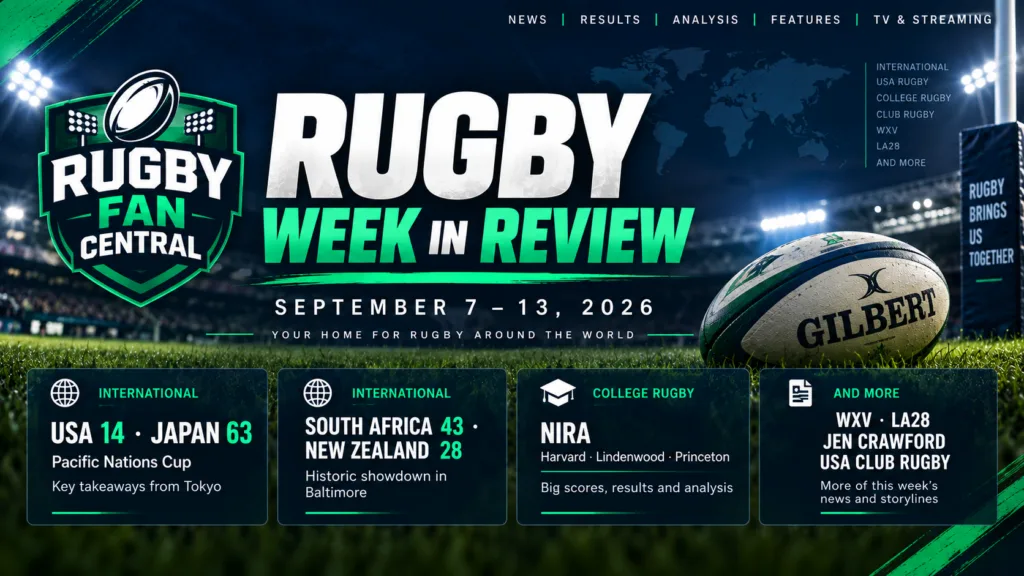
American rugby was at the center of several of the biggest stories in the sport during the week of September 7–13.
The USA Men’s Eagles suffered a 63–14 loss to Japan in the Pacific Nations Cup semifinals, while Baltimore hosted the conclusion of Rugby’s Greatest Rivalry as South Africa defeated New Zealand 43–28 to secure the four-Test series 3–1.
Back home, the second weekend of the National Intercollegiate Rugby Association season produced enormous victories for Harvard, Lindenwood and Princeton, while the wider American college and club seasons continued gathering momentum.
Women’s international rugby also returned through the new WXV Global Series, with England, Canada and New Zealand winning their opening matches.
Away from the weekend results, two announcements carried particular significance for American rugby: the United States was guaranteed places in both the men’s and women’s rugby sevens tournaments at the Los Angeles 2028 Olympic Games, while USA great Jen Crawford was named to the World Rugby Hall of Fame.
Here is what mattered across rugby during RFC’s Monday-to-Sunday review window of September 7–13, 2026.
By the Numbers
Nine numbers that defined the rugby week of September 7–13, 2026.
Japan’s semifinal victory over the USA.
South Africa’s series-clinching victory over New Zealand.
The Springboks’ final series advantage.
Points scored by Lindenwood against Queens.
Program-record points in the Tigers’ shutout of LIU.
Points scored in the Crimson’s shutout of Brown.
Canada’s points against Scotland in the opening round.
Men’s and women’s teams combined in Olympic rugby sevens.
Jen Crawford’s World Rugby Hall of Fame inductee number.
Japan Exposes the Gap for the Men’s Eagles
The USA arrived at Hanazono Rugby Stadium with an opportunity to reach the Pacific Nations Cup final.
Japan quickly took control.
The Brave Blossoms ultimately defeated the Eagles 63–14, advancing to the championship match. Shilo Klein and Tavite Lopeti scored the USA tries, but Japan controlled long stretches of the match and held the Eagles scoreless throughout the second half.
The result did more than eliminate the USA from championship contention.
It provided another measurement of where the Eagles currently stand against a Japanese program they are trying to close the gap on.
For RFC, the concern was not simply the 49-point final margin. Japan repeatedly generated quick possession and found space against the American defense, preventing the Eagles from establishing sustained control of the match.
The USA now has an immediate opportunity to respond.
Defending Pacific Nations Cup champion Fiji defeated Canada 45–29 in the other semifinal, setting up Japan against Fiji for the championship and USA against Canada in the third-place match.
Both games are scheduled for September 19 at Prince Chichibu Memorial Stadium in Tokyo.
For the Eagles, Canada represents another important measuring point as the program continues building toward its longer-term international goals.
Follow the Men’s Eagles
South Africa Finishes the Job in Baltimore
One of international rugby’s great rivalries ended its 2026 chapter on American soil.
South Africa defeated New Zealand 43–28 at M&T Bank Stadium in Baltimore, securing the inaugural Rugby’s Greatest Rivalry series by three Tests to one.
The Springboks held a narrow 17–14 halftime advantage before pulling away in the second half.
South Africa scored six tries in the victory, with scrum-half Morné van den Berg named Player of the Match.
Kurt-Lee Arendse supplied one of the decisive moments when his late try helped put the contest beyond New Zealand.
The result mattered internationally because South Africa completed a major series victory over the All Blacks.
For American rugby, the location mattered too.
A heavyweight Test between two of the sport’s most recognizable national teams was staged in an NFL stadium in Baltimore five years before the United States is scheduled to host Men’s Rugby World Cup 2031.
That gave the September 12 match additional significance for the American game.
It was another opportunity for a U.S. audience to experience elite international rugby at home as the country moves toward hosting the World Cup.
Harvard, Lindenwood and Princeton Put Up Huge NIRA Numbers
The second weekend of the National Intercollegiate Rugby Association season produced three results that immediately stood out:
Harvard 76–0 Brown
Lindenwood 103–5 Queens
Princeton 91–0 LIU
Defending champion Harvard followed its tense 26–24 opening victory over Sacred Heart with a 13-try shutout of Brown.
Gemma Ogoke scored three tries, while Sana’a Lunon and Maya Hilger scored twice apiece.
Harvard led 40–0 at halftime and extended its winning streak to 15 matches.
Lindenwood went even bigger.
The Lions led Queens 34–5 at halftime before scoring 69 unanswered second-half points in a 103–5 victory.
Lindenwood moved to 2–0 overall after opening its season with a 51–0 non-conference victory over Southern Nazarene.
Princeton then produced another remarkable scoreline.
The Tigers defeated LIU 91–0, establishing a program record for points scored.
Princeton is 2–0 under Karameli Fa’ae’e after beginning the season with a 52–17 victory over La Salle.
Through those first two matches, Princeton has scored 143 points while conceding only 17.
Davenport also opened NIRA competition with a 44–0 victory over West Chester.
The margins immediately raise one of the developing questions surrounding the 2026 NIRA season: how much separation exists between the strongest programs and the rest of the field?
It is still September, and two weekends are nowhere near enough to answer that question.
But Harvard, Lindenwood and Princeton have provided some striking early evidence.
Follow NIRA Rugby
Major Non-Conference Women’s College Results Add Context
Not every significant women’s college result from the weekend counted toward NIRA competition.
Life University defeated Dartmouth 49–22 in a non-conference matchup.
The final margin does not tell the entire story.
The teams were tied 17–17 at halftime before Life took control during the second half.
La Salle also defeated Army 27–7 in an exhibition after trailing 7–0 at halftime. The Explorers scored 27 unanswered points after the break.
Keeping those classifications clear matters.
RFC tracks league, non-conference and exhibition games separately because identical-looking scores can carry very different consequences for standings, rankings and postseason qualification.
Men’s College Rugby Continues to Build
The wider American men’s college calendar continued expanding as conference schedules moved deeper into September.
In Liberty Rugby Conference action, Dartmouth defeated American International College 59–7.
Siena also recorded a 52–0 victory over Syracuse.
Across National Collegiate Rugby, more conferences are beginning to accumulate enough results for early standings pictures to emerge.
For RFC, that growing volume is increasingly important.
An individual score tells readers what happened on one field.
Connected results begin telling a much larger story — conference standings, team records, rankings implications and eventually postseason positioning.
September still provides an incomplete picture across much of college rugby.
Every verified result makes that picture clearer.
USA Club Rugby Moves Deeper Into the Fall Season
The American senior club season also continued gathering pace during the September 12 weekend.
RFC’s results system recorded action across multiple divisions and geographic unions as the fall schedule expanded.
Among the more notable developments was Chicago North Shore responding to its opening 10–7 loss to the Chicago Lions with a 62–7 victory over the Twin Cities Amazons.
The Chicago Lions followed their opening victory by defeating the Metropolis Valkyries 37–15, continuing their strong start in Midwest Women’s Division I.
Columbus also responded emphatically after an opening loss to Pittsburgh Forge, while Mystic River and New York Athletic Club produced a far lower-scoring battle in American Rugby Premiership play.
The contrast is part of what makes September difficult to evaluate.
Early-season results can produce enormous margins, close finishes and rapid week-to-week swings as clubs settle into their schedules.
RFC will continue tracking the verified results as the divisional races develop.
FULL RFC COVERAGE
→ USA Club Rugby Hub
→ USA Club Rugby Results
→ Rugby Fixtures
WXV Opens a New Era
The redesigned WXV Global Series began on September 12 with three major women’s internationals.
England eventually pulled away from Australia 48–15, although the final margin disguised how competitive the opening half had been.
Australia led 10–5 at halftime.
The world champion Red Roses then scored seven tries after the break to turn the match decisively.
Canada produced another commanding result, defeating Scotland 64–26 in Edinburgh.
New Zealand completed the opening-round winners with a 28–14 victory over France.
The matches marked the beginning of WXV’s redesigned global structure.
They also continued World Rugby’s trial of the smaller size 4.5 rugby ball in women’s international competition — an experiment RFC is following because of its potential implications for the future of the women’s game.
Follow the WXV Global Series
USA Is Going to LA28
One of the week’s most important American rugby developments happened away from the field.
World Rugby confirmed the qualification pathway for rugby sevens at the Los Angeles 2028 Olympic Games.
There will be 12 men’s and 12 women’s teams.
The United States does not have to qualify.
As host nation, the USA receives an automatic quota place in both competitions.
The four highest-ranked eligible teams in each gender in the final HSBC SVNS World Championship 2027 standings — excluding the already-qualified USA — will earn Olympic places.
Six additional places in each competition will come through regional qualification tournaments during the second half of 2027.
The final men’s and women’s places will be decided at the Olympic Repechage in June 2028.
For USA Rugby, the announcement removes one major uncertainty from the next Olympic cycle.
Whatever happens during the qualification process elsewhere, both American teams will compete in Los Angeles.
That carries particular significance for the USA women.
At Paris 2024, they defeated Australia to win bronze — the first Olympic rugby sevens medal in U.S. history.
Their next Olympic appearance will come at home.
Jen Crawford Joins the World Rugby Hall of Fame
American rugby gained another place in the World Rugby Hall of Fame during the week.
World Rugby named former Women’s Eagle Jen Crawford as inductee No. 179 in its 2026 class.
Crawford earned 23 USA caps from 1988 to 2000 and scored 24 Test tries.
She was a central figure in the USA team that won the inaugural Women’s Rugby World Cup in 1991, defeating England 19–6 in the final.
Crawford returned for the next two World Cup finals.
She scored twice as the USA lost 38–23 to England in 1994 and captained the Women’s Eagles when they finished runners-up again in 1998, losing 44–12 to New Zealand.
Her impact extended well beyond international rugby.
With the Berkeley All-Blues, Crawford helped the club win nine consecutive USA Rugby National Women’s Club Championships. She later helped establish opportunities for younger players and served as a Player’s Representative on the USA Rugby Board.
Crawford was inducted into the USA Rugby Hall of Fame in 2019.
Her World Rugby induction will take place alongside England great Sue Day when the USA plays England in the WXV Global Series in New Jersey on October 30.
The setting is particularly appropriate.
One of the players who helped establish the United States as an early power in women’s rugby will be honored while another generation of Women’s Eagles represents the country at home.
Follow USA Women’s Rugby
What the Week Changed
Some weeks are dominated by one result.
September 7–13 was different.
For the Men’s Eagles, the 63–14 defeat to Japan provided an uncomfortable measurement of the work still required against one of the teams the USA wants to challenge consistently.
For South Africa, Baltimore completed a 3–1 series victory over New Zealand while putting one of international rugby’s biggest rivalries in front of an American audience.
For NIRA, the second weekend produced extraordinary numbers. Harvard, Lindenwood and Princeton remain unbeaten, and all three demonstrated how quickly they can overwhelm an opponent.
For women’s international rugby, WXV began its redesigned era with major Tests across Europe.
And for American rugby’s longer-term future, two developments will last far beyond September: guaranteed USA participation at LA28 and another American pioneer entering the World Rugby Hall of Fame.
It was a consequential seven days for rugby in the United States.
What Comes Next
The Men’s Eagles get an immediate chance to respond to Osaka.
The USA faces Canada on September 19 in Tokyo in the Pacific Nations Cup third-place match, while Japan and Fiji meet for the championship.
NIRA enters another weekend with Harvard, Lindenwood and Princeton carrying unbeaten records and increasingly interesting questions surrounding the developing national picture.
National Collegiate Rugby and USA Club Rugby schedules continue expanding as conference and divisional races begin to take shape.
WXV also moves into its next round.
For American rugby, those competitions are increasingly connected to a much larger picture.
The Men’s Eagles are trying to close the international gap.
The American college and club seasons are accelerating.
The Women’s Eagles are moving toward their October home Tests.
The USA’s Olympic places at LA28 are secured.
And Rugby World Cup 2031 sits further down the road.
The fall rugby season is no longer starting.
It is here.