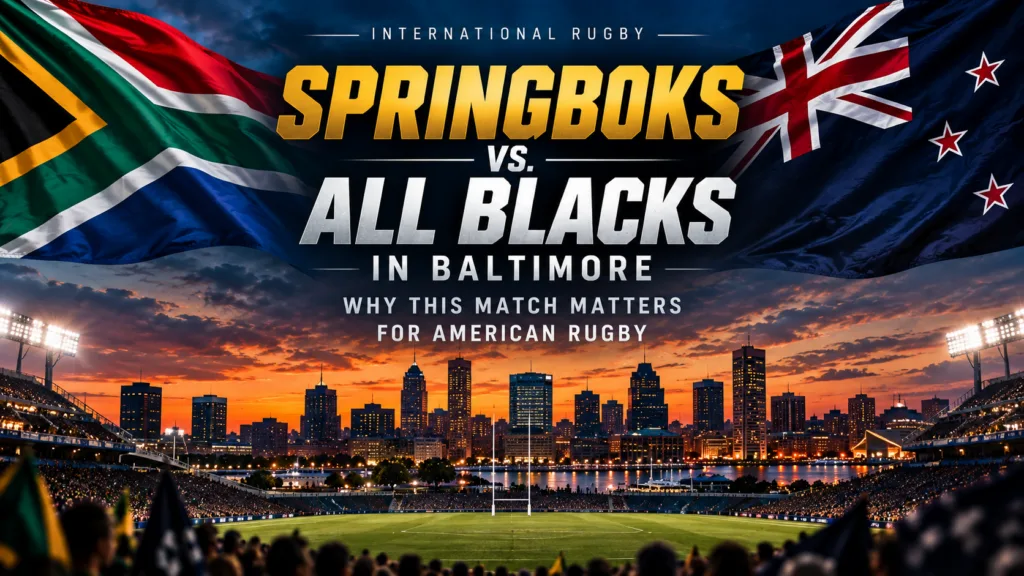
When the Springboks and All Blacks take the field Saturday at M&T Bank Stadium in Baltimore, one of rugby’s greatest rivalries will arrive on one of American sports’ biggest stages.
But this is about considerably more than deciding a four-Test series.
More than 70,000 fans are expected inside the home of the NFL’s Baltimore Ravens. World Rugby is helping position major international matches in the United States. South Africa and New Zealand see significant commercial opportunity in playing here.
And all of it is happening five years before the United States hosts the Men’s Rugby World Cup for the first time.
Baltimore is becoming a test of a much bigger question for the sport:
Can major international rugby events turn America’s enormous sports market into a lasting rugby market?
A series is still on the line
There is plenty at stake before considering anything happening off the field.
South Africa enters Saturday’s fourth and final Test with a 2–1 series lead over New Zealand.
A Springboks victory would complete a 3–1 series win. An All Blacks victory would leave the four-Test series tied 2–2.
M&T Bank Stadium provides an unusual setting for the finale.
The 70,257-seat stadium is best known as the home of the Baltimore Ravens. More than 70,000 spectators are expected for Saturday’s match.
It will also be the All Blacks’ seventh Test played on U.S. soil.
But Baltimore was not selected simply because organizers wanted a different backdrop for the final Test.
The United States is part of a much larger strategy.
Why Baltimore?
When the Baltimore match was announced, SA Rugby, New Zealand Rugby and World Rugby made the American objective clear.
World Rugby CEO Alan Gilpin described bringing world-class international matches to key U.S. cities as central to the sport’s strategy ahead of the 2031 Men’s Rugby World Cup and 2033 Women’s Rugby World Cup.
Baltimore is also an applicant host city for Rugby World Cup 2031.
That gives Saturday’s event additional significance as World Rugby continues evaluating American cities, venues and markets ahead of the tournament.
The match offers an opportunity to see how an American market responds when two of the world’s most recognizable rugby teams are placed inside an NFL stadium and marketed as a major sporting event.
And commercially, there is another reason.
The money matters — even if the exact number isn’t clear
Moving the fourth Test to the United States was a financial decision as well as a strategic one.
SA Rugby CEO Rian Oberholzer has been clear that expanding the Springboks brand beyond South Africa is important to the union’s financial future and that the United States is an important market ahead of Rugby World Cup 2031.
Reuters reported in August that the Baltimore match was projected to generate between $4 million and $6 million more than a Test hosted in a South African stadium.
Rugby’s Greatest Rivalry is structured as a 50-50 commercial partnership between SA Rugby and New Zealand Rugby, with earnings pooled from sponsorships, stadium ticket sales, merchandise and international broadcast rights.
More recently, South Africa’s Daily Maverick, citing several unnamed sources, reported that SA Rugby and New Zealand Rugby could each make R90 million more from the Baltimore game than if the match had been staged in South Africa.
ESPN has reported a still larger estimate, suggesting each union could make $9 million more from the Baltimore match than it would have in South Africa.
Those estimates do not align.
Neither SA Rugby nor New Zealand Rugby has publicly released financial details confirming exactly how much each union will make from Baltimore.
Daily Maverick reports that the actual income figures from the 2026 Rugby’s Greatest Rivalry tour have not been made public and are expected to become clearer when the unions’ financial statements are released.
For that reason, Rugby Fan Central is not treating any of the reported estimates as a confirmed figure.
What is clear is the broader point:
A major Test in the United States can potentially generate substantially more money than staging the same match in a traditional rugby market.
That helps explain why Baltimore matters well beyond Saturday.
By the Numbers
The numbers behind the Baltimore Test and rugby’s growing focus on the United States.
World Rugby is making a major bet on America
Baltimore needs to be viewed as part of something much larger.
World Rugby’s current six-year strategy culminates with the 2031 Men’s Rugby World Cup in the United States.
The governing body says it plans to partner with unions and invest £200 million in the U.S. in the lead-up to 2031, with the goal of unlocking rugby’s potential in the world’s largest sports market.
Its ambitions for the tournament itself are enormous.
World Rugby is targeting a surplus of more than US$1 billion from Rugby World Cup 2031, money that would be used to support investment in rugby around the world.
Before that tournament arrives, the United States will host Olympic rugby sevens at the 2028 Los Angeles Games.
Then come consecutive American Rugby World Cups: the men’s tournament in 2031 and the women’s tournament in 2033.
That gives rugby a five-to-seven-year window unlike anything the sport has previously had in the United States.
The challenge is converting major events into lasting interest.
Selling 70,000 tickets isn’t the same as building American rugby
This may be the most important distinction surrounding Baltimore.
A huge crowd for Springboks against All Blacks demonstrates that the United States can provide a substantial market for one of rugby’s premier events.
It does not automatically mean American rugby has cracked the U.S. sports market.
Reuters reported this week that rugby continues to face a difficult battle for attention in a country dominated by the NFL, MLB, NBA and NHL.
That challenge has been visible even with two of rugby’s most famous teams in Baltimore.
Springbok No. 8 Jasper Wiese told Reuters this week that players had received relatively little recognition while walking around the city.
The Springboks and All Blacks can attract attention because of their histories, international followings and positions among the elite teams in world rugby.
The larger challenge is what happens after someone watches them in Baltimore on Saturday.
Do they follow the USA Eagles?
Do they watch college rugby?
Do they find their local rugby club?
Do their children begin playing?
Do they come back when another international Test arrives?
Those questions matter far more to the long-term health of American rugby than the attendance figure from one Saturday afternoon.
The All Blacks have been testing America for years
New Zealand’s appearance in Baltimore is not an isolated experiment.
The All Blacks have previously played six Tests on U.S. soil.
Those included matches against the United States in 1913, 2014 and 2021, Ireland in 2016 and 2025, and Fiji in San Diego in 2024.
Baltimore will become No. 7.
But this event takes the strategy to another level.
This time New Zealand isn’t playing the United States, Fiji or even a standalone Test against Ireland.
It is bringing the Springboks.
And rather than being a detached exhibition, Baltimore is the final Test of a meaningful four-match series between two of international rugby’s biggest rivals.
That makes Saturday one of the most significant experiments yet in selling elite international rugby to an American audience.
Could more major Tests move to America?
If Baltimore succeeds financially, it may not remain unusual for long.
World Rugby CEO Alan Gilpin has already discussed the possibility of more major international matches being staged in the United States as the sport builds toward 2031.
That discussion has even extended to the possibility of future Six Nations fixtures being taken to the American market.
The economics are important.
Large American stadiums can hold 60,000, 70,000 or more spectators. Major U.S. cities offer substantial corporate hospitality and sponsorship markets. Rugby also has established communities of supporters with connections to countries including Ireland, South Africa, New Zealand, Italy and the Pacific Islands.
Put the right teams in the right American city and international rugby may have discovered a valuable new commercial model.
But that creates another question.
Will America become a place where international rugby comes to make money, or will those matches also help grow American rugby?
Ideally, it becomes both.
The road to 2031 runs through matches like Baltimore
USA Rugby has ambitions of dramatically expanding participation before the World Cup arrives.
Reuters reported this week that USA Rugby currently has more than 100,000 active members across youth, high school, college and senior club rugby.
The organization would like that number to reach 500,000 by the time the Rugby World Cups are staged in the United States.
Getting there will require far more than occasional appearances from the Springboks and All Blacks.
It requires youth rugby, clubs, colleges, coaches, referees, facilities, sustainable high-performance pathways, accessible broadcasts and national teams capable of capturing American attention.
But major events can provide something those parts of the game cannot easily manufacture on their own:
Visibility.
Saturday gives tens of thousands of people an opportunity to experience international rugby inside a familiar American sports environment.
Millions more could encounter the sport through television, streaming, social media and coverage surrounding the match.
The opportunity is what happens next.
Baltimore is the beginning, not the destination
Saturday will eventually produce a winner.
South Africa could leave the United States with a 3–1 series victory. New Zealand could level one of rugby’s greatest rivalries at 2–2.
There will be tries, tackles, celebrations and another chapter in more than a century of Springboks-All Blacks history.
But from an American perspective, the more consequential result may take years to determine.
World Rugby is investing heavily in the United States.
The 2028 Olympics are coming to Los Angeles.
The Men’s Rugby World Cup arrives in 2031.
The Women’s Rugby World Cup follows in 2033.
And more than 70,000 people are expected to fill an NFL stadium in Baltimore to watch two of the world’s great rugby nations.
That demonstrates that elite international rugby can command a major stage in America.
The next challenge is much harder:
Turning the people who come to see the All Blacks and Springboks into people who stay for American rugby.
Sources & Further Reading
Rugby Fan Central reviewed official announcements and reporting from multiple sources while preparing this article.