By The Rugby Fan Central
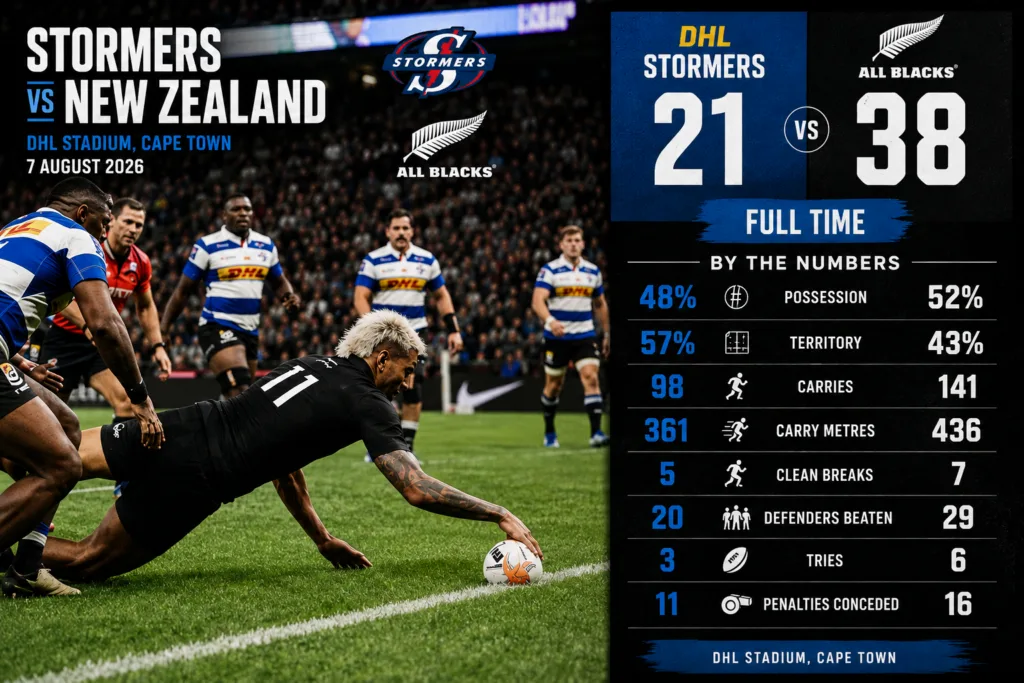
New Zealand beat the Stormers 38–21 in Cape Town, but the final margin disguises a match that remained level deep into the second half. The Stormers controlled where much of the rugby was played. New Zealand were far more dangerous when opportunities appeared.
For 56 minutes, the Stormers had New Zealand exactly where they wanted them.
Seabelo Senatla’s second-half try and Yaqeen Ahmed’s conversion had brought the home side back to 14–14.
The Stormers had territory. New Zealand had already been reduced to 13 players during the first half. The visitors were conceding penalties.
Then the match changed.
Rieko Ioane scored. Leroy Carter followed. Josh Moorby added another.
In less than ten minutes, 14–14 became 33–14.
That burst explains New Zealand’s 38–21 victory better than the final score alone.
By the numbers
The contradiction jumps off the page.
The Stormers had 57% territory. New Zealand scored six tries.
New Zealand didn’t dominate where the game was played, but they did considerably more damage with the possession they had.
By the Numbers
Stormers controlled territory — but not the scoreboard
Territory normally tells us something about which team dictated the match.
Not this time.
The Stormers finished with 57% territory, including 63% during the second half.
Yet New Zealand generated considerably more attacking volume.
The visitors carried 141 times compared with 98, made 436 metres compared with 361 and beat 29 defenders compared with 20.
They also crossed the gain line on 82 carries, compared with 54 for the Stormers.
New Zealand didn’t need to spend the entire game in Stormers territory.
When they got there, they were far more likely to hurt them.
New Zealand survived an extraordinary first-half test
New Zealand opened the scoring after five minutes when Samisoni Taukei’aho powered over, with Beauden Barrett converting.
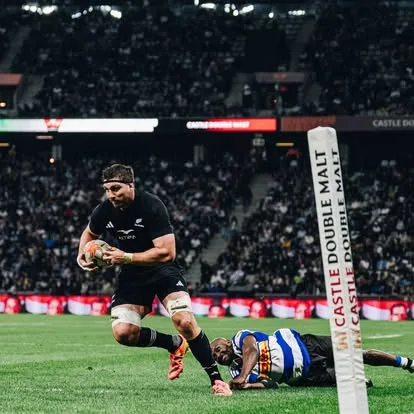
Then came a sequence that could have completely changed the match.
Anton Lienert-Brown was shown yellow after 11 minutes.
Two minutes later, Simon Parker was also sent to the sin bin.
New Zealand were down to 13 players.
The Stormers responded almost immediately.
A driving maul powered towards the New Zealand line before Deon Fourie grounded the ball. Ahmed converted.
7–7.
But that was all the Stormers managed while New Zealand were under their greatest pressure.
New Zealand survived.
And just before halftime, they struck again.
Parker finished an attacking move in the 38th minute and Barrett converted.
Stormers 7–14 New Zealand at halftime.
For all the disciplinary trouble, New Zealand still went into the break ahead.
The Stormers made it a contest again
The Stormers emerged after halftime and gradually forced themselves back into the match.
In the 55th minute, Seabelo Senatla finished an attacking move after Deon Fourie helped create the opening.
Ahmed converted.
14–14.
After nearly an hour, there was nothing between the teams on the scoreboard.
The Stormers had reasons to believe they could win it.
They were controlling territory. Their maul had caused problems. New Zealand’s penalty count continued to climb.
But New Zealand possessed something the Stormers couldn’t consistently match.
Explosive attacking efficiency.
The ten minutes that decided the match
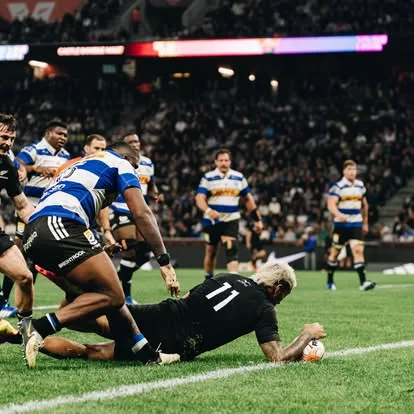
Rieko Ioane scored from close range in the 66th minute. Five minutes later, Peter Lakai found space in the Stormers defence and helped create the opening for Leroy Carter.
Then Josh Moorby crossed in the 75th minute.
The Stormers had spent nearly an hour fighting their way back to level. New Zealand needed only a few minutes to pull away again.
New Zealand’s carriers changed everything
The individual numbers help explain how.
Despite spending ten minutes in the sin bin, Lienert-Brown finished as the match’s leading carrier by metres.
No player beat more defenders, and Carter’s try came during the sequence that broke the Stormers.
Lakai repeatedly challenged the defensive line and provided the assist for Carter’s second-half try.
Dayimani produced the Stormers’ highest carrying total and remained one of their most effective attacking outlets.
The Stormers’ maul gave New Zealand problems
The Stormers did have a clear attacking weapon.
Their maul.
They generated 30 metres from 12 mauls, winning all 12.
Fourie’s first-half try came directly from that pressure.
The Stormers also won 16 lineouts and repeatedly used field position to create opportunities.
But their set piece wasn’t flawless.
They finished with 80% lineout success and 71% scrum success.
New Zealand, by comparison, recorded 100% success from both their own lineouts and scrums.
That gave the visitors a stable platform when the match began to open up.
Discipline is New Zealand’s warning sign
The attacking performance was impressive.
The disciplinary performance was not.
Lienert-Brown and Parker were both sent to the sin bin during the first half.
Moorby joined them late.
His yellow card accompanied a 77th-minute penalty try for the Stormers, cutting New Zealand’s lead to 33–21.
Against another opponent, repeatedly playing with 14 — and briefly 13 — could have been decisive.
On this night, New Zealand’s attacking efficiency covered those mistakes.
That won’t always happen.
One final New Zealand statement
Even after the Stormers’ penalty try, New Zealand weren’t finished.
In the 80th minute, replacement hooker Asafo Aumua picked up from the base of a ruck close to the Stormers line and powered over.
Josh Jacomb missed the conversion.
Stormers 21. New Zealand 38.

It was New Zealand’s sixth try of the night and the final reminder of how quickly they could punish the Stormers when an opportunity appeared.
What actually decided it?
The Stormers controlled territory and fought their way back to 14–14, but New Zealand were far more dangerous when the game opened up.
The Stormers controlled where much of the match was played. New Zealand controlled what happened when space appeared — and in the final quarter, that was decisive.
Match scoring
Stormers 21: Deon Fourie try, Seabelo Senatla try, penalty try; Yaqeen Ahmed 2 conversions.
New Zealand 38: Samisoni Taukei’aho, Simon Parker, Rieko Ioane, Leroy Carter, Josh Moorby, Asafo Aumua tries; Beauden Barrett 3 conversions, Josh Jacomb conversion.
Halftime: Stormers 7–14 New Zealand
Venue: DHL Stadium, Cape Town
Date: August 7, 2026
Competition: Rugby’s Greatest Rivalry 2026
THE FINAL WHISTLE ISN’T THE END OF THE STORY. GO BEYOND THE SCORE →
Go beyond the result with player stats, team data, the match timeline and full lineups.