
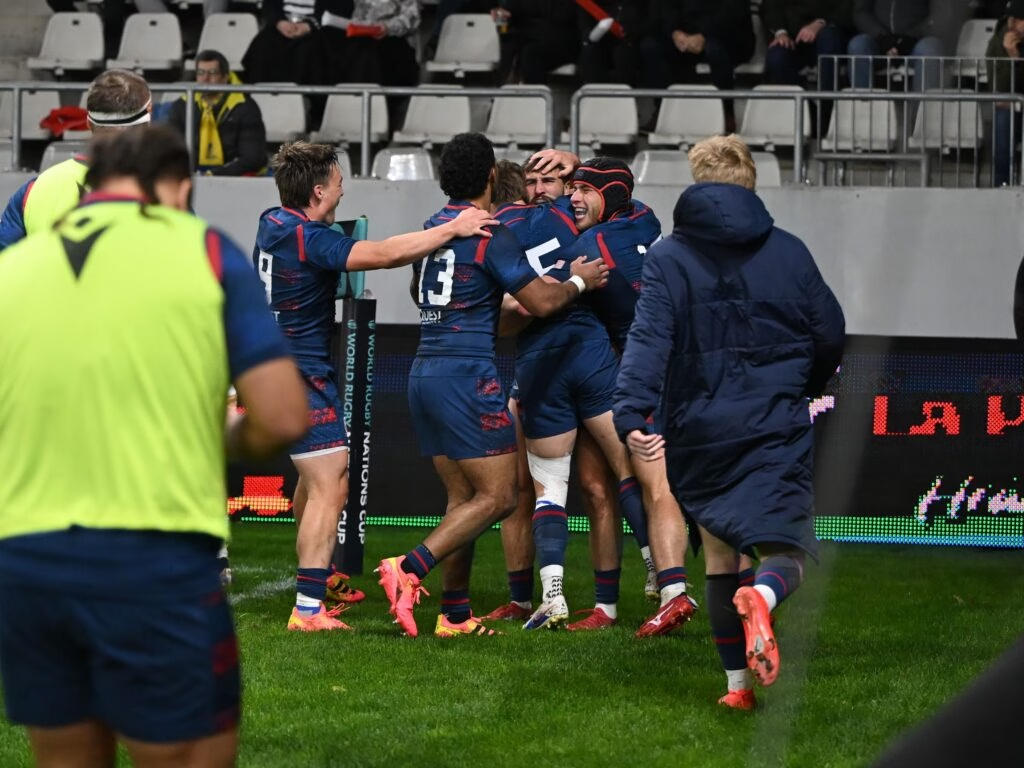
Seven tries, a fifth consecutive victory and the retention of the Pershing Cup secure the Americas and Pacific pool championship for the United States, setting up a meeting of unbeaten champions against Georgia.
The United States men’s national rugby team secured the inaugural World Rugby Nations Cup Americas and Pacific pool title with a commanding 53–24 victory over Romania in Bucharest on Saturday, November 14.
The victory improved the Eagles to 5–0 in the competition, clinched first place in their pool with one round remaining and delivered the largest winning margin in USA history against Romania.
Scott Lawrence’s team scored seven tries, led 22–10 at halftime and pulled away in the second half. Rufus McLean scored twice, while Noah Brown, Perry Mayo, Jason Damm, Nathan Den Hoedt and Tavite Lopeti also crossed the line.
The result sets up a compelling final weekend: the United States and Georgia, winners of the tournament’s two pools, will meet in Tbilisi on November 21. Both teams are seeking to finish the inaugural competition unbeaten.
Five wins, one pool title, and the Pershing Cup
The victory was more than another successful afternoon for the Eagles. It secured two trophies: the Nations Cup Americas and Pacific pool championship and the Pershing Cup, contested between the United States and Romania.
The result also demonstrated how far the Eagles’ attack has developed during the competition. Their previous Nations Cup match, a narrow 28–26 victory over Hong Kong China, required a late comeback. Against Romania, the United States established control early and built its largest margin of victory over the Oaks.
Lawrence praised both the performance and its significance.
“The Pershing Cup stays with the Eagles. We’re proud of the performance, proud of the group, and proud to represent the United States.”
How the Nations Cup pools work
The Nations Cup divides its 12 participating nations into two geographically aligned pools of six, but teams play opponents from the opposite pool rather than their own.
The United States competes in the Americas and Pacific pool alongside Canada, Chile, Samoa, Tonga and Uruguay. Georgia belongs to the Europe, Asia and Africa pool, which also includes Hong Kong China, Portugal, Romania, Spain and Zimbabwe.
Each pool crowns its own champion based on results against the six opposing nations. There is no single championship final between the two pool winners.
USA’s Road to the Nations Cup Pool Title
| Date | Opponent | Result |
|---|---|---|
| July 4 | Portugal | W 30–29 |
| July 11 | Zimbabwe | W 31–15 |
| July 18 | Spain | W 29–22 |
| November 8 | Hong Kong China | W 28–26 |
| November 14 | Romania | W 53–24 |
| November 21 | Georgia | Upcoming |
The five victories have produced 171 points scored and 116 conceded, a points differential of +55. Three were decided by seven points or fewer, but the Eagles’ 29-point victory over Romania was emphatic.
How the Eagles defeated Romania
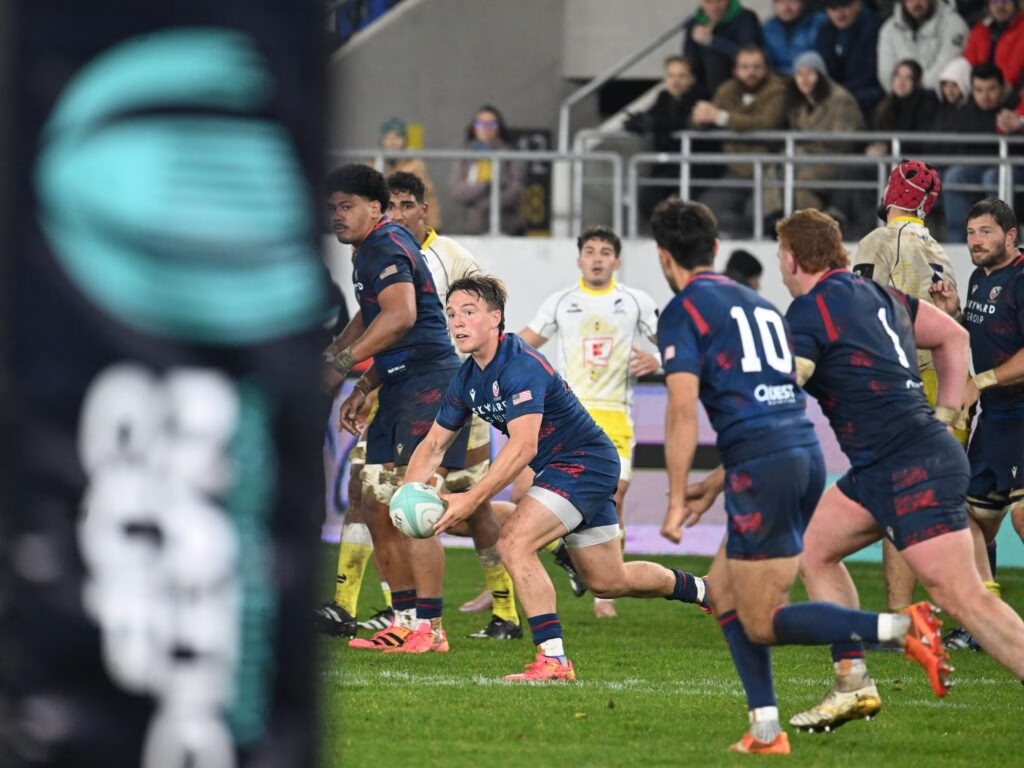
The United States opened the scoring through a Chris Hilsenbeck penalty in the opening minutes. Hilsenbeck then created the first try with a kick behind Romania’s defensive line, which Noah Brown chased down to score.
Scrum-half Oscar Lennon helped create the second try, breaking through the defense before finding Rufus McLean. The Eagles had built a 15–0 lead before Romania responded through Taylor Gontineac.
Perry Mayo restored the Americans’ momentum, finishing an attacking move to give the visitors their third try. Romania captain Cristi Boboc then scored from a driving maul to cut the deficit to 22–10 at halftime.
The opening minutes of the second half effectively settled the contest.
Captain Jason Damm powered over from close range shortly after the restart, and lock Nathan Den Hoedt followed with another forward-driven try. Hilsenbeck converted both, extending the advantage to 36–10.
Tavite Lopeti added the Eagles’ sixth try after an attacking sequence involving center Dominic Besag, pushing the score to 43–10.
Romania received a penalty try after USA’s Nafi Ma’afu was shown a yellow card, but the Eagles continued to score. Replacement Tom Pittman kicked a penalty, and McLean completed his two-try performance following a break and pass from Marno Redelinghuys.
Adrian Emanuel Mitu scored late for Romania, but the result was already beyond doubt.
Watch: USA vs. Romania — Nations Cup 2026
Watch USA vs. Romania from the 2026 World Rugby Nations Cup.
Match scoring summary
| Team | Tries | Conversions | Penalties | Total |
|---|---|---|---|---|
| USA | 7 | 6 | 2 | 53 |
| Romania | 4 | 1 | 0 | 24 |
Romania’s 24 points came from a seven-point penalty try, three other tries worth 15 points, and one successful conversion worth two points.
Hilsenbeck finished with 13 points from five conversions and a penalty, while Pittman added five from a conversion and a penalty.
The United States’ seven tries were scored by McLean (two), Brown, Mayo, Damm, Den Hoedt and Lopeti.
What the numbers reveal about the Eagles’ performance
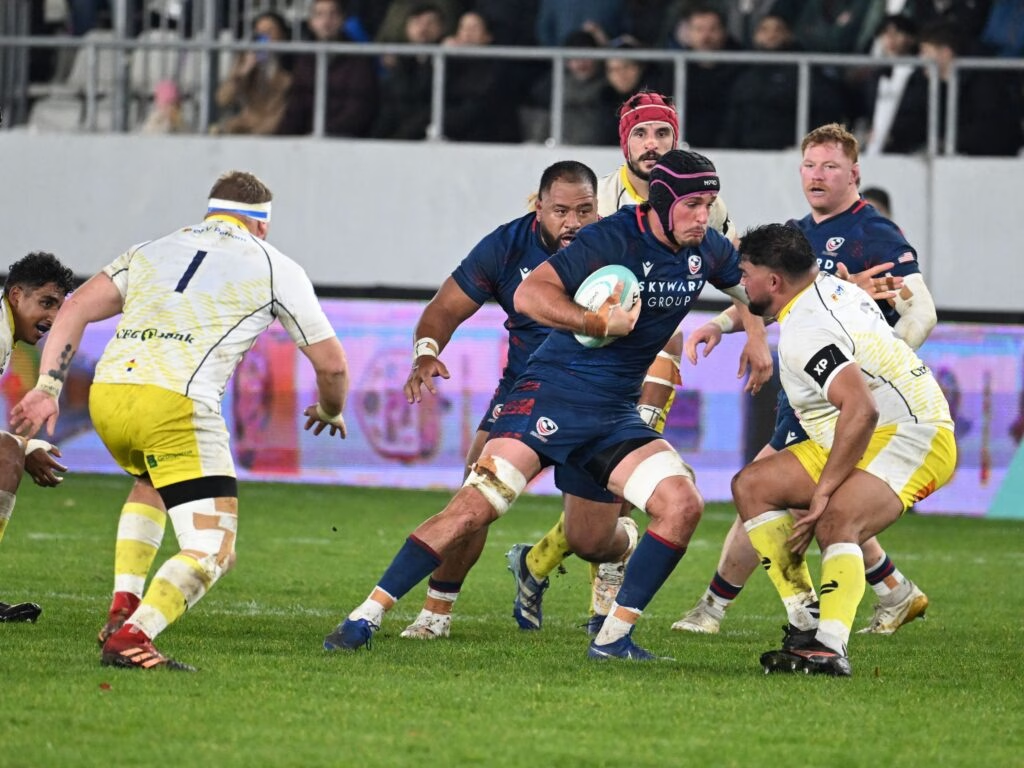
RFC’s analysis of World Rugby match data reveals that the United States’ victory was built on attacking efficiency, strong defensive execution and an ability to turn limited opportunities into substantial territorial gains.
Despite having only a narrow advantage in possession, the Eagles generated significantly more attacking metres and broke through Romania’s defense repeatedly.
Romania vs. USA — Round 5 Match Statistics
| Statistic | USA | Romania |
|---|---|---|
| Possession | 52% | 48% |
| Territory | 56% | 44% |
| Carries | 85 | 87 |
| Metres gained | 372 | 197 |
| Defenders beaten | 32 | 13 |
| Clean breaks | 6 | 1 |
| Tackles made | 126 | 119 |
| Missed tackles | 13 | 32 |
| Turnovers won | 6 | 5 |
| Penalties conceded | 16 | 9 |
| Lineout success | 93% | 92% |
Source: World Rugby match data; RFC analysis.
Attacking Efficiency Made the Difference
Metres Gained
Defenders Beaten
Clean Breaks
Source: World Rugby match data; RFC analysis.
The most revealing statistic is the difference in metres gained. Despite making two fewer carries than Romania, the Eagles gained 175 more metres and beat more than twice as many defenders.
The United States averaged approximately 4.38 metres per carry, compared with Romania’s 2.26, nearly doubling the hosts’ attacking return per carry.
The Eagles also recorded six clean breaks to Romania’s one, illustrating how effectively they found space in the defensive line.
Those numbers help explain how the United States scored seven tries without dominating possession.
Defensive execution supported the attack
The Americans missed only 13 tackles compared with Romania’s 32, despite making more tackles overall.
That contrast helped the Eagles restrict Romania’s attacking gains while creating opportunities to counterattack.
Romania’s 197 metres gained from 87 carries underscored the difficulty the home side experienced in advancing the ball.
The United States also maintained a 93% lineout success rate, providing a reliable platform for its attack.
Discipline remains an area for improvement
One statistic stands out as a concern ahead of the Georgia match.
The Eagles conceded 16 penalties to Romania’s nine, a significant imbalance despite their comfortable victory.
Ma’afu’s second-half yellow card also resulted in a penalty try for Romania, demonstrating how quickly disciplinary problems can translate into points.
Against a Georgia side that has won all five of its Nations Cup matches, similar lapses could prove more costly.
The challenge for Lawrence’s team will be to maintain the attacking efficiency displayed in Bucharest while reducing the penalties that give opponents additional possession and territory.
A captain’s performance and new Eagles
Damm was central to the victory, leading the team and contributing a second-half try that helped establish the decisive advantage.
The captain credited the team’s execution of its game plan.
“It came down to us working really hard within our game model. We saw the results of that and, when it’s going well, it looks amazing.”
The match also brought international debuts for Rhyno Herbst and Spencer Huntley.
The victory was significant not only for the experienced players who secured the pool championship but also for the newcomers gaining international experience as the Eagles build toward the 2027 Men’s Rugby World Cup.
Georgia Awaits in a Meeting of Unbeaten Champions
Georgia also secured its Nations Cup pool title on Saturday with a 55–31 victory over Tonga, scoring eight tries in its 300th international match.
Both Georgia and the United States enter their final match with five victories from five games.
Although both teams have already clinched their respective pool championships, the final match will determine which side finishes the inaugural tournament with a perfect 6–0 record.
For the Eagles, the opportunity is to complete a title-winning campaign that has combined narrow victories under pressure with increasingly convincing attacking performances.
Georgia represents a substantial final challenge. The Lelos have scored freely throughout the competition and demonstrated their attacking strength again against Tonga.
The United States will need the same attacking efficiency it displayed against Romania, but with greater discipline and fewer opportunities conceded.
The 53–24 win in Bucharest was one of the clearest examples yet of what Lawrence’s team can produce when its attacking structure, forward play and finishing work together.
The Nations Cup Americas and Pacific pool title is secured. The Pershing Cup remains with the Eagles. One final test awaits against the champions of the other pool, with an unbeaten inaugural campaign on the line.