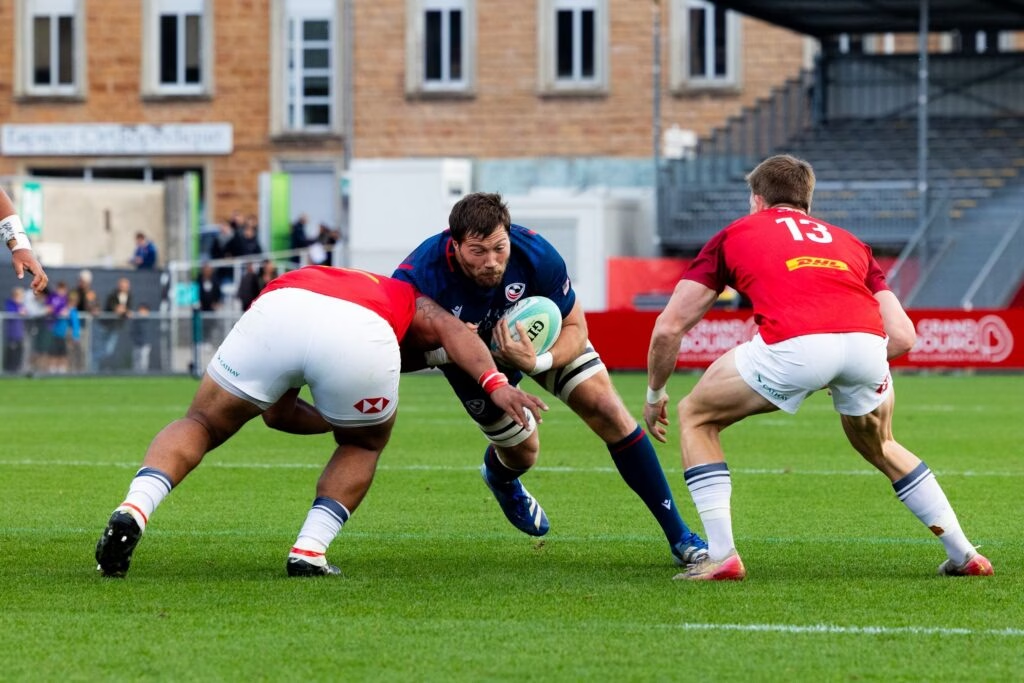
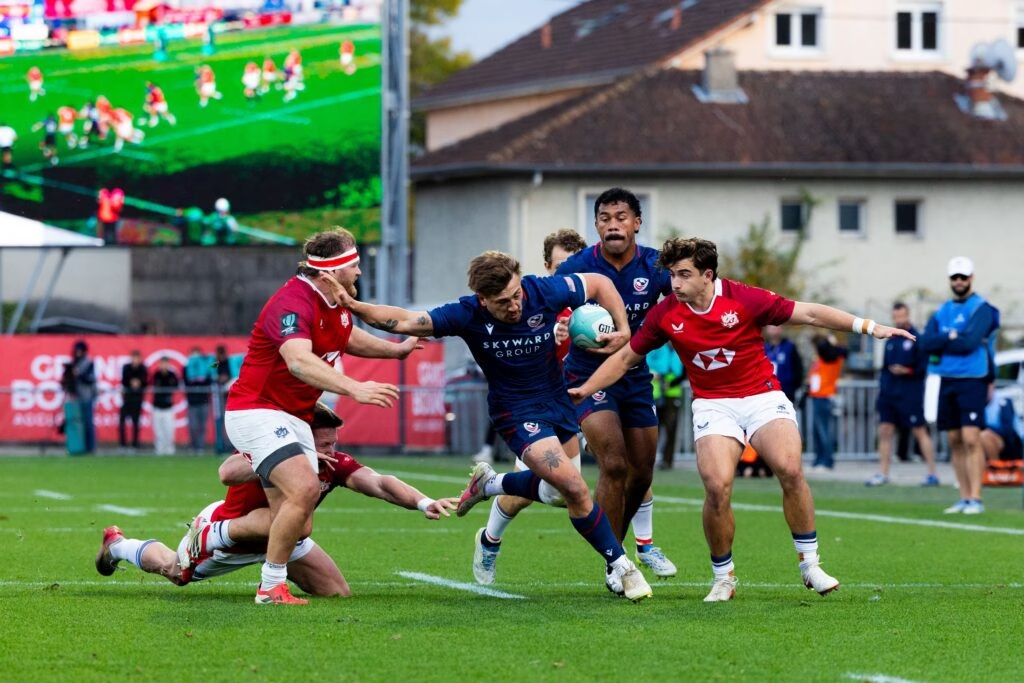
The United States dominates possession and territory but needs Kaleb Geiger’s 76th-minute try and Christopher Hilsenbeck’s conversion to survive a major scare in France and strengthen its pursuit of the inaugural Nations Cup Pool A title.
Halftime: Hong Kong China 17–14 USA
The United States men’s national rugby team escaped with a dramatic 28–26 victory over Hong Kong China on Sunday, November 8, overcoming a five-point deficit in the closing minutes to preserve its unbeaten record in the inaugural World Rugby Nations Cup.
Replacement hooker Kaleb Geiger scored the decisive try in the 76th minute, and fly-half Christopher Hilsenbeck converted to give the Eagles a two-point lead they would not relinquish.
The victory improved the United States to 4–0, strengthening its position in the race for the inaugural Pool A championship.
But the final score only begins to explain the afternoon.
According to match data from Rugby Fan Central’s Match Centre, the Eagles controlled 62% of possession, enjoyed 59% of territory, carried the ball 139 times and won 98 rucks.
Hong Kong China managed just 38% possession and 82 carries.
Yet the Americans trailed at halftime, briefly took the lead in the second half, then fell behind again and needed a late rescue to avoid an upset.
The difference was efficiency.
Hong Kong China made the most of its opportunities, scoring two tries and adding four penalties. The United States generated considerably more attacking volume but undermined that advantage with 12 penalties conceded, turnovers and defensive mistakes.
Even two Hong Kong China yellow cards failed to produce the decisive advantage the Eagles might have expected.
For head coach Scott Lawrence, the result delivered another Nations Cup victory while providing plenty of evidence of where his team must improve.
Four wins from four: USA’s Pool A title ambitions
The United States entered November alongside Georgia as the only unbeaten teams in the Nations Cup. Both maintained their perfect records in round four, with Georgia defeating Canada 59–14 in Tbilisi.
The competition features 12 teams divided into two pools of six. Each nation plays opponents from the opposite pool across the July and November international windows, with a separate champion crowned from each pool after six rounds.
The Eagles compete in Pool A alongside Canada, Chile, Samoa, Tonga and Uruguay. Pool B features Georgia, Hong Kong China, Portugal, Romania, Spain and Zimbabwe.
The tournament is part of World Rugby’s reformed international calendar, designed to provide regular competition for Rugby World Cup-qualified nations outside the Nations Championship. It is scheduled to take place in even-numbered years.
USA NATIONS CUP RESULTS 2026
Three of the Eagles’ four victories have been decided by seven points or fewer. Only the 31–15 victory over Zimbabwe produced a margin greater than one converted try.
Hong Kong China capitalizes on early American mistake
The Eagles’ afternoon began badly.
Just five minutes into the contest, Hong Kong China center Marcus Ramage charged down a clearing kick from American fullback Perry Mayo, gathered possession and scored the opening try.
Nathan de Thierry converted to give Hong Kong China a 7–0 lead.
Mayo responded almost immediately, crossing for a try at 09:03 on the match clock, in the tenth minute. Hilsenbeck converted to tie the match.
Hong Kong China then suffered its first disciplinary setback when winger Harry Sayers received a yellow card at 10:26, temporarily reducing his side to 14 players.
The Americans took advantage of the numerical superiority.
No. 8 Jamason Fa’anana-Schultz scored at 18:29, finishing a close-range attack by the American forwards. Hilsenbeck added the conversion, putting the Eagles ahead 14–7.
At that stage, the United States appeared to have settled into the match.
But Hong Kong China remained dangerous whenever it found space.
De Thierry kicked a penalty in the 27th minute to narrow the deficit to four points.
Then, in the 38th minute, flanker Jack Bartlett broke through the American defense and raced away for a spectacular long-range try.
De Thierry’s conversion restored Hong Kong China’s lead, 17–14, heading into halftime.
The Americans had scored twice and enjoyed a period playing against 14 men, but they had failed to establish control of the scoreboard.
Two yellow cards, but little advantage for the Eagles
One of the most revealing aspects of the match was the United States’ inability to fully capitalize on Hong Kong China’s disciplinary problems.
Sayers’ first-half yellow card gave the Americans a numerical advantage during which Fa’anana-Schultz scored a converted try.
However, the Eagles failed to build on that seven-point return.
The pattern repeated after halftime.
Hong Kong China captain Joshua Hrstich received a yellow card at 40:16, giving the Eagles another opportunity to attack against 14 players.
This time, the Americans failed to score at all during the ten-minute sin-bin period.
Hong Kong China survived the disadvantage without conceding a point and subsequently extended its lead through de Thierry’s penalty in the 57th minute.
The Eagles finally responded when sustained forward pressure produced a penalty try at 58:36, putting them ahead 21–20.
But that score came more than eight minutes after Hrstich’s standard sin-bin period had ended.
Hong Kong China was not finished.
Dylan McCann kicked a penalty at 64:39 to restore a 23–21 lead, then added another at 70:07 to extend the advantage to 26–21.
With fewer than ten minutes remaining, the United States was facing its first Nations Cup defeat.
Geiger provides the late breakthrough
Geiger entered the match in the 57th minute, replacing starting hooker Shilo Klein.
With the Americans trailing by five points, the replacement forward forced his way across the try line at 75:58 on the match timeline.
The score tied the contest at 26–26.
Hilsenbeck stepped up for the conversion and delivered, putting the United States ahead 28–26 with just over three minutes remaining.
The Eagles held on to secure their fourth consecutive Nations Cup victory.
Geiger’s impact highlighted the importance of the American bench, with fresh forwards helping maintain pressure late in the contest.
The Eagles finished with three scored tries — from Mayo, Fa’anana-Schultz and Geiger — plus a penalty try awarded in the second half.
Hilsenbeck converted all three scored tries, and the penalty try supplied an automatic seven points.
It was enough to win, but only just.
Inside the Numbers: How USA Nearly Lost a Match It Dominated
The complete match statistics reveal a sharp contrast between territorial control and scoreboard efficiency.
Match statistics from RFC’s Match Centre export. Higher values do not necessarily indicate better performance in every category.
More possession, but not enough penetration
The United States carried the ball 139 times compared with Hong Kong China’s 82, a difference of 57 carries.
The Eagles generated 379 metres from those carries, compared with 323 for Hong Kong China.
Despite the substantial difference in attacking volume, the gap in metres gained was comparatively small.
Hong Kong China averaged 3.94 metres per carry compared with the Americans’ 2.73, approximately 44% more per carry.
That comparison does not account for field position or the different circumstances in which carries occurred. Nevertheless, it illustrates how Hong Kong China remained competitive despite having substantially less possession.
The Eagles beat 25 defenders compared with Hong Kong China’s 14 and produced 11 offloads against three.
Those figures demonstrate the Americans’ ability to create attacking opportunities. The problem was converting them into points.
Penalties and turnovers kept Hong Kong China alive
The United States conceded 12 penalties compared with eight by Hong Kong China.
That difference proved costly because Hong Kong China scored 12 points from four successful penalty kicks, nearly half its final total.
Hong Kong China also won nine turnovers compared with five for the Eagles, repeatedly interrupting American attacking sequences.
Its defense completed 165 tackles and missed 25, while the United States completed 100 and missed 14. Calculated from those counts, Hong Kong China’s tackle completion rate was approximately 87%, compared with 88% for the Americans.
Despite facing substantially more defensive work, Hong Kong China maintained a comparable completion rate and generated enough turnovers to keep the contest close.
The American Set Piece Provided a Strong Platform
| Statistic | 🇭🇰Hong Kong China | 🇺🇸USA |
|---|---|---|
| Lineouts won | 12 | 14 |
| Lineout success | 75% | 88% |
| Scrums won | 3 | 2 |
| Scrum success | 50% | 100% |
| Rucks won | 52 | 98 |
| Ruck success | 96% | 96% |
The Eagles won 88% of their lineouts and maintained 96% ruck success, matching Hong Kong China’s breakdown efficiency while completing substantially more rucks.
The scrum figures reflect a relatively small number of recorded scrums and should not be overinterpreted.
Overall, the set-piece and breakdown statistics reinforce the same conclusion: the United States had a reliable platform from which to control the match, but did not consistently translate that control into scoreboard pressure.
Individual performances: Mayo, Damm and Fa’anana-Schultz lead the way
Perry Mayo — Fullback: Recovered from the early charged-down kick to score the Eagles’ opening try. Mayo finished with 19 carries, 79 metres gained, 15 carries across the gain line and nine catches from kicks, making him the leading American ball carrier by metres.
Jason Damm — Captain and lock: Recorded 17 carries, 12 carries across the gain line and five mauls won. His work reflected the Eagles’ emphasis on sustained forward possession and close-range attacking pressure.
Jamason Fa’anana-Schultz — No. 8: Scored the Eagles’ second try and finished with 13 carries, nine carries across the gain line and four defenders beaten.
Christopher Hilsenbeck — Fly-half: Converted all three American scored tries, including Geiger’s decisive late effort. His six points from the tee proved essential in a match decided by two, while he also contributed 280 metres from kicks out of hand.
Hong Kong China’s standout performers
Jack Bartlett — Flanker: Scored a long-range first-half try and recorded 60 metres carried. Bartlett previously played for Gloucester and Coventry and represented England at U18 and U20 level before moving to Hong Kong.
Marcus Ramage — Center: Scored the opening try following a charged-down kick, beat four defenders and won two turnovers. Ramage previously spent three seasons with Nottingham Rugby before returning to Hong Kong.
Harry Sayers — Wing: Recorded 64 metres carried, the second-highest individual total in the match, despite receiving an early yellow card.
Nathan de Thierry — Fly-half: Scored 10 points through two conversions and two penalties, beat four defenders and contributed 310 kicking metres.
Hong Kong China’s rise toward Rugby World Cup 2027
Hong Kong China is preparing for its first Men’s Rugby World Cup appearance after qualifying for the 2027 tournament in Australia.
Head coach Andrew Douglas, who previously coached Major League Rugby’s Old Glory DC, joined the national program in August 2023 and guided the team through successful 2024 and 2025 Asia Rugby Championship campaigns.
The program has developed a full-time training structure, bringing together players with experience in Hong Kong’s domestic Premiership and overseas professional competitions.
Sunday’s narrow defeat suggested that Hong Kong China is becoming a more competitive opponent as it prepares for its World Cup debut.
Complete Scoring Summary
| Minute | Scoring Event | Score (HKC–USA) |
|---|---|---|
| 5′ | Marcus Ramage try | 5–0 |
| 6′ | Nathan de Thierry conversion | 7–0 |
| 10′ | Perry Mayo try | 7–5 |
| 11′ | Christopher Hilsenbeck conversion | 7–7 |
| 19′ | Jamason Fa’anana-Schultz try | 7–12 |
| 20′ | Hilsenbeck conversion | 7–14 |
| 27′ | De Thierry penalty | 10–14 |
| 38′ | Jack Bartlett try | 15–14 |
| 39′ | De Thierry conversion | 17–14 |
| 57′ | De Thierry penalty | 20–14 |
| 59′ | USA penalty try | 20–21 |
| 65′ | Dylan McCann penalty | 23–21 |
| 71′ | McCann penalty | 26–21 |
| 76′ | Kaleb Geiger try | 26–26 |
| 77′ | Hilsenbeck conversion | 26–28 |
Scoring times rounded from Rugby Fan Central Match Centre data.
What’s next: USA faces Romania in Bucharest
The Eagles now travel to Romania for their fifth Nations Cup match on Saturday, November 14, at Stadionul Național Arcul de Triumf in Bucharest.
🇷🇴 Romania vs. USA 🇺🇸
Round 5
Saturday, November 14, 2026
11:30 a.m. ET · 10:30 a.m. CT · 6:30 p.m. local
Stadionul Național Arcul de Triumf, Bucharest
Paramount+ (United States)
Romania enters the contest following a 43–38 defeat to Tonga on November 6, in which both teams scored six tries.
The result demonstrated Romania’s attacking potential but also exposed defensive vulnerabilities that the Americans will look to exploit.
For the Eagles, the challenge is to reduce costly penalties, improve defensive consistency and make better use of their attacking opportunities.
The bottom line: unbeaten, but with work to do
Four victories from four Nations Cup matches represent encouraging progress for the Eagles.
The United States has demonstrated resilience, produced decisive moments from its replacements and found ways to win matches that could easily have slipped away.
Geiger’s late try and Hilsenbeck’s conversion were the clearest examples of that determination against Hong Kong China.
But Hong Kong China deserves considerable credit for pushing an unbeaten opponent to the final minutes despite spending much of the match without the ball.
The Eagles leave France with their perfect record intact, their Pool A championship ambitions alive and another reminder that statistical superiority does not guarantee victory.
Winning close matches is a valuable skill. Learning how to avoid making them close in the first place could be even more important.