
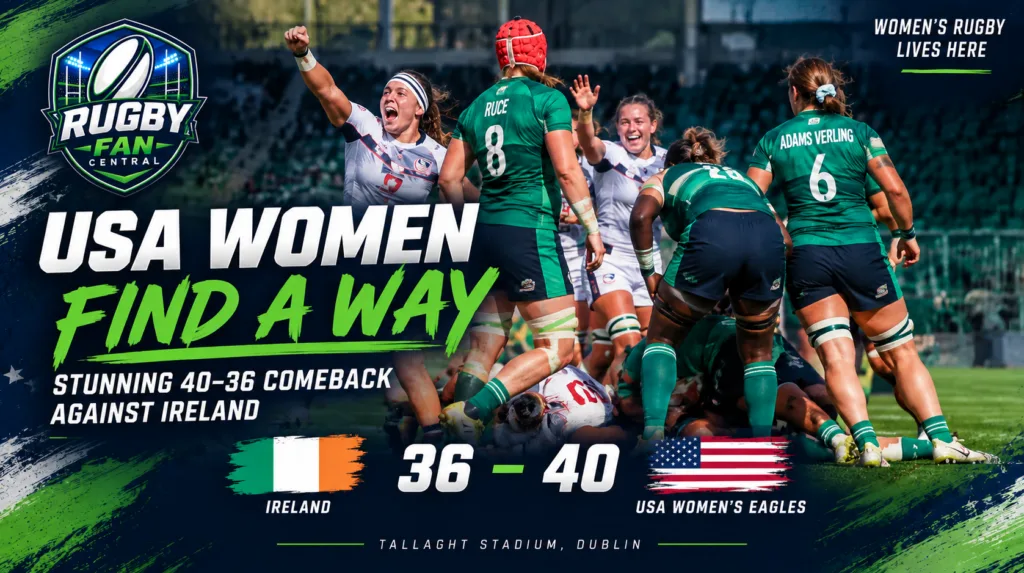
Ireland 36–40 USA | WXV Global Series | Tallaght Stadium, Dublin
There are victories that look good in the results column, and then there are victories that make you wonder whether you have just watched a team discover something about itself.
The USA Women’s Eagles’ 40–36 victory over Ireland in Dublin felt like the latter.
Not because it was perfect. Far from it. Ireland tore into the Eagles from the opening whistle, scoring three tries inside the first 20 minutes and racing into a 17–0 lead. The hosts played with pace and confidence, and for a while the USA looked in danger of being blown away.
But they weren’t.
The Eagles found a way into the match. Then they found their forwards. Then they found their maul. By the second half, Ireland couldn’t stop them.
The USA trailed 24–12 at halftime and 31–12 early in the second half. They were 19 points down, away from home against one of the leading teams in the world, and the match appeared to be slipping away.
Instead, the Eagles scored 28 unanswered points, turning that 31–12 deficit into a 40–31 lead before surviving a late Ireland try to win 40–36.
It was one of those stretches of rugby where everything suddenly seemed to click. Watching it as a USA rugby fan, three things really stood out: Abigail Paton at scrum-half, the relationship at nine and ten, and a USA driving maul that looked as dangerous as we have seen it in a long time.
Abigail Paton was outstanding at No. 9
Let’s start with USA scrum-half Abigail Paton.
From a fan’s perspective, she was one of the standout performers. The statistical feed doesn’t give us the passing, kicking and breakdown numbers needed to quantify everything she did, but you could see her influence on the way the Eagles played.
As the USA settled into the match, the attack became increasingly connected. The service looked sharp, the Eagles began generating better tempo around the breakdown and the forwards started receiving the ball in positions where they could do damage.
Paton was right in the middle of it.
What stood out was the sense of control. The Eagles have powerful individual ball carriers, but against Ireland they increasingly looked like those pieces were working together rather than simply taking turns trying to break the defensive line.
Paton also had a direct hand in one of the biggest moments of the comeback. With Ireland suddenly under enormous pressure, she supplied the pass that released Freda Tafuna through a defensive gap for the Eagles’ sixth try. USA Rugby specifically highlighted Paton’s assist in its account of the score.
Tafuna deservedly received the official player-of-the-match honor, but Paton’s performance at nine deserves plenty of attention too.
The USA had something working at 9–10
Alongside Paton was Annabella “Bella” Vogel at fly-half, and their combination was one of the most encouraging parts of the afternoon.
Some of this is observation rather than something we can measure from the available statistical feed, but the Eagles appeared increasingly comfortable operating through their halfbacks as the match developed. Paton provided tempo from the base while Vogel gave the USA composure outside her.
Vogel also supplied something that becomes extremely important in a four-point international: points.
She converted five of the USA’s six tries, finishing with 10 points from the tee. Both teams scored six tries, but Ireland converted only three of theirs. That difference in conversion success ultimately accounts for the four-point margin on the scoreboard.
There was also an important connection between the USA’s kicking game and its most destructive attacking weapon. When Ireland conceded penalties, the Eagles were able to turn them into attacking lineouts, and those lineouts increasingly became a major problem for the Irish defense.
The personnel changed later in the match, with Nina Mason making her Eagles debut at fly-half as the USA adjusted its backline. USA Rugby said Mason settled into the role seamlessly.
So the entire comeback shouldn’t be attributed solely to Paton and Vogel. But the combination gave the Eagles something to build from, and for a USA team looking for combinations that can carry forward, what we saw around nine and ten was encouraging.
And then there was that maul
This might have been the most exciting part of the entire performance.
When was the last time the Women’s Eagles maul looked this dangerous?
For a period in the second half, Ireland knew exactly what was coming and still couldn’t stop it. That’s the difference between simply having a maul and having a genuine attacking weapon.
Kathryn Treder scored twice from close range as the USA’s set piece began taking over the match. Her first came in the 56th minute. Ireland’s Vicky Elmes Kinlan was then shown a yellow card in the 63rd, and Treder crossed again almost immediately. Four minutes later, Hallie Taufoou scored as the Eagles continued to turn pressure into points.
USA Rugby described the Eagles as coming out after halftime with improved set-piece execution and unleashing a driving maul Ireland could not stop.
That assessment wasn’t limited to the American side. Irish Rugby’s own match account described the USA maul as a “massive weapon” as Ireland struggled to contain the Eagles close to the line.
And that’s important, because this wasn’t simply a case of American fans getting excited about a few strong carries. Ireland knew where the pressure was coming from and couldn’t consistently deal with it.
What made the maul particularly impressive was that it wasn’t just about power. A dominant international maul requires the lineout to function, the catch to be clean, the transfer to work, body height to stay low, the ball to remain protected and the pack to react when the defense changes shape.
The Eagles did those things repeatedly.
Ireland knew where the ball was going. The USA kept going there anyway.
For American rugby, that should be exciting. Physicality has rarely been the question. Turning that physicality into a technically sound, repeatable attacking platform is something different.
This looked repeatable.
Fifteen minutes that changed everything
The scale of the turnaround is worth appreciating.
Ireland scored shortly after halftime and converted to extend its lead to 31–12. At that point, the hosts were 19 points ahead.
Then Kathryn Treder scored and Vogel converted. 31–19.
Treder scored again and Vogel converted. 31–26.
Hallie Taufoou crossed and Vogel added another two. USA 33–31.
Then Freda Tafuna burst through for the sixth American try and Vogel converted again. USA 40–31.
The Eagles had scored four converted tries and 28 unanswered points in roughly 15 minutes.
Think about what happened there.
The USA didn’t merely erase a 19-point deficit. They turned it into a nine-point lead.
And they didn’t do it through an interception, a lucky bounce and a couple of moments of chaos. They did it by taking control of the rugby match.
That’s what makes this performance so interesting.
The USA forwards took over
Look at the American try scorers: Georgie Perris-Redding, Hope Rogers, Kathryn Treder twice, Hallie Taufoou and Freda Tafuna.
Every USA try was scored by a forward.
That is quite a statement from the American pack.
It may also tell us something about what this USA team can become. The Eagles didn’t beat Ireland by trying to become Ireland. They found something that looked distinctly American: powerful carriers, aggressive forwards, a destructive set piece and enough control around the halfbacks to put those weapons in the right places.
When those ingredients came together, Ireland had enormous problems stopping them.
There was something else encouraging about the comeback too. The USA didn’t weaken when the replacements arrived.
They got stronger.
Nina Mason made her Eagles debut. Kapoina Bailey entered the contest. Erica Jarrell-Searcy added another physical presence, while the Eagles were also able to bring the experience of Kate Zackary from the bench.
Head coach Jack Hanratty emphasized afterward that this had been a complete squad performance. He called it a “23 job” and praised the impact of the replacements.
International teams don’t just need substitutes. They need players who can enter after 50 or 60 minutes and make the game more uncomfortable for the opposition.
The USA bench did exactly that.
The first 20 minutes still matter
For all the excitement about the comeback, there is another side to this performance.
The Eagles cannot regularly give international teams a three-try head start and expect to survive.
Ireland scored in the seventh, 14th and 19th minutes. By the end of the opening quarter, the USA were 17–0 down.
The hosts’ pace caused problems, the USA defense struggled to settle and Ireland was able to find space far too easily. The Eagles eventually reached halftime trailing 24–12 before Ireland stretched the advantage to 31–12 after the restart.
That has to be examined.
The Eagles won’t always be able to score 40 points to escape from a start like that.
But there is an important difference between identifying problems after another defeat and watching a team recognize those problems, adjust and solve them during the match.
That’s what the USA did in Dublin.
BY THE NUMBERS
The numbers behind an extraordinary USA comeback in Dublin.
Four converted tries turned a 31–12 deficit into a 40–31 USA lead.
This felt like something
Ireland wasn’t finished.
Dorothy Wall scored in the 79th minute to cut the American advantage to four points. The conversion was missed, leaving Ireland one final opportunity to steal back a match that had seemed firmly under its control less than half an hour earlier.
But the Eagles finished it.
Ireland 36. USA 40.
And maybe that’s the lasting impression from Dublin.
Not simply that the USA won, but how they won.
They were hit hard early and went 17–0 behind. They worked their way back into the match, only for Ireland to stretch the lead to 19 points after halftime. And instead of panicking or abandoning their structure, the Eagles leaned harder into what was beginning to work.
Paton impressed at nine. Vogel provided control and points. The replacements added something. The forwards took over.
And the maul became almost inevitable.
For a period in that second half, everybody watching knew what the USA wanted to do. Ireland knew what the USA wanted to do.
And Ireland still couldn’t stop it.
That’s the part of this victory that should have American rugby fans excited.
One match doesn’t mean everything is fixed, and one comeback doesn’t tell us where this team will ultimately go. The opening 20 minutes showed there is still plenty to work on.
But sometimes a performance gives you a glimpse of what a team could become.
For about 20 extraordinary minutes in Dublin, the Women’s Eagles gave us one.
And it was a lot of fun to watch.