World Rugby has extended its size 4.5 rugby ball trial throughout the 2027 HSBC SVNS season after research identified faster ruck speeds, improving passing rates and no significant deterioration in goal-kicking accuracy. However, questions remain over its potential adoption in women’s fifteens rugby.
World Rugby has confirmed that its bespoke women’s rugby ball trial will continue for a second season across all levels of the HSBC SVNS Series and World Championship.
The announcement, made on November 24, 2026, comes just four days before the opening HSBC SVNS 1 tournament in Dubai and follows an extensive evaluation of the ball’s performance during the 2025/26 international women’s sevens season.
The research examined 1,395 matches across five seasons, comparing the performance of the bespoke size 4.5 ball against historical trends established using the traditional size 5 rugby ball.
While ruck speeds improved and passing rates increased throughout the trial season, most performance metrics remained consistent with historical trends. World Rugby characterized the overall findings as positive to neutral.
The decision extends the research period rather than introducing a permanent change to the Laws of the Game, with the future of the smaller ball in women’s fifteens still under consideration.
What Has World Rugby Learned From the First Season?
World Rugby’s evaluation combined match-performance analysis with feedback from more than 130 elite women’s sevens players and 18 coaches.
The performance research compared the 2025/26 small-ball season against the trajectories of four previous seasons using the traditional rugby ball.
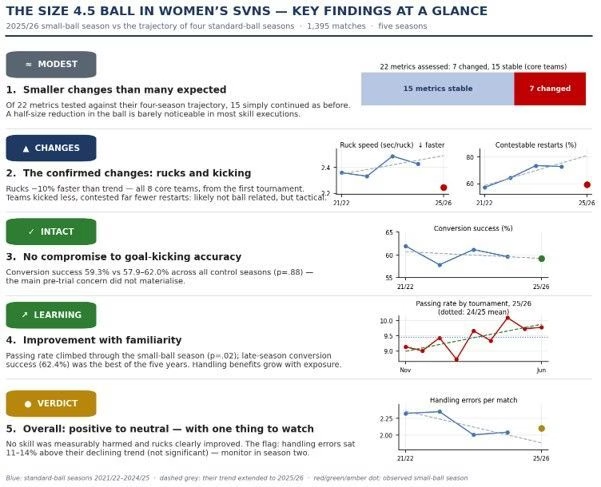
Of the 22 performance metrics assessed across the eight core teams, 15 remained consistent with historical trends, while seven showed changes.
Importantly, seven changed metrics do not necessarily mean seven improvements.
Source: World Rugby performance research graphic.
Key Performance Findings
| Performance Indicator | Initial Findings |
|---|---|
| Matches analyzed | 1,395 |
| Seasons analyzed | Five |
| Performance metrics assessed | 22 |
| Metrics remaining stable | 15 |
| Metrics showing changes | 7 |
| Players consulted | More than 130 |
| Coaches consulted | 18 |
| Positive-to-negative sentiment | 4:1 |
| Ruck speed | Approximately 10% faster than historical trend |
| Passing rates | Four-year declining trend reversed |
| Overall conversion success | 59.3% |
| Historical conversion success | 57.9–62.0% |
| Late-season conversion success | 62.4% |
| Handling errors | 11–14% above projected trend; not statistically significant |
| Overall research assessment | Positive to neutral |
Source: World Rugby media release, November 24, 2026 , and accompanying performance research infographic, The Size 4.5 Ball in Women’s SVNS: Key Findings at a Glance.
World Rugby reported a four-to-one ratio of positive to negative sentiment from its consultation process.
While encouraging, this should not be interpreted as confirmation that 80% of players support permanent adoption. The published ratio describes the balance of reported sentiment rather than necessarily representing an individual vote on changing rugby’s equipment requirements.
Faster Rucks and Improving Passing Rates
One of the clearest findings from the research was the improvement in ruck speed.
Rucks were approximately 10% faster than their projected historical trend, with the improvement observed across all eight core teams from the first tournament.
Passing rates also increased throughout the trial season, reversing a four-year declining trend. The increase during the season was statistically significant (p = 0.02).
World Rugby’s findings suggest that some handling benefits may develop as players become increasingly familiar with the ball.
However, changes in performance cannot automatically be attributed to the equipment alone. Coaching, tactical developments, competition structures and player development may also influence the results.
The research identified reductions in kicking frequency and contested restarts, but suggested these were more likely attributable to tactical changes than to the ball itself.
Goal-Kicking Accuracy Remains Consistent
One of the principal concerns surrounding the introduction of a smaller rugby ball was whether it would negatively affect kicking accuracy.
World Rugby’s research found that overall conversion success during the 2025/26 trial season was 59.3%, compared with a range of 57.9% to 62.0% across the four previous seasons.
The difference was not statistically significant (p = 0.88).
0%20%40%60%80%Historical lowHistorical highTrial seasonLate trial seasonSource: World Rugby performance research graphic. Historical figures represent the lowest and highest conversion success rates across the four control seasons.
Late-season conversion success reached 62.4%, which World Rugby identified as the best of the five years examined.
The distinction between overall season performance and late-season improvement is important. Although overall conversion accuracy remained consistent with historical performance, the later results suggest that increasing familiarity with the ball may have contributed to improved execution.
The findings do not establish that the smaller ball improves goal-kicking accuracy overall, but they indicate that the anticipated deterioration in conversion success did not materialize during the sevens trial.
Handling Errors Remain an Area to Monitor
Despite the encouraging results, World Rugby identified handling errors as an area requiring further monitoring.
Handling errors per match were approximately 11–14% above their projected declining trend during the 2025/26 season.
Although the difference was not statistically significant, the research identified it as an area to monitor during the second season of testing.
This does not establish that the smaller ball caused more handling errors. However, it is an important finding given that improving handling is one of the objectives behind the ball’s development.
The overall research assessment was positive to neutral, with no assessed skill shown to have been measurably harmed and ruck speed demonstrating a clear improvement.
How Is the Size 4.5 Rugby Ball Different?
The bespoke ball, developed with rugby ball manufacturer Gilbert, is not simply a conventional junior rugby ball being introduced into elite women’s competition.
It has been specifically designed for the women’s game, incorporating changes to its dimensions, grip, aerodynamic properties and kicking characteristics.
The ball is approximately 3% smaller than the traditional size 5 rugby ball while retaining a similar weight.
| Feature | Traditional Size 5 | Bespoke Size 4.5 |
|---|---|---|
| Size | Standard adult ball | Approximately 3% smaller |
| Weight | 410–460 grams under Law 2 | Similar to size 5 |
| Grip | Conventional match-ball design | Designed to assist handling |
| Aerodynamics | Conventional match-ball design | Modified aerodynamic properties |
| Kicking | Established design | Bespoke kicking sweet spot |
| Application | Standard adult rugby | Selected trial competitions |
Retaining a similar weight is an important design consideration, particularly given the potential effects of equipment changes on passing distance, kicking performance and ball flight.
The objective is to evaluate whether equipment specifically developed for women’s rugby can improve aspects of performance without compromising established skills.
How Did the Smaller Rugby Ball Trial Begin?
World Rugby’s research into alternative rugby ball designs predates the introduction of the bespoke ball into international women’s sevens.
Earlier trials included a lighter ball used during the Women’s Under-18 Six Nations in 2024, followed by additional testing in international, domestic and elite training environments.
The redesigned ball was subsequently introduced into international women’s sevens for the 2025/26 season before trials expanded into international women’s fifteens during 2026.
Rugby Ball Trial Timeline
| Period | Development |
|---|---|
| 2024 | An earlier, lighter version is trialed during the Women’s Under-18 Six Nations. |
| By November 2025 | Further trials include Under-20 internationals, domestic competitions in Spain and Colombia, and elite club training sessions. |
| November 2025 | The redesigned size 4.5 ball is introduced into international women’s sevens. |
| September–October 2026 | International fifteens trials take place during the WXV Global Series and Challenger. |
| November 2026 | World Rugby confirms a second season of testing across HSBC SVNS. |
| Early 2027 | Stakeholders consider the next steps for fifteens at the Shape of the Game meeting. |
| 2028 | Los Angeles hosts the Olympic Games. The permanent status of the ball remains undecided. |
The extension of the sevens trial provides World Rugby with another full season of competitive data and an opportunity to assess whether the initial findings can be sustained.
Why Is World Rugby Considering Different Equipment?
The research forms part of a broader discussion about whether sporting equipment should be designed specifically around the athletes using it.
Other sports already incorporate different equipment specifications. Women’s basketball uses a smaller basketball than men’s basketball, while women’s cricket uses a ball with different size and weight specifications.
In rugby, a smaller ball could potentially influence several aspects of the game, including grip, passing, offloading and ball control under pressure.
However, there is an important distinction between investigating equipment that could improve performance and suggesting that women cannot perform effectively using a traditional size 5 rugby ball.
Women have demonstrated exceptional handling, passing and kicking skills at the highest levels of international rugby using the existing equipment.
The question facing World Rugby is whether an alternative design offers measurable benefits without introducing disadvantages elsewhere in the game.
The initial research suggests that the overall impact may be more modest than some anticipated, with 15 of the 22 assessed performance metrics continuing along their historical trajectories.
Women’s Players Remain Divided Over the Smaller Ball
Despite the broadly encouraging sentiment reported during the sevens consultation, the introduction of a smaller rugby ball has generated debate within the women’s game.
England fly-half Zoe Harrison was among those to express opposition to the trial, raising concerns about changing equipment that players have used throughout much of their rugby careers.
Speaking to BBC Sport in May 2026, Harrison highlighted her experience of using a size 5 ball since the age of 14 and raised concerns about the effect of a smaller ball on kicking.
Other international players have discussed the adjustments required when using the bespoke ball.
Wales hooker Kelsey Jones discussed adapting her lineout throwing technique, while England fullback Ellie Kildunne identified differences when attempting spiral kicks during the fifteens trial.
Their experiences illustrate why feedback from different playing positions is important.
A scrum-half, hooker, fly-half and fullback may experience the same equipment change differently because of the specific skills required by their positions.
The positive sentiment reported during the sevens trial is therefore an important consideration, but it should not be treated as a substitute for position-specific feedback or the experiences of players in fifteens rugby.
Why Sevens and Fifteens Need Separate Evaluations
Although rugby sevens and fifteens share the same fundamental principles, their tactical and technical demands differ considerably.
| Area | Rugby Sevens | Rugby Fifteens |
|---|---|---|
| Players per team | 7 | 15 |
| Standard match duration | 14 minutes | 80 minutes |
| Attacking emphasis | Space, speed and distribution | Structured and open-field attack |
| Lineouts | Smaller formations | More complex formations |
| Kicking | Restarts, conversions and tactical opportunities | Broader tactical kicking requirements |
| Positional specialization | Generally less pronounced | Greater specialization |
World Rugby’s analysis found no statistically significant deterioration in conversion accuracy during the women’s sevens trial. However, this does not necessarily establish how the smaller ball would affect the broader tactical kicking requirements of fifteens rugby.
Territorial kicking, touch-finding, tactical kicking under pressure and other position-specific skills require separate evaluation.
Lineout throwing, longer passing sequences and handling in more congested defensive environments may also present different challenges.
Similarly, the handling-error findings from sevens underline the importance of examining how the ball performs across different playing positions and match situations in fifteens rugby.
Positive results in one format should not automatically be treated as evidence that the same outcomes will occur in the other.
World Rugby: Decisions Must Be Evidence-Led
World Rugby’s Chief Player Welfare and Rugby Services Officer, Mark Harrington, has emphasized the importance of continuing to gather evidence and feedback before determining the future of the bespoke ball.
The extension provides another season in which researchers can evaluate performance trends, player experiences and the effects of increasing familiarity with the equipment.
World Rugby’s Chief of Women’s Rugby, Sally Horrox, has also highlighted the importance of listening to players and ensuring that developments within the women’s game are informed by their experiences.
The latest findings provide a basis for continued research, but they do not represent a decision to introduce the smaller ball permanently across women’s rugby.
The second season will be particularly important in determining whether the observed improvements in ruck speed and passing rates are sustained and whether handling errors return to their historical declining trend.
What Happens Next in Women’s Fifteens Rugby?
The international women’s fifteens trials conducted during the WXV Global Series and Challenger concluded in October 2026.
World Rugby is evaluating the findings and feedback from those competitions, with the next steps expected to be considered at the Shape of the Game meeting in early 2027.
That process will provide an opportunity for players, unions and other stakeholders to consider the evidence and discuss the future direction of the trial.
Under World Rugby Law 2, the traditional adult rugby ball must meet established specifications relating to its dimensions and weight.
Law 2.4 permits balls of different sizes for matches involving young players. That existing provision is distinct from the current elite women’s rugby trial.
The extension of the HSBC SVNS trial does not establish a universal requirement for women’s rugby to use a different ball from men’s rugby.
No permanent gender-specific equipment requirement has been announced.
What Could a Smaller Rugby Ball Mean for American Rugby?
For American rugby, the most immediate impact will be experienced by the USA Women’s Eagles Sevens as they prepare for another HSBC SVNS season using the bespoke ball.
Having competed with the equipment throughout the previous season, the Eagles will have an opportunity to build on their existing experience rather than adjust to an entirely new match ball.
The second season could provide additional insight into whether familiarity with the equipment contributes to improvements in passing, handling and kicking execution.
The potential implications for American fifteens rugby are more complex.
If World Rugby eventually decides to introduce the smaller ball permanently into international women’s fifteens, domestic competitions and development pathways may need to consider how their equipment policies align with international rugby.
That could have implications for Women’s Elite Rugby (WER), National Intercollegiate Rugby Association (NIRA), National Collegiate Rugby (NCR), College Rugby Association of America (CRAA), senior club rugby and youth development programs.
However, no requirement for these competitions or organizations to adopt the bespoke ball has been established by the current trial extension.
Equipment Costs and Grassroots Rugby
Any potential wider adoption would also raise practical questions beyond elite performance.
American rugby clubs and college programs operate with widely varying financial resources. Many rely on membership fees, fundraising, volunteers and limited equipment budgets.
Introducing a new match-ball specification could create additional costs if organizations were required to replace existing training and match balls.
Questions would also arise over whether teams should train with the same ball used in international competition and how players transitioning between domestic and international environments would adapt.
These are considerations that would need to be addressed if the trial progresses toward wider implementation.
What Questions Still Need to Be Answered?
World Rugby’s research infographic provides considerably more detail than the headline findings alone, particularly regarding conversion accuracy, historical performance trends and handling errors.
Nevertheless, important questions remain before the long-term implications of the bespoke ball can be fully assessed.
| Area | Outstanding Questions |
|---|---|
| Ruck speed | What were the precise average ruck times across each of the five seasons? |
| Passing and handling | How did pass completion, offloading and handling errors vary by playing position and match situation? |
| Goal-kicking | What factors contributed to the improvement in late-season conversion accuracy, and can it be sustained? |
| Handling errors | Will handling errors return to their historical declining trend during the second season? |
| Research methodology | How were tactical developments, competition formats and player development accounted for? |
| Player welfare | Did injury surveillance identify any changes associated with the trial? |
| Fifteens performance | How do the sevens findings compare with the results of the WXV trials? |
| Implementation costs | What would wider adoption cost domestic competitions, colleges and grassroots clubs? |
Publication of more detailed research methodology and performance data would help players, coaches, governing bodies and independent analysts better understand the findings.
It would also help distinguish between improvements associated with the trial period and improvements that can be directly attributed to the ball.
Los Angeles 2028: An Important Milestone
The continuation of the trial comes at an important stage in the international rugby sevens calendar, with the Los Angeles 2028 Olympic Games less than two years away.
Equipment consistency could become an important consideration as national teams prepare for Olympic qualification and competition.
For the United States, hosting the Olympic Games presents a significant opportunity to increase the visibility of rugby and build on the growing profile of the women’s sevens program.
Continuing with the same ball for another HSBC SVNS season provides players and coaches with additional time to develop familiarity with its characteristics.
However, the extension should not be interpreted as confirmation that the bespoke size 4.5 ball will become the permanent equipment standard for the Los Angeles Olympics.
No final decision has been announced.
The Road Ahead
World Rugby’s initial research presents a more nuanced picture than a straightforward endorsement of the smaller rugby ball.
Across 1,395 matches and five seasons, 15 of the 22 performance metrics assessed remained consistent with their historical trends. Ruck speeds improved, passing rates increased throughout the trial season, and overall conversion accuracy remained within historical levels.
However, handling errors remain an area for further monitoring, while some changes in kicking and restart tactics were considered more likely to reflect tactical developments than the introduction of the smaller ball.
World Rugby characterized the overall findings as positive to neutral, providing a basis for continued testing rather than establishing a case for immediate universal adoption.
The second season of the HSBC SVNS trial, alongside the evaluation of the WXV fifteens trials, will provide further evidence as World Rugby considers the future of the bespoke size 4.5 ball.
For now, the smaller ball remains part of an ongoing trial rather than a permanent change to the Laws of the Game.
Follow the 2027 HSBC SVNS Series
The 2027 HSBC SVNS 1 season begins in Dubai on November 28–29, with both the USA Men’s and Women’s Eagles Sevens competing in the top tier of international rugby sevens.
Follow the complete season on Rugby Fan Central, including fixtures, results, standings, team information and tournament coverage.
Visit the Rugby Fan Central HSBC SVNS 2027 Hub
Frequently Asked Questions
What size rugby ball is being used in women’s international sevens?
A bespoke size 4.5 ball is being used throughout the 2026/27 HSBC SVNS Series and World Championship as part of an ongoing World Rugby trial.
How much smaller is the bespoke rugby ball?
The bespoke ball is approximately 3% smaller than a traditional size 5 rugby ball but has been designed to retain a similar weight.
Has the smaller rugby ball improved performance?
World Rugby reported ruck speeds approximately 10% faster than historical trends and improving passing rates throughout the trial season. However, 15 of the 22 performance metrics assessed remained stable, and the overall research assessment was positive to neutral.
Has the smaller rugby ball affected goal-kicking accuracy?
Overall conversion success was 59.3% during the trial season, compared with 57.9–62.0% across the four previous seasons. The difference was not statistically significant. Late-season conversion success reached 62.4%.
Has the smaller rugby ball reduced handling errors?
World Rugby’s research found that handling errors were approximately 11–14% above their projected declining trend. The difference was not statistically significant, but researchers identified it as an area for further monitoring.
When will World Rugby decide on the smaller ball for women’s fifteens?
The next steps will be considered at the World Rugby Shape of the Game meeting in early 2027, following an evaluation of the WXV trials.
Is the size 4.5 ball mandatory for all women’s rugby?
No. The bespoke size 4.5 ball is being evaluated in selected competitions. The trial does not establish a universal gender-specific equipment requirement.
Will the smaller ball be used at the LA 2028 Olympic Games?
No final decision has been announced.
Sources and Further Reading
- World Rugby — Women’s specific ball trial extended for second season of HSBC SVNS Series November 24, 2026
- World Rugby — The Size 4.5 Ball in Women’s SVNS: Key Findings at a GlanceAccompanying performance research infographic.
- World Rugby — Expansion of women’s rugby ball trials into HSBC SVNS November 2025
- World Rugby — Laws of the Game: Law 2, The Ball
- BBC Sport — Zoe Harrison’s reaction to the smaller rugby ball trial May 6, 2026
- The Guardian — How the smaller ball trial in WXV has brought a ‘mixed bag of emotions’ September 8, 2026