
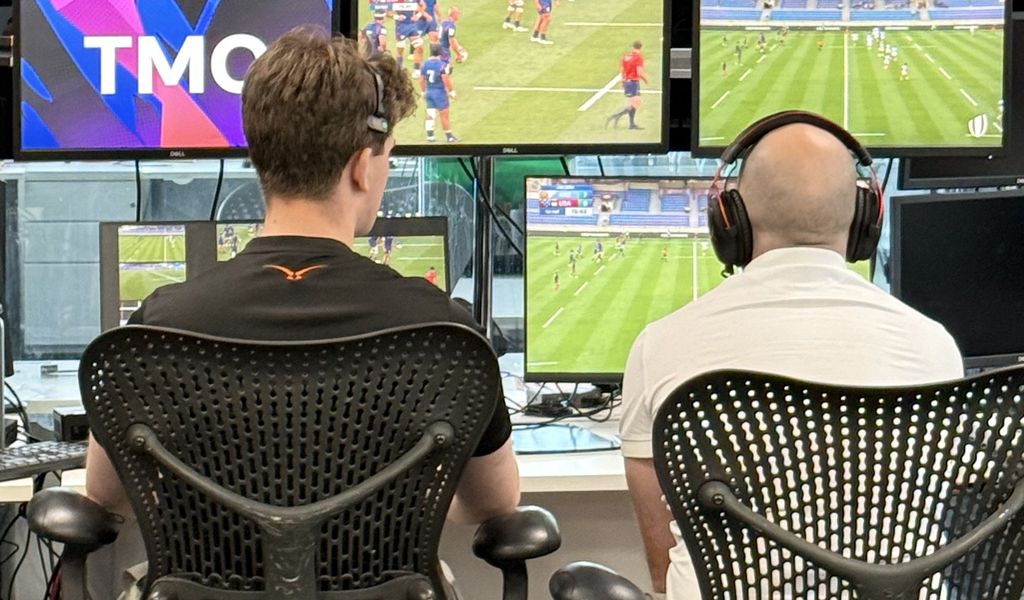
The Television Match Official isn’t going away—but where it operates from is changing.
World Rugby has announced a major overhaul of its officiating technology, with Television Match Officials (TMOs) set to work from a centralized hub during this summer’s World Rugby Nations Cup and World Rugby U20 Championship.
The trial is designed to give every TMO access to the same technology, the same camera angles, and greater control over the review process—an effort to improve consistency after years of debate over how video reviews are handled across different competitions.
At a Glance
The headline
TMOs will no longer work from the stadium. Instead, they’ll operate from a centralized hub in Basingstoke, England.
What’s changing?
Officials will have independent access to every available broadcast camera angle, while the TMO—not the television broadcaster—will control the footage shown to the referee.
Why now?
World Rugby wants to standardize officiating technology across international competitions, improving consistency while reducing operational costs.
When do the new standards apply?
International competitions must meet the new minimum technology standards by August 2027, although unions are encouraged to adopt them sooner.
Will it stop controversial decisions?
No. The changes standardize the evidence available to officials, but many decisions will still depend on how the laws are interpreted.
Why World Rugby Is Making the Change

Few aspects of modern rugby divide opinion quite like the TMO.
While video technology has helped officials make more accurate decisions, not every competition provides the same level of support. Different tournaments use different technology providers, different camera setups, and different review procedures. In some competitions, TMOs have access to every available replay. In others, they rely on the television broadcaster to supply footage during reviews.
That inconsistency came into sharp focus during the 2025/26 Investec Champions Cup semi-final between Bath and Union Bordeaux-Bègles. After the match, Bath Director of Rugby Johann van Graan questioned the review process following several dangerous tackle incidents that went unpunished, drawing attention to the different standards being used across competitions.
For World Rugby, the solution is straightforward: ensure every international TMO works with the same technology, the same camera access, and the same operating procedures.
A Different Way of Working
For the Nations Cup and World Rugby U20 Championship, TMOs will no longer be based inside the stadium.
Instead, they will operate from a dedicated World Rugby hub in Basingstoke in partnership with Hawk-Eye.
From there, officials will have access to:
- Every available broadcast camera angle.
- Independent control of replay footage.
- Split-screen viewing.
- Enhanced zoom functionality.
- Improved tools for reviewing tries, touchline decisions, and foul play incidents.
The biggest operational change is who controls the evidence.
Under the new system, the TMO—not the television broadcaster—decides which replays are shown to the referee. That removes a long-standing criticism that production decisions could influence what officials are able to review.
Instead, referees and TMOs will work directly from every available camera angle.
New Standards for International Rugby
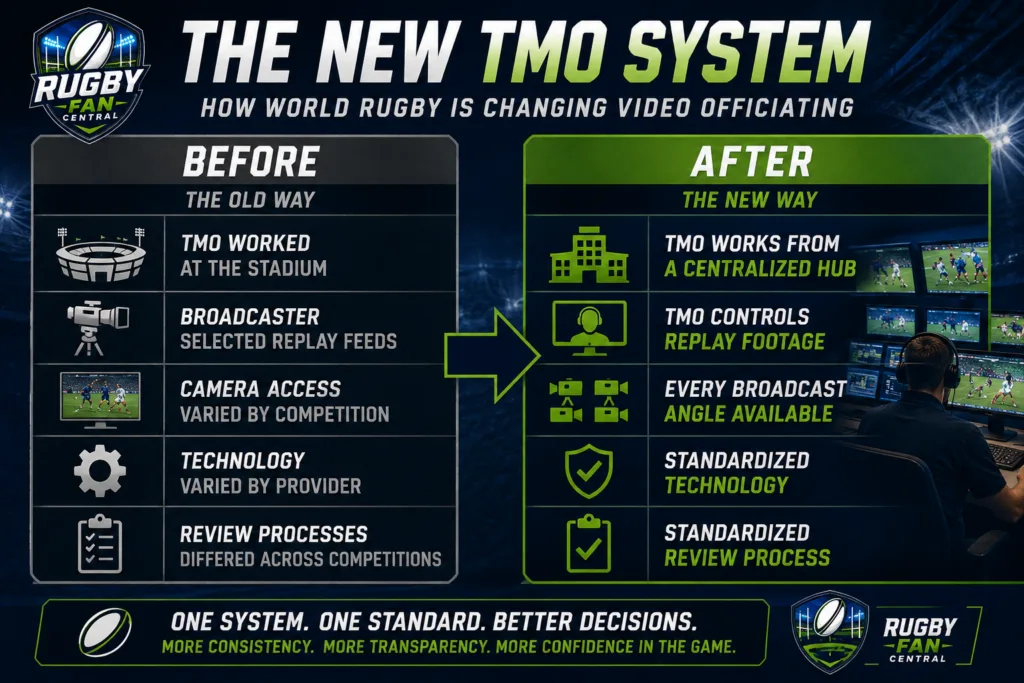
Alongside the trial, World Rugby has introduced new minimum technology standards that international competitions must meet by August 2027.
The standards require:
- Every broadcast camera angle to be available to the TMO and Foul Play Review Officer.
- The TMO to control the footage shown to the referee.
- TMO and Foul Play Review Officer operators to complete World Rugby accreditation.
- Technology providers to meet minimum operational standards for reviewing incidents efficiently.
These practices have already been used at recent Rugby World Cups. World Rugby now wants them to become the benchmark across all of its international competitions.
What Will Fans Notice?

For most supporters, the biggest change may not be what they see—but what they no longer hear.
If the trial is successful, there should be fewer situations where officials are unable to review an incident because the correct camera angle wasn’t available. Every international match will use the same review process and the same access to replay technology.
What won’t change is the referee’s role. The on-field official will still make the final decision after consulting the TMO.
Whether the television experience itself changes remains unclear. World Rugby has not announced any changes to referee audio, broadcast graphics, or whether viewers will see the same replay angles available to officials. For now, the focus is on improving decision-making behind the scenes rather than changing the broadcast.
The Challenges Ahead
Like any major change, the remote hub brings new questions.
Communication between the referee and a TMO working thousands of miles away will need to be seamless, particularly during fast-moving passages of play.
There is also a balance to strike between speed and accuracy. More replay tools should help officials make better-informed decisions, but additional camera angles can also encourage longer reviews if incidents require more detailed analysis.
A centralized operation creates another consideration. While it improves consistency and reduces costs, it also becomes a single point of failure. Any significant technical issue could potentially affect multiple matches rather than a single venue.
Some observers will also wonder whether officials lose part of the match-day context by working remotely rather than inside the stadium, where crowd reaction, player interaction, and the rhythm of the contest are easier to experience.
What We Still Don’t Know
The trial answers some long-standing questions, but others remain.
Will the additional technology actually reduce review times?
How quickly will referees and remote TMOs communicate during high-pressure moments?
Will broadcasters give viewers access to the same replay angles being used by officials?
Those answers are likely to emerge over the coming weeks as the Nations Cup and World Rugby U20 Championship provide the first real-world test of the system.
Better Evidence Doesn’t Remove Subjectivity
Perhaps the most important point is this: better technology doesn’t eliminate debate.
Rugby’s biggest officiating controversies rarely come down to missing camera angles. More often, they stem from how officials interpret head contact, mitigation, dangerous tackles, and foul play.
Two referees can watch the same six camera angles and still reach different conclusions.
This trial standardizes the evidence—not the judgement.
Supporters may see fewer debates about whether officials had access to the right replay, but disagreements over individual decisions are unlikely to disappear.
Not Every Competition Will Follow
The new standards apply to World Rugby’s international competitions, but they will not automatically extend across the professional club game.
Competitions such as the Investec Champions Cup and domestic leagues are encouraged to adopt similar technology and operating procedures, but World Rugby cannot require independent tournament organizers to do so.
For the foreseeable future, supporters should expect greater consistency at international level while differences remain between competitions.
World Rugby’s View
World Rugby Chief of Rugby Mark Robinson said the changes are intended to improve confidence in officiating while making better use of technology.
“The use of officiating technology is one of the most debated areas in our sport. It is important for match officials, teams, competition owners and fans that rugby has a consistent, effective and efficient environment in place that can be trusted to deliver the right outcome without impairing the game flow and experience.
“These innovations are the first steps in a deep dive review of this area. Not only will they aid on-field outcomes, but significantly they also support cost-effectiveness for the game.”
The Bigger Picture
This trial isn’t really about moving TMOs into a different building.
It’s about creating a more consistent officiating environment.
By giving officials independent control over replay footage and ensuring every international match has access to the same technology, World Rugby is addressing one of the sport’s genuine weaknesses: inconsistent access to evidence.
Whether the trial succeeds won’t be measured by the number of controversial decisions—those are part of rugby and always will be.
Instead, World Rugby will hope supporters come away believing every international match is reviewed under the same conditions, with the same technology and the same opportunity to reach the correct outcome.
If that happens, the remote TMO hub could become one of the most significant officiating developments since video review was first introduced to the international game.