
World Rugby’s latest report reveals how record audiences also brought record levels of online abuse—and why protecting players and match officials has become one of the sport’s biggest priorities.
By The Rugby Fan Central Team

Imagine walking off the field after playing in the biggest match of your career.
The crowd is still celebrating. Television cameras are following the winning team. Around the world, millions of supporters are sharing highlights from the match.
Then you unlock your phone.
Instead of congratulations, your social media feeds are filled with abuse.
Some messages criticise your performance.
Others attack your appearance.
Some question whether you belong in the sport at all.
According to World Rugby, that became the reality for a number of participants during Women’s Rugby World Cup 2025.
While the tournament will be remembered for record-breaking crowds, unprecedented audiences and unforgettable rugby, it also highlighted one of the fastest-growing challenges facing elite sport: protecting players and match officials from online abuse.
World Rugby’s newly released Social Media Protection Service Report found that monitored participants during Women’s Rugby World Cup 2025—including players, match officials and official tournament accounts—were 69 percent more likely to receive verified online abuse than those monitored during the Men’s Rugby World Cup 2023.
The comparison is based on the proportion of monitored accounts receiving verified abuse rather than a direct comparison of the total number of abusive posts. Even with that distinction, the findings provide one of the clearest pictures yet of the online challenges facing women’s rugby as the sport continues its rapid growth.
This is not simply a report about abusive comments.
It is a report about visibility, responsibility and how rugby is adapting to a world where elite athletes compete in two arenas—one on the field, and one online.
The Report at a Glance
World Rugby Social Media Protection Service Report
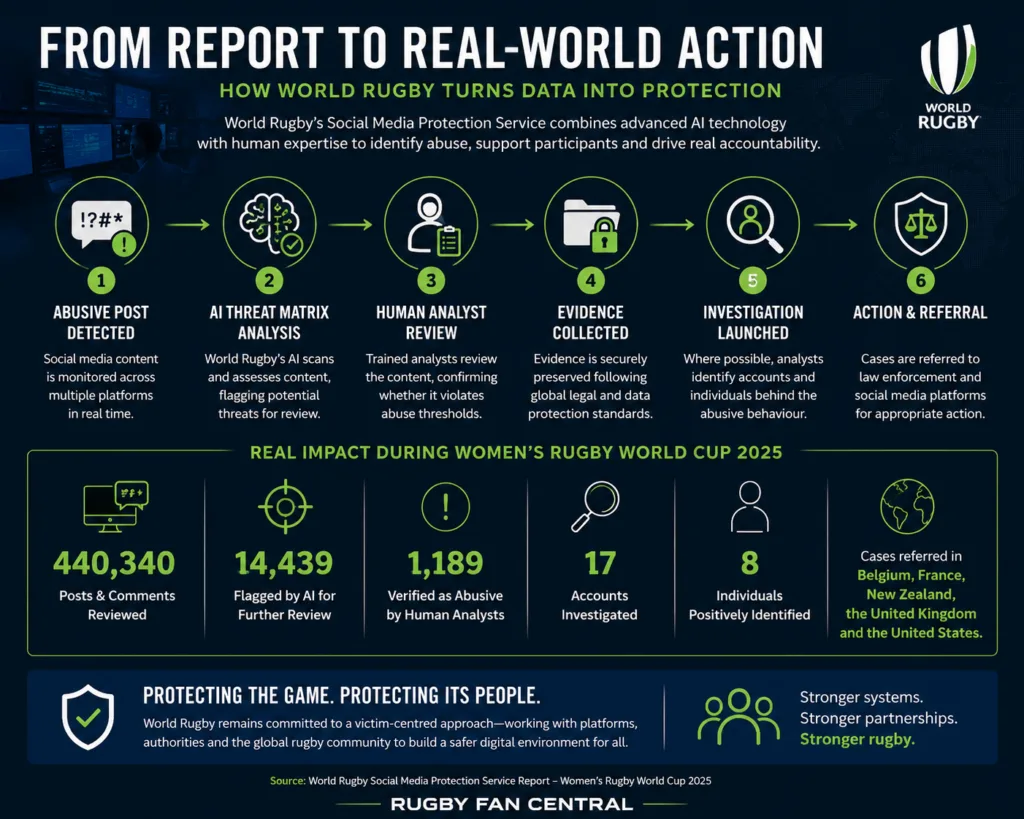
Women’s Rugby World Cup 202569%More Likely to Receive Verified AbuseWorld Rugby found that monitored participants during the Women’s Rugby World Cup 2025 were 69% more likely to receive verified online abuse than monitored participants during the Men’s Rugby World Cup 2023.440,340Posts & Comments Analysed14,439Flagged by Threat Matrix AI1,189Verified as Abusive45Monitored Accounts Targeted17Accounts Investigated8Individuals Positively Identified
Record Crowds, Record Attention
Women’s Rugby World Cup 2025 was unlike any tournament that came before it.
Across seven weeks, the women’s game reached audiences once considered out of reach.
The tournament sold 444,465 tickets, achieved 92 percent overall attendance, and culminated in a world-record crowd of 81,885 for the final. Millions more watched around the world, while tournament content generated more than 1.1 billion social media impressions, reflecting the growing global profile of women’s rugby.

Photo: Rugby Fan Central Team
For players, coaches and officials, those figures represent years of investment finally paying dividends.
Women’s rugby has never been more visible.
Broadcasters are investing.
Sponsors are paying attention.
Players are becoming recognised well beyond traditional rugby audiences.
Greater visibility brings enormous opportunities for the sport.
It also creates greater exposure to online audiences—and unfortunately, to those who use social media to intimidate, harass and abuse.
For years, conversations around player welfare have focused on concussion, injuries and recovery.
Increasingly, they also include what happens after the final whistle.
Behind the Scenes: The Team Few Fans Ever Saw
While supporters watched matches unfold on the field, another operation was running quietly in the background.
Throughout the tournament, World Rugby partnered with digital intelligence specialists Signify Group to operate its Social Media Protection Service, monitoring four major platforms—Instagram, X, Facebook, and TikTok—for abusive content directed at tournament participants.
The programme combined artificial intelligence with specialist human analysis.
Threat Matrix AI identified 14,439 posts that warranted closer inspection.
Those messages were then reviewed individually by human analysts.
Following that review, 1,189 posts were verified as abusive.
Those messages affected 45 monitored accounts, while 17 accounts met the threshold for formal investigation.
Perhaps the most revealing statistic is this:
Only 0.27 percent of all monitored posts were ultimately verified as abusive.
That figure does not minimise the problem.
Instead, it highlights the importance of the review process.
Artificial intelligence wasn’t deciding guilt.
It acted as an early warning system, allowing trained analysts to determine whether content genuinely crossed the line before any further action was taken.
For players and officials, it meant there was a dedicated team working behind the scenes so they could focus on rugby rather than spending the tournament reporting abusive messages themselves.
There is no place for hate in rugby or in society.
Gilpin said social media has transformed sport by allowing athletes to connect directly with supporters around the world.
However, he acknowledged that the same platforms also expose participants to increasing levels of abuse, making online safeguarding an essential part of modern athlete welfare.
More Than Just Numbers
Statistics explain the scale of an issue.
They rarely explain its impact.
Out of more than 440,000 posts reviewed during the tournament, only 1,189 were ultimately verified as abusive.
On paper, that appears to represent only a tiny fraction of the online conversation.
But percentages can be deceptive.
For the participants who became the focus of coordinated abuse, the experience was not measured in fractions of a percent.
It was measured in dozens—or even hundreds—of messages arriving within hours, often immediately after the biggest moments of their careers.
One of the report’s clearest messages is that online abuse is not simply about volume.
It is about concentration.
A relatively small number of determined individuals can have an outsized impact on the wellbeing of players and match officials.
The Nature of the Abuse
Perhaps the report’s most important finding isn’t simply that abuse occurred.
It’s how participants were targeted.
The most common categories of verified abuse were:
| Category | Percentage |
|---|---|
| General abuse | 23.1% |
| Body shaming | 21.1% |
| Transphobia | 14.1% |
| Sexism | 10.2% |
| Doping accusations | 8.8% |
The findings reveal that much of the abuse directed at Women’s Rugby World Cup participants extended well beyond sporting performance.
Rather than focusing solely on mistakes made during matches, many abusive messages centred on appearance, gender and identity.
That distinction matters.
Criticism of performance—however unpleasant—is an unfortunate reality across many professional sports.
The patterns documented in World Rugby’s report often moved beyond performance entirely, targeting participants for who they were rather than how they played.
World Rugby notes that this represented one of the key differences between the abuse documented during the Women’s Rugby World Cup and that observed during the men’s tournament.
Understanding those differences is important because it shapes how governing bodies, social media platforms and safeguarding programmes respond.
The challenge is no longer simply detecting offensive language.
Many readers might assume that X (formerly Twitter) was the primary source of abusive messages during the tournament.
It is recognising the different forms abuse can take as women’s rugby reaches larger audiences than ever before.
Where the Abuse Happened
The report found otherwise.
More than half of all verified abuse originated on Instagram, making it the platform where players and match officials were most frequently targeted.
| Platform | Verified Abusive Posts |
|---|---|
| 637 | |
| X | 279 |
| 197 | |
| TikTok | 76 |
Instagram accounted for 53.6 percent of all verified abusive content.
The finding is significant because Instagram is often viewed as the platform where athletes build their personal brands, connect with supporters and share moments away from the field.
Its accessibility is also what makes abuse feel so personal.
Unlike criticism shouted from the stands, abusive messages can appear directly on an athlete’s phone within moments of a match ending, often reaching them before they have even left the stadium. That immediacy presents a different challenge for player welfare than sport has traditionally faced.
Behind Every Statistic Is a Person
Statistics explain scale.
They rarely explain experience.
One of the report’s most thoughtful decisions was not to identify the participants who became the focus of online abuse.
Instead, World Rugby referred to them simply as “Player 1,” “Player 2” and “Player 3.”
The report reveals that one participant alone received more than half of all abusive messages detected during the tournament.
That same player accounted for:
- more than 80 percent of all body-shaming abuse
- more than 70 percent of all transphobic abuse
World Rugby’s decision to anonymise participants keeps the focus where it belongs.
Not on individuals.
But on the broader challenge facing the sport.
Behind every statistic is a player or official who was trying to perform on one of rugby’s biggest stages while also becoming the target of abuse online.

Photo: Rugby Fan Central Team
When Abuse Peaked
One of the report’s most revealing graphics charts abusive messages throughout the tournament.
The spikes weren’t random.
They followed moments when emotions were at their highest.
One player experienced a sharp increase in body-shaming comments following a TikTok post early in the tournament.
Another spike occurred on 6 September, when a World Rugby match official received a surge of abuse following New Zealand’s Rugby Championship victory over South Africa. Although that fixture fell outside the Women’s Rugby World Cup itself, it took place during the monitoring period and involved officials protected under the same safeguarding programme.
The largest spike came after England defeated Canada in the Women’s Rugby World Cup Final, when celebratory Instagram posts generated another wave of abusive messages directed at one player.
The timeline illustrates an important reality.
Online abuse rarely happens in isolation.
It often follows moments of heightened visibility, emotional reactions and intense public attention.
When Online Abuse Becomes a Real-World Investigation
Monitoring social media was only one part of the programme.
The other was accountability.
According to the report, 17 accounts crossed the investigation threshold established by Signify Group’s analysts.
Investigators then used open-source intelligence techniques to identify those responsible.
By the time the report was published:
- Eight individuals had been positively identified
- Their details had been referred to World Rugby for further action
- The individuals were located in Belgium, France, the United Kingdom, New Zealand and the United States
Additional investigations remained ongoing.
The programme represents a shift in how governing bodies are responding to online abuse.
Rather than asking athletes to simply ignore harmful messages or report them individually, organisations are increasingly treating online abuse as a safeguarding issue requiring specialist investigation and, where appropriate, real-world consequences.
Rugby Isn’t Facing This Challenge Alone
Rugby is not the only sport confronting this issue.
In recent years, organisations including FIFA have introduced dedicated social media protection programmes during major international tournaments.
Like World Rugby, FIFA partnered with Signify Group, combining artificial intelligence with specialist human analysis before escalating the most serious cases for investigation.
While football operates on a much larger global scale, the philosophy behind both programmes is remarkably similar.
Protecting athletes today extends beyond physical wellbeing.
It also means helping create safer digital environments where players and officials can engage with supporters without becoming targets of abuse.
The similarities suggest that online safeguarding is becoming an increasingly important part of athlete welfare across international sport—not just rugby.
Looking Ahead
World Rugby has confirmed that its Social Media Protection Service will continue beyond Women’s Rugby World Cup 2025.
The programme will now cover all Emirates World Rugby Match Officials during international competitions in 2026, while the governing body has also called for stronger collaboration between sports organisations, governments and social media companies.
The report argues that meaningful progress will require more than technology alone.
It calls for improved reporting systems, stronger accountability, continued education and greater cooperation between governing bodies and digital platforms.
For World Rugby, the publication of this report is not presented as the end of the conversation.
It is intended to be the beginning of a broader one.
Rugby’s Next Challenge Isn’t on the Pitch
Women’s Rugby World Cup 2025 will rightly be remembered for record crowds, unforgettable performances and the continued rise of the women’s game.
Those achievements deserve to be celebrated.
The report also serves as a reminder that growth brings new responsibilities.
As more people discover women’s rugby, more athletes will find themselves in the public eye—not only during eighty minutes on the field but every day on social media.
Protecting players now means more than safeguarding them from injury.
It also means helping ensure they can compete without becoming targets of abuse once the match is over.
The conversation extends beyond elite tournaments.
Just days after World Rugby published its findings, Wellington Rugby made the extraordinary decision to cancel an entire weekend of community club rugby after referees withdrew their services following repeated incidents of abuse. Supported by both Wellington Rugby and New Zealand Rugby, the decision underscored a broader truth: protecting the people who make the game possible has become a challenge at every level of rugby.
The circumstances in Wellington were different. They involved abuse directed at referees during community matches rather than online abuse linked to an international tournament.
Yet both stories point toward the same principle.
Respect—one of rugby’s core values—is being tested in new ways.
World Rugby’s report focuses on safeguarding participants in digital spaces.
The events in Wellington remind us that respect also has to exist on the sidelines, in the stands and throughout the grassroots game.
No single report will eliminate abuse.
No technology will stop it entirely.
But by measuring the problem, investigating the most serious offenders and committing to long-term action, World Rugby has demonstrated that online abuse does not have to be accepted as an unavoidable part of elite sport.
Women’s Rugby World Cup 2025 may ultimately be remembered not only as the tournament that transformed the visibility of the women’s game, but also as the moment rugby recognised that protecting its players and match officials must extend well beyond the final whistle.
This feature draws on official publications and publicly available reports. Readers interested in exploring the source material can access the documents below.
Further Reading
Source
Comparable Research
- FIFA: Social Media Protection Service Report – FIFA Women’s World Cup 2023
- World Rugby – Impact Beyond 2025 (the wider legacy programme supporting the growth of women’s rugby and player welfare