
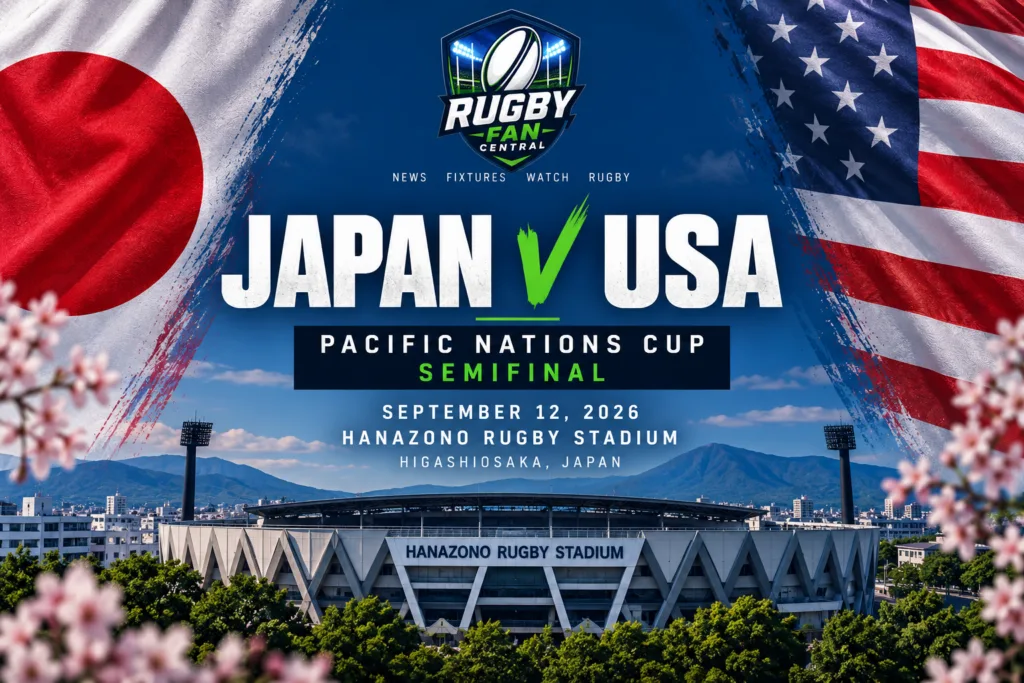
The USA Men’s Eagles face Japan at Hanazono Rugby Stadium on Saturday with a place in the Pacific Nations Cup final at stake.
After sweeping Portugal, Zimbabwe and Spain during the opening stage of the 2026 World Rugby Nations Cup, the Eagles arrive in Japan with momentum. An Eagles-heavy USA XV also followed that run with a non-capped 25–24 victory over Argentina XV in Fort Lauderdale.
But Japan represents a significant step up.
The Brave Blossoms enter the semifinal after a 57–12 victory over Canada and have dominated the recent series against the United States. For Scott Lawrence’s Eagles, Saturday is a chance to measure their progress against one of the teams they will need to compete with as the program continues building toward Rugby World Cup 2031 on home soil.
How to Watch USA vs. Japan
Match: Japan vs. USA
Competition: 2026 Pacific Nations Cup semifinal
Date: Saturday, September 12, 2026
Kickoff: 6:05 AM ET
Venue: Hanazono Rugby Stadium, Higashiosaka, Japan
U.S. streaming: Paramount+
The winner advances to the Pacific Nations Cup final in Tokyo on September 19.
The losing semifinalist will play in the third-place match on the same day.
The Pacific Nations Cup Has Reached the Knockout Stage
The 17th edition of the Pacific Nations Cup features a condensed four-team format in 2026.
Defending champions Fiji face Canada in the first semifinal at Hanazono before Japan and the United States meet in the second.
Both the final and third-place playoff will be held at Prince Chichibu Memorial Stadium in Tokyo on September 19.
For the Eagles, that means the equation is simple.
Beat Japan and they play for the Pacific Nations Cup championship.
By the Numbers
The form, results and history behind the Pacific Nations Cup semifinal.
Opta’s historical data provides an interesting contrast between the recent rivalry and the complete series. Japan have won nine of the last 10 meetings, but the USA still hold a 13–12 advantage across all 26 matches, with one draw.
The Eagles Arrive With Momentum
The USA could hardly have asked for a better opening run in the Nations Cup.
The Eagles edged Portugal 30–29 in Denver, defeated Zimbabwe 31–15 in Charlotte and completed the sweep with a 29–22 victory over Spain in Cary.
Those results gave the United States three consecutive Test victories and first place in its opening group.
A month later, a USA XV featuring numerous Eagles players defeated Argentina XV 25–24 in Fort Lauderdale.
That match was not a capped Test, so it should not be counted as a fourth consecutive Eagles Test victory. But the result still mattered.
The Americans defended their own try line late in the match to preserve the one-point victory, giving the group another experience in closing out a tight contest.
Japan will provide a much more difficult examination.
Lawrence Knows Japan Is a Step Up
USA head coach Scott Lawrence has been direct about what awaits his team.
Japan bring greater speed, physicality and precision than the Eagles faced during their first three Nations Cup matches.
The Brave Blossoms are also a Nations Championship side, giving the Americans an opportunity to measure themselves against a program competing regularly against some of the sport’s strongest nations.
That is particularly significant as USA Rugby continues developing depth ahead of the 2031 Rugby World Cup.
This semifinal is not just about one tournament.
It is another data point in determining how close the Eagles are to consistently challenging teams above them in the international hierarchy.
Japan’s Form Shows Both Danger and Opportunity
Japan’s 57–12 win against Canada last weekend showed exactly how dangerous the Brave Blossoms can be.
Japan scored nine tries, with eight of those scores fashioned by their forwards.
But their recent results also show they are not untouchable.
On August 8, Japan hosted Australia at the same Hanazono Rugby Stadium where Saturday’s semifinal will be played.
Australia escaped with a 35–32 victory.
One week later, the Wallabies defeated Japan 56–17 in Townsville.
Japan also suffered Nations Championship defeats against Ireland and France earlier in the year.
The Brave Blossoms remain favorites against the Eagles, but the Australian match at Hanazono demonstrated that Japan can be placed under pressure at home.
Recent History Belongs to Japan
This matchup has undergone a dramatic transformation.
The United States actually lead the all-time series 13 wins to 12, with one draw across 26 matches.
But that historic advantage has almost disappeared.
Japan have won nine of the last 10 meetings. The USA’s only victory during that stretch came in Sacramento in 2015, when the Eagles won 23–18.
The most recent meeting was considerably less competitive.
Japan defeated the United States 47–21 during the 2025 Pacific Nations Cup.
There is another historical hurdle facing the Eagles.
According to Opta, the USA have lost their last 12 matches played on Japanese soil, regardless of opponent. Their most recent victory in Japan came against Romania in Tokyo in 2005.
A victory Saturday would therefore end more than one streak.
The Forward Battle Could Decide It
The Eagles may have a stronger platform up front than the recent Japan-USA results suggest.
According to Opta, the United States recorded a 100% scrum success rate during its three Nations Cup matches.
The Eagles also produced a 93% lineout success rate, the best mark of any team in the competition.
That gives the USA something tangible to build around.
Clean set-piece possession can slow Japan’s ability to dictate the pace of the match and give Ruben de Haas and Chris Hilsenbeck opportunities to control territory.
The breakdown could be equally important.
Nathan Den Hoedt and captain Jason Damm recorded the two highest ruck-arrival totals in the Nations Cup, with 77 and 72 respectively. Paddy Ryan also tied for the competition lead with three jackal turnovers.
Japan, however, possess one of the most disruptive breakdown players in the match.
Ben Gunter won six turnovers during the Southern Series portion of the Nations Championship, tied for the most by any player. His combined total of 175 carries, tackles and ruck involvements was bettered by only one player in that competition segment.
The battle for quick ball could determine whether Japan are allowed to play at their preferred tempo.
Expect the Eagles to Kick
One of the clearest statistical fingerprints of this USA team has been its kicking game.
The Eagles made 100 kicks in play during the Nations Cup — more than any other team.
That total included 42 box kicks, at least 12 more than any other side.
Twenty-two percent of USA kicks resulted in an aerial contest, also the highest rate in the competition.
That suggests de Haas and Hilsenbeck will play an important role beyond simply moving the American attack.
The Eagles may look to challenge Japan in the air, force the Brave Blossoms to start attacks from deeper positions and reduce the amount of clean possession Japan receive near halfway.
The danger is obvious.
A territorial kicking strategy only works if the kick chase remains connected and accurate.
Poor kicks against Japan can quickly become counterattacking opportunities.
USA Starting XV
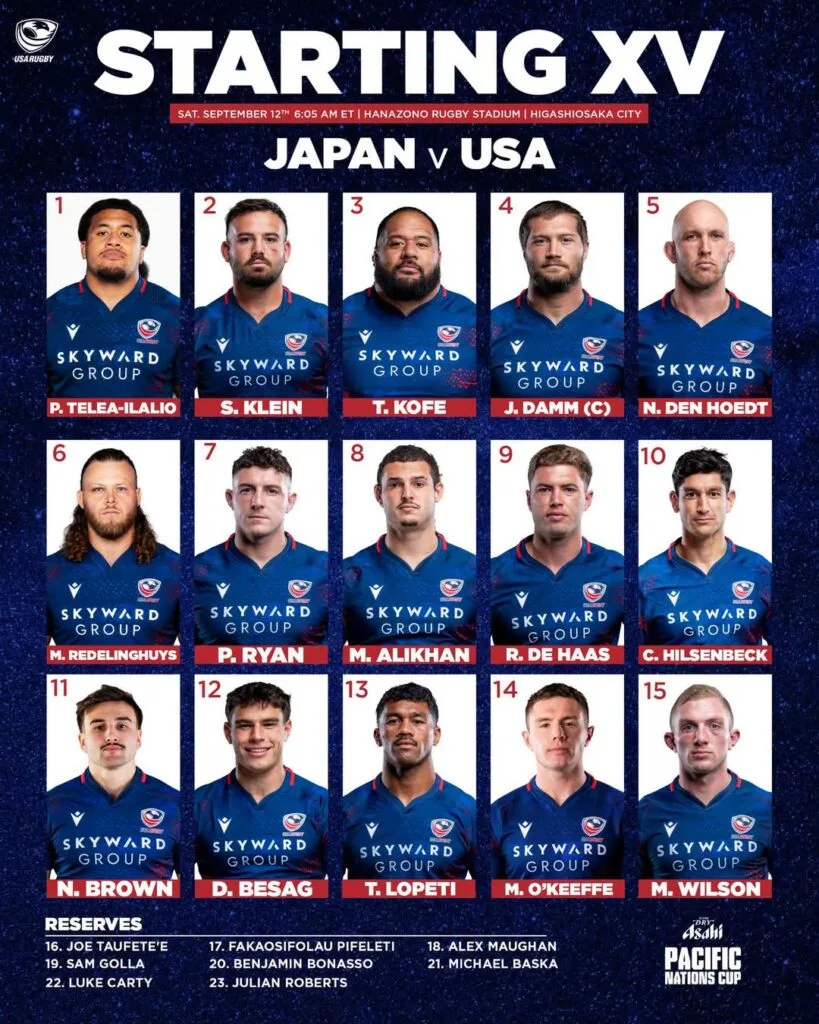
Five Eagles to Watch
Ruben de Haas — Scrum-half
De Haas sits at the center of the American tactical plan.
Opta recorded him with 195 passes across the USA’s three Nations Cup matches.
His decisions around the base will matter enormously against Japan.
When does he increase the tempo?
When does he box kick?
When does he give Hilsenbeck control?
If the Eagles can prevent Japan from turning the match into a constant high-speed exchange, de Haas will likely have played a major role.
Chris Hilsenbeck — Fly-half
Hilsenbeck returns at fly-half and gives the Eagles an experienced controlling option alongside de Haas.
Territory, goal kicking and decision-making will all matter.
The USA may not receive many easy scoring opportunities against Japan, making Hilsenbeck’s ability to turn pressure into points particularly important.
Dominic Besag — Center
Besag continues to establish himself as an important piece of the Eagles midfield.
Japan will test the American defensive organization with pace, width and quick phase play.
Besag’s defensive communication and ability to generate go-forward ball could help determine whether the USA midfield can hold together.
Jason Damm — Captain
Damm’s influence extends well beyond wearing the captain’s armband.
He recorded 72 ruck arrivals during the Nations Cup, second only to teammate Nathan Den Hoedt among all players in the competition.
He also led the Eagles with 28 successful tackles across the three Nations Cup matches and won three turnovers.
Against a Japanese team built around speed and continuity, Damm’s work around the tackle and breakdown could be critical.
Joe Taufete’e — Replacement Hooker
Joe Taufete’e provides one of the most intriguing options from the bench.
The veteran returns after injury and could make his first USA appearance since coming on as a replacement against Romania in August 2023.
Taufete’e brings experience, physicality and a proven ability to influence matches.
If Saturday remains close entering the final quarter, his introduction could become significant.
Japan Has Named Its Best 23
Japan head coach Eddie Jones has made his intentions clear.
“This is our best 23,” Jones said ahead of the semifinal.
Japan’s starting XV is:
1. Sojiro Otsuka
2. Mamoru Harada
3. Shuhei Takeuchi
4. Michael Stolberg
5. Harry Hockings
6. Ben Gunter
7. Kanji Shimokawa
8. Jack Cornelsen
9. Naoto Saito (captain)
10. Ryunosuke Ito
11. Kazuma Ueda
12. Yuya Hirose
13. Dylan Riley
14. Inoke Burua
15. Sam Greene
Reserves
16. Kenji Sato
17. Sena Kimura
18. Takumi Inaba
19. Esei Haangana
20. Tiennan Costley
21. Faulua Makisi
22. Shinobu Fujiwara
23. Samisoni Tua
Three Areas That Could Decide the Match
1. Can the USA Slow Japan Down?
Japan are at their most dangerous when they generate quick possession and force defenders into repeated decisions.
The Eagles cannot allow the match to become chaotic.
Accurate kicking, connected defense and disciplined breakdown work will be essential.
2. Can the American Set Piece Hold?
This may be one of the USA’s best opportunities.
A 100% scrum success rate and competition-leading 93% lineout success give the Eagles a legitimate foundation from which to play.
If that efficiency survives against Japan, the Eagles will have opportunities to control possession and territory.
3. Can the Eagles Remain Accurate for 80 Minutes?
Japan will punish cheap turnovers.
The Americans cannot afford unnecessary penalties, dropped balls or disconnected kick chases.
The Eagles do not necessarily need to dominate possession.
They do need to make their possessions count.
American Depth Is Being Tested
The semifinal also forms part of a broader effort to expand the international player pool.
Taufete’e is returning after injury.
Mason Pedersen has also returned to the group, while several players remain unavailable because of injury or other availability reasons.
Selected players and staff will remain in Japan following the Pacific Nations Cup for a USA Falcons development tour that includes high-intensity opposed sessions against Japan Rugby League One opposition.
That may prove nearly as important to the long-term program as the result Saturday.
The Eagles need more players capable of competing at international pace.
The Japan trip gives the coaching staff another opportunity to identify them.
What a Win Would Mean
The immediate reward is obvious.
Beat Japan and the USA advance to the Pacific Nations Cup final in Tokyo.
But the significance would extend beyond the tournament bracket.
Japan are ranked above the United States and have controlled this rivalry for more than a decade.
A victory at Hanazono would provide one of the strongest pieces of evidence yet that the current Eagles program is narrowing the gap.
It would also reverse a stretch in which Japan have won nine of the last 10 meetings and snap the USA’s 12-match losing streak on Japanese soil.
What Happens If the USA Loses?
The tournament does not end Saturday.
The losing semifinalist advances to the third-place playoff in Tokyo on September 19.
That means the Eagles are guaranteed another international-level match regardless of the result at Hanazono.
From a development standpoint, another week together and another meaningful game remain valuable.
But that should not reduce the stakes of the semifinal.
The opportunity to reach a Pacific Nations Cup final is directly in front of them.
RFC Analysis
There are reasons to believe the Eagles can make this uncomfortable for Japan.
The USA have shown they can win close matches.
Their set piece has been highly efficient.
Their kicking game provides a clear method for controlling territory.
And the Eagles have several forwards producing significant work at the breakdown.
But Japan remain the more accomplished side and possess a level of attacking speed that the Americans did not consistently face during their three Nations Cup victories.
The key may not be whether the USA can match Japan’s attacking ambition.
It may be whether they can prevent Japan from playing the match they want.
Slow the ball.
Win the set piece.
Kick accurately.
Force Japan to begin possessions from deep.
Stay within one score entering the final 20 minutes.
If the Eagles can do those things, pressure begins to shift toward the home side.
And then the match becomes very interesting.
Another Step Toward 2031
Scott Lawrence’s long-term project has never been built around one result.
The larger target is 2031.
The United States will host the Men’s Rugby World Cup that year, and Lawrence’s “Moonshot 2031” project is designed around building an Eagles program capable of reaching the quarterfinals on home soil.
Matches like this are part of finding out what that requires.
Japan are exactly the kind of opponent the Eagles eventually need to beat consistently if that ambition is going to become realistic.
Saturday provides another opportunity to measure the distance.
The Road Leads to Tokyo
The Eagles have already accomplished something important in 2026.
They won all three of their opening Nations Cup matches.
Now comes the more revealing test.
Japan have won nine of the last 10 meetings between the teams, reached the last two Pacific Nations Cup finals and will have home support behind them at Hanazono.
The USA arrive with a strong set piece, a clear tactical identity and growing confidence.
One victory separates them from the Pacific Nations Cup final.
Now they have to go earn it.
Japan vs. USA
Pacific Nations Cup Semifinal
Saturday, September 12, 2026
Hanazono Rugby Stadium — Higashiosaka, Japan
6:05 AM ET
Paramount+ in the United States
Match officials:
Referee: Jordan Way
Assistant referees: Damon Murphy, Morgan White
TMO: Graham Cooper