
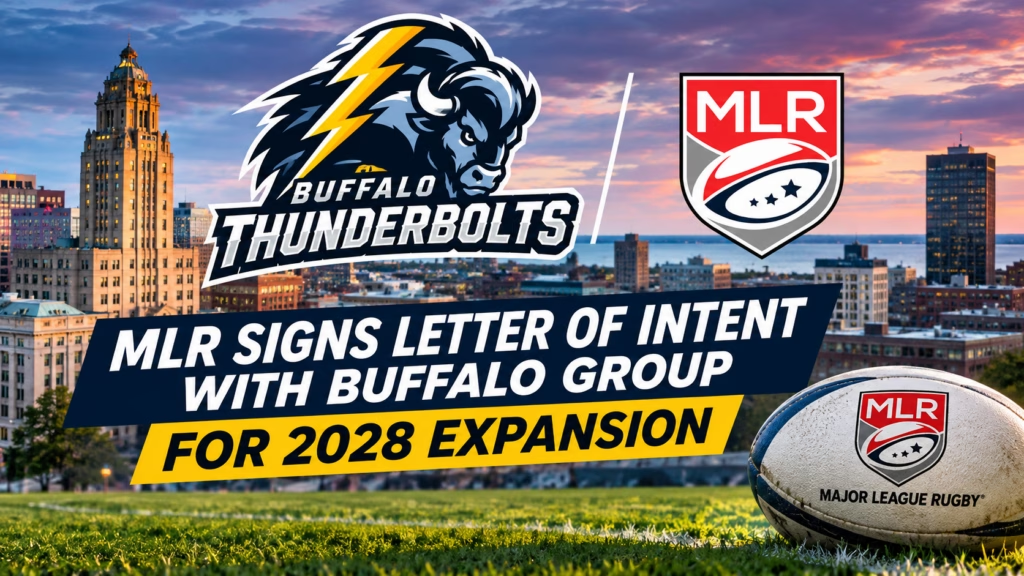
The proposed Buffalo Thunderbolts are pursuing a place in Major League Rugby (MLR) as the league evaluates new ownership groups and targets expansion ahead of the 2031 Rugby World Cup.
November 5, 2026 — Major League Rugby (MLR) has signed a letter of intent with a Buffalo ownership group seeking to establish a professional rugby franchise for the 2028 season, marking the first formal step toward bringing the league to Western New York.
The group, led by Joe DiPasquale and Mark Winokur, has been designated an MLR 2028 Expansion Candidate and intends to operate under the Buffalo Thunderbolts name.
The agreement does not guarantee Buffalo a franchise. The prospective owners must still secure investment, finalize a playing venue and satisfy the league’s financial and operational requirements before receiving approval.
The announcement comes as MLR prepares for a five-team 2027 season following several years of contraction. The league is evaluating prospective ownership groups as it pursues a target of 12 teams by the 2031 Men’s Rugby World Cup in the United States.
Buffalo Thunderbolts Begin Formal Expansion Process
The Buffalo bid is led by DiPasquale, a local filmmaker and rugby supporter, and Winokur, the former CEO of the Miami Sharks.
The proposal has received public backing from Buffalo Mayor Sean Ryan and New York State Assemblyman Bill Conrad, both of whom highlighted the region’s sporting tradition and established rugby community.
“Buffalo is one of America’s great sports cities, and we would be excited to welcome Major League Rugby to our community,” Ryan said in the league’s November 5 announcement.
MLR Co-President Alex Magleby identified the region’s cross-border reach as another attraction.
“Buffalo is a great sports city led by fiercely loyal and passionate fans, with deep rugby roots and a unique cross-border reach into Canada,” Magleby said.
DiPasquale told Buffalo radio station WBEN that the ownership group was progressing discussions with prospective investors and exploring several potential venues. He said Buffalo was the only interested market to have signed a letter of intent at that point, although other groups were also talking with the league.
The Thunderbolts name draws on Buffalo’s aviation history, referencing the Republic P-47 Thunderbolt fighter aircraft manufactured locally by Curtiss-Wright during World War II.
MLR Evaluating 17 Ownership Groups as Expansion Plans Develop
Buffalo’s candidacy is part of a broader effort to rebuild Major League Rugby’s presence across the United States.
Magleby told RugbyPass that MLR was in discussions with 17 prospective ownership groups at different stages of evaluation. In comments to The Guardian, he outlined a plan to advance approximately six groups into a formal bidding process, with three potentially selected.
The league has expressed a goal of reaching eight teams in 2028 and 12 by 2031. Magleby also told RugbyPass that MLR hopes to announce two new franchises following the 2027 championship game.
Selecting three expansion groups would bring the five existing clubs to eight, matching the league’s 2028 target. One possibility is that two franchises could be announced after the 2027 final, with a third confirmed separately. However, MLR has not established that announcement sequence, and no additional franchises have been formally awarded.
For Buffalo, interest from other ownership groups means signing a letter of intent is only the beginning of a competitive selection process.
How Major League Rugby Reached Five Teams
MLR launched in 2018 and expanded to 13 teams by 2022, but maintaining that growth proved difficult.
The competition’s membership changed repeatedly as franchises withdrew, relocated, merged or entered the league.
| Season | Teams | Major Developments |
|---|---|---|
| 2022 | 13 | Dallas Jackals made their MLR debut |
| 2023 | 12 | Austin Gilgronis and Los Angeles Giltinis excluded; Chicago Hounds debuted |
| 2024 | 12 | Miami Sharks and Anthem RC joined; Toronto and New York did not return |
| 2025 | 11 | Dallas Jackals withdrew |
| 2026 | 6 | Four clubs departed; San Diego Legion and RFCLA combined into California Legion |
| 2027 | 5 | Anthem RC ceased operations after 2026 |
Two significant franchises completed their final seasons in 2023: the Toronto Arrows and Rugby New York, the 2022 MLR champions, which had rebranded as the Rugby New York Ironworkers for that season.
Los Angeles underwent separate changes. The original Los Angeles Giltinis were excluded from the 2023 competition. Rugby ATL subsequently relocated from Georgia and became Rugby Football Club Los Angeles (RFCLA) for 2024. In July 2025, RFCLA and San Diego Legion combined to form California Legion ahead of the 2026 season.
The four other departures ahead of 2026 were the Utah Warriors, Miami Sharks, Houston SaberCats and NOLA Gold.
Following Anthem RC’s departure, the five clubs remaining for 2027 are:
- Chicago Hounds
- New England Free Jacks
- Old Glory DC
- California Legion
- Seattle Seawolves
Seattle is the only remaining club from MLR’s inaugural 2018 season.
The contraction has increased the importance of MLR’s next expansion decisions. The league must demonstrate that new ownership groups can establish sustainable operations rather than simply restore its former team count.
Buffalo’s Rugby Roots and Cross-Border Opportunity
Buffalo offers an established rugby community rather than a market where the sport would have to be introduced from scratch.
Buffalo Rugby Club was founded in 1966 and marked its 60th anniversary in 2026. The wider Western New York region also has collegiate rugby connections through the University at Buffalo, Buffalo State, SUNY Fredonia and St. Bonaventure University.
Conrad, who has played and coached rugby in the region, pointed to that history as an advantage for the proposed franchise.
Buffalo’s location could also help the Thunderbolts attract supporters from Southern Ontario, where the Toronto Arrows previously provided a professional rugby presence.
That cross-border opportunity is central to the ownership group’s pitch, although it remains to be seen how many supporters would regularly travel to Buffalo for matches.
Stadium and Investment Plans Still Need to Be Finalized
The Thunderbolts have yet to announce a home venue or completed ownership investment structure.
DiPasquale told WBEN that the group had discussed several stadium possibilities, including potential cooperation with Buffalo Pro Soccer, which is pursuing its own professional franchise but has experienced delays related to stadium development.
According to RugbyPass, the Buffalo group is considering a venue with capacity for up to 10,000 spectators while initially targeting crowds of approximately 3,000 to 5,000.
Those figures are planning objectives, not confirmed attendance projections.
MLR’s expansion process requires prospective owners to demonstrate financial capacity, present business plans and establish how they intend to develop local support.
Magleby told The Guardian that the league is placing greater emphasis on financial safeguards, including multi-year operating reserves, suitable stadium arrangements, domestic player development and community engagement.
The approach reflects lessons from MLR’s previous expansion and contraction cycles, when several franchises entered the competition but could not sustain operations.
What Does This Mean for Rugby Fans in Western New York?
For supporters in Buffalo and Southern Ontario, a successful Thunderbolts bid would restore relatively close access to professional men’s rugby after the departures of Rugby New York and the Toronto Arrows.
Until then, fans can continue following MLR through its national broadcast agreement with ESPN, which was extended through the 2027 season.
Under the October 6 agreement, Sunday Night Rugby will feature a weekly primetime match streaming live on the ESPN App, while five MLR matches will air on ESPN’s linear television channels.
With only five clubs competing in 2027, fans without a nearby franchise can still follow the Chicago Hounds, New England Free Jacks, Old Glory DC, California Legion or Seattle Seawolves nationally.
The smaller competition also means fewer regional rivalries and fewer opportunities for supporters outside those five markets to attend matches in person.
A Buffalo franchise would not immediately solve those geographic limitations, but it could reestablish a professional rugby presence in an important part of the northeastern United States and the Canadian border region.
April 2027 Could Be Buffalo’s First Major Checkpoint
The Buffalo ownership group now faces several months of financial, commercial and stadium planning.
According to RugbyPass, MLR expects to review the group’s initial submission by the end of April 2027. A successful review could lead to an exclusive negotiating agreement covering the proposed Western New York territory, followed by a final franchise application and league approval.
The league also hopes to make expansion announcements following the 2027 championship game.
Those two milestones will provide a clearer indication of whether Buffalo is progressing toward a 2028 debut — and whether MLR’s wider rebuilding ambitions are beginning to translate into confirmed franchises.
Sources
Buffalo expansion and league plans
MLR franchise history
- MLR — Dallas Jackals Move Inaugural Season to 2022
- MLR — 2023 Competition Update
- MLR — Chicago Hounds Expansion Announcement
- MLR — Toronto Arrows Cease Operations, November 2023
- MLR — New York Ironworkers Withdrawal
- MLR — Rugby ATL Relocation to Los Angeles
- MLR — Rugby FC Los Angeles Announcement
- MLR — 2024 Competition Schedule
- MLR — Dallas Jackals Withdrawal Ahead of 2025
- MLR — California Legion Formation
- MLR — 2025 ESPN Agreement and Team List
- MLR — 2026 Competition Format
- MLR — 2026 Competition Schedule
- North American Rugby Database — Anthem RC
Broadcast coverage