
World Rugby has officially approved a lower legal tackle height for community rugby, with the new law set to take effect globally on July 1, 2026.
Under the updated law, the highest legal point of contact for a tackle will be the base of the sternum. The change is part of World Rugby’s ongoing player welfare strategy and follows multiple years of trials involving unions across the rugby world.
The governing body says the law is designed to reduce head contact and improve player safety. However, as with many significant law changes, the decision has already sparked debate among coaches, referees, players, and supporters about how it could change the game.
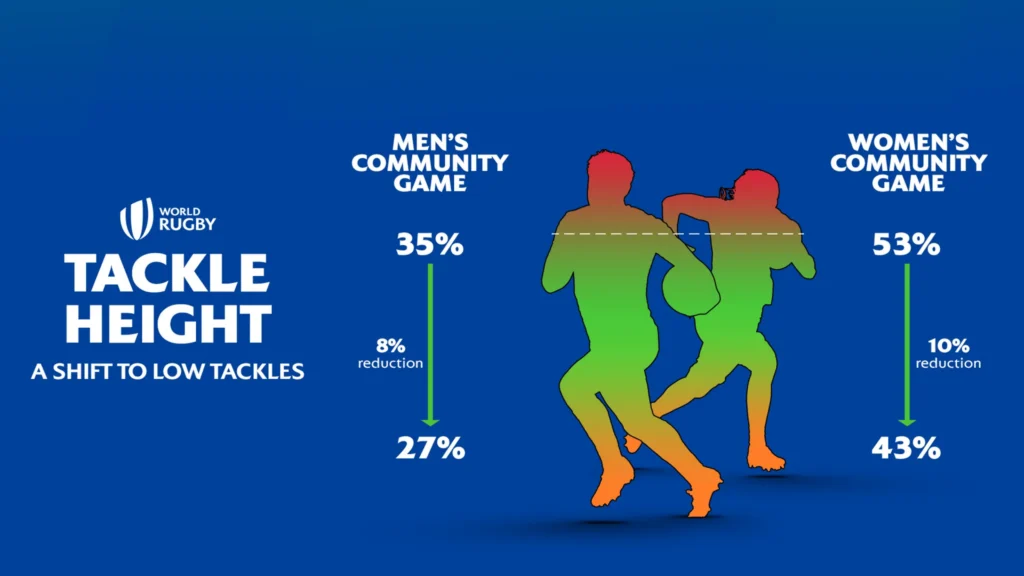
10 unions trialed the sternum or waist tackle height for tacklers over 2 years with over 150,000 tackles studied
Player welfare is at the heart of the move to full law.
Several other successful law trials adopted into full law including the scrum brake foot
What Has Changed?
The new law lowers the maximum legal tackle height in community rugby to the base of the sternum, effectively requiring defenders to tackle below the chest area.
World Rugby says trials involving approximately 150,000 tackles across 11 unions resulted in fewer upright collisions and positive changes in player behavior around contact situations.
According to the governing body, participating unions reported an 8-10 percent reduction in upright tackles, while several unions also recorded decreases in concussion rates during the trial period.
The law will apply to community rugby beginning July 1, 2026.
Why World Rugby Made the Change
Player welfare has become one of the sport’s biggest priorities over the last decade.
Concussions and head injuries remain a major concern across rugby, particularly at youth and amateur levels where players may not have access to the same coaching, medical support, or officiating resources available in the professional game.
World Rugby believes lowering the tackle height can reduce the likelihood of head-on-head and head-on-shoulder collisions while encouraging safer tackling techniques.
The decision follows a growing trend across rugby to reduce unnecessary head contact without fundamentally altering the sport’s physical nature.
What Could It Mean for the Game?
While the safety objectives are clear, many within the rugby community are already discussing how the law could influence tactics and gameplay.
One of the biggest talking points is the potential increase in offloads.
If defenders are consistently required to tackle lower, ball carriers may have greater freedom to keep their arms available through contact. That could lead to more offloads, more broken defensive structures, and potentially a faster, higher-scoring style of rugby.
Modern defenses have increasingly relied on dominant tackles that stop momentum and prevent attackers from freeing their hands. A lower tackle height could place even greater importance on two-player tackles and coordinated defensive systems.
For attacking teams, the change may create new opportunities to keep the ball alive and maintain continuity through multiple phases.
The Injury Question
Another topic generating discussion is whether injury risk could shift rather than disappear.
Supporters of the law point to the reduction of head contact as the primary goal, arguing that fewer high collisions should lead to safer outcomes for players.
Others have questioned whether forcing tacklers lower could increase exposure to knees, hips, and thighs during contact situations.
At this stage, World Rugby’s research has focused largely on reducing head contact and concussion risk. The long-term impact on other injury patterns will likely become clearer as unions continue to collect data after implementation.
What About Referees?
For many grassroots participants, the biggest challenge may not be the tackle itself—it may be enforcement.
Unlike professional competitions, most community rugby matches do not have Television Match Officials, replay systems, or multiple camera angles.
Referees are often required to make split-second decisions in dynamic contact situations.
Determining whether a tackle was made below the sternum or slightly above it will place additional emphasis on referee education and consistency.
As the law comes into effect, coaching and officiating guidance will be just as important as the wording of the law itself.
What Does This Mean for USA Rugby?
For American players, coaches, and referees, the concept may already sound familiar.
USA Rugby adopted the sternum-height tackle variation for community rugby beginning with the 2024-25 membership year as part of World Rugby’s global law variation program.
The latest announcement effectively confirms that the lower tackle-height approach is becoming a permanent feature of the community game worldwide.
While many clubs have already begun adapting to the standard, the global implementation ensures a more consistent approach across participating unions.
The Bigger Picture
The lower tackle-height law represents one of the most significant community rugby law changes in recent years.
Supporters see it as an important step toward making rugby safer and more sustainable for future generations. Critics question whether it could alter key elements of the game or simply shift injury risks elsewhere.
The reality is that the success of the law will likely depend on more than just the wording in the law book.
Coaching, referee education, player adaptation, and continued research will all play a role in determining whether the change achieves its intended goals.
What is certain is that rugby’s community game will look a little different when the new law takes effect on July 1, 2026.
Whether that difference is viewed as a positive evolution or an unnecessary change remains a matter of debate.
RFC Question
Will the lower tackle-height law make rugby safer without changing the game too much?
Vote in our poll and let us know your thoughts in the comments.
Other Law Changes Approved by World Rugby
While the lower tackle-height law received the most attention, the World Rugby Council also approved several other law changes following successful trials.
Among the changes moving into full law are:
- The introduction of the scrum brake foot, designed to reduce axial loading and lessen pressure on players’ heads and necks during scrums.
- Restrictions on water carriers entering the field of play.
- Formal recognition of the Television Match Official (TMO) as part of the officiating team.
- The option for elite competitions to use 20-minute red cards if they choose to adopt the system.
These amendments will come into effect on July 1 and form part of World Rugby’s ongoing efforts to improve player welfare, match management, and game flow across the sport.
The full wording of all approved law changes is available through World Rugby’s Laws section.