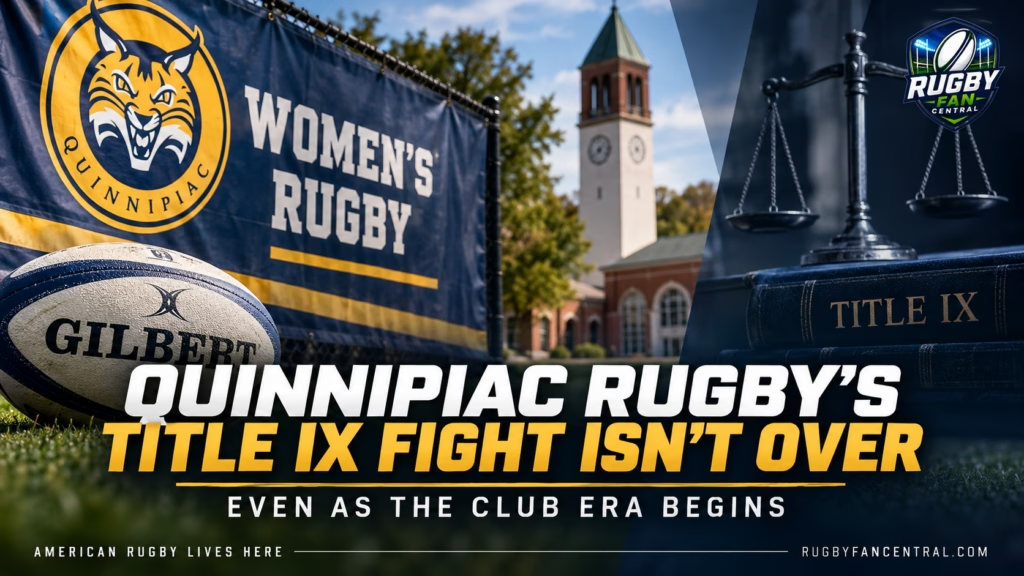
Quinnipiac women’s rugby has officially begun its new life as a club program, five months after the university announced it would remove varsity status from one of the most successful women’s college rugby programs in the United States.
Quinnipiac promoted the new club team’s September 19 home opener against UConn at the Quinnipiac Rugby Field, confirming that the transition from varsity to club competition has taken effect for the 2026–27 academic year.
The change ends, at least for now, a 15-year varsity era that included three consecutive national championships and established Quinnipiac as one of the recognizable programs in NCAA women’s rugby.
But the legal fight over that decision is not over.
Current and incoming members of Quinnipiac’s women’s rugby program are pursuing a federal lawsuit alleging that the university’s decision violated Title IX and amounted to illegal retaliation connected to Title IX complaints made by former head coach Becky Carlson.
Quinnipiac disputes those allegations and says its athletics realignment was designed around long-term competitive priorities, financial sustainability and Title IX compliance.
The result is an unusual situation: Quinnipiac women’s rugby is playing as a club while a federal lawsuit continues over the decision that put it there.
From Three-Time National Champion to Club Rugby
Quinnipiac announced on April 14 that women’s rugby would transition from varsity to club status at the conclusion of the 2025–26 competitive cycle.
The decision represented a dramatic change for a program that began varsity competition in 2011 and won three consecutive national championships in 2015, 2016 and 2017.
Quinnipiac said the move followed a review of varsity participation, conference affiliation, departmental resources and gender-equity considerations.
As part of the same athletics realignment, the university announced it would add a men’s indoor and outdoor distance program within its existing track and field structure.
Quinnipiac said moving rugby to club status would preserve an opportunity for women to continue playing while allowing varsity resources to be redirected toward programs it considers to have greater long-term stability and strategic alignment.
In the university’s April 14 announcement, Athletic Director Greg Amodio said the decision was “in no way meant to diminish the dedication, effort or ability” of the program’s student-athletes, coaches and alumni.
Quinnipiac also said it would work with Campus Recreation to maintain a well-resourced club program and continue monitoring participation, scholarships and other gender-equity measures.
The players challenging the decision see it very differently.
Players Took Quinnipiac to Federal Court
Current and incoming members of Quinnipiac’s women’s rugby program filed suit in federal court against Quinnipiac University, Athletic Director Greg Amodio, university president Marie Hardin and the university’s Board of Trustees.
The plaintiffs allege that demoting women’s rugby violates Title IX through gender discrimination and constitutes illegal retaliation connected with Title IX complaints made by Carlson.
Those allegations remain contested and have not been established at trial.
The players sought immediate court intervention that would have prevented Quinnipiac from moving the program to club status while the lawsuit proceeded.
U.S. District Judge Kari A. Dooley held an evidentiary hearing on June 23 and 24, followed by oral arguments on June 26.
Her decision came four days later.
What the June 30 Ruling Actually Decided
On June 30, Dooley denied the players’ motion for a temporary restraining order and preliminary injunction.
That was a significant setback for the players because it allowed Quinnipiac’s planned transition to club rugby to proceed for the 2026–27 season.
But it was not a final judgment on the underlying lawsuit.
Dooley concluded that, on the record before the court at that stage, the plaintiffs had not demonstrated likely success on the merits of their claims or sufficiently serious questions going to the merits to satisfy the standard required for preliminary relief.
The distinction matters because preliminary-injunction proceedings do not finally resolve the disputed facts or determine who ultimately prevails in the case.
Speaking to the Boston Globe on July 11, plaintiffs’ attorney Christine Brown emphasized that point, saying that although the motion had been denied, it “isn’t determinative of whether or not there is a viable cause of action here.”
The plaintiffs continue to contend that Quinnipiac targeted a successful women’s varsity program and dispute the university’s justification for the move.
Quinnipiac maintains that the restructuring followed a broader institutional review and was consistent with its obligations under Title IX.
The court intends to move the case forward quickly.
In her June 30 decision, Dooley said that if the players ultimately prevail at trial and receive the injunctive relief they seek, the expectation is that there would be sufficient time before the 2027–28 academic year to reinstate women’s rugby as a varsity sport.
For 2026–27, however, Quinnipiac was permitted to proceed with the change.
The Club Era Has Now Begun
That transition is no longer theoretical.
In a September 17 university update, Quinnipiac listed women’s rugby among its Club Sports programs and promoted the September 19 home opener against UConn.
A program that previously competed within Quinnipiac Athletics and the NCAA women’s rugby structure is therefore operating through the university’s club-sports system while litigation over the loss of varsity status continues.
The distinction matters.
NIRA programs operate as NCAA varsity programs administered through their universities’ athletic departments and subject to NCAA rules and institutional athletics structures.
Club rugby operates outside that varsity framework.
Rugby remains available to Quinnipiac students, but the institutional structure surrounding the team has changed substantially.
Becky Carlson Has Moved On
Another connection to Quinnipiac’s varsity era has ended.
Carlson, who built and coached the program from its beginning in 2011 through its final varsity season, is now director of athletics at the University of Maine at Fort Kent.
UMFK announced the appointment on September 10, although Carlson joined the university in August.
Her Quinnipiac tenure included all three national championships, 99 victories and the development of 32 All-Americans. She also coached future U.S. Olympic medalist Ilona Maher.
Carlson is central to the allegations in the federal case. The plaintiffs allege that Quinnipiac’s decision amounted in part to retaliation connected to Title IX complaints she made while coaching the program.
Quinnipiac disputes the retaliation claim.
Carlson’s departure means the new club program begins under a different institutional model and without the coach who led the varsity team throughout its existence.
Why Quinnipiac Matters Beyond One University
The significance of the story extends beyond Hamden, Connecticut.
Women’s college rugby is part of a wider U.S. college rugby system divided across several different structures.
NIRA represents NCAA varsity women’s rugby programs administered through university athletic departments. Other women’s teams compete through National Collegiate Rugby, CRAA and additional club structures.
At the same time, organizations across the sport are trying to expand participation, establish stronger development pathways and increase rugby’s institutional presence on American campuses.
Quinnipiac provides an important counterpoint to that growth story.
This is not a newly established rugby club attempting to earn varsity recognition. It is a three-time national championship program that has moved from varsity rugby to club status.
That does not establish that women’s college rugby nationally is shrinking. New programs continue to emerge elsewhere, and overall participation can grow while individual universities make different decisions about varsity sponsorship.
But Quinnipiac demonstrates why two measures of growth should not be confused: more women playing college rugby is not necessarily the same thing as more universities sponsoring NCAA varsity rugby.
That distinction matters as American rugby considers how college programs fit into the wider player-development pathway — and as questions continue over who runs college rugby in America and how its different systems fit together.
What Happens Next
For the 2026–27 season, the immediate position is clear.
Quinnipiac women’s rugby is competing as a club, the university’s decision to remove varsity status has taken effect, and Carlson is no longer leading the program.
The unresolved question is whether that decision survives the federal litigation.
The June 30 ruling allowed Quinnipiac to proceed with the transition, but it did not finally resolve the players’ Title IX discrimination and retaliation claims.
If the players ultimately prevail and obtain the relief they seek, the court has already identified the possibility of varsity rugby returning for 2027–28.
Until then, one of the most established programs in American women’s college rugby has entered a very different era — while the legal argument over how it got there continues.