
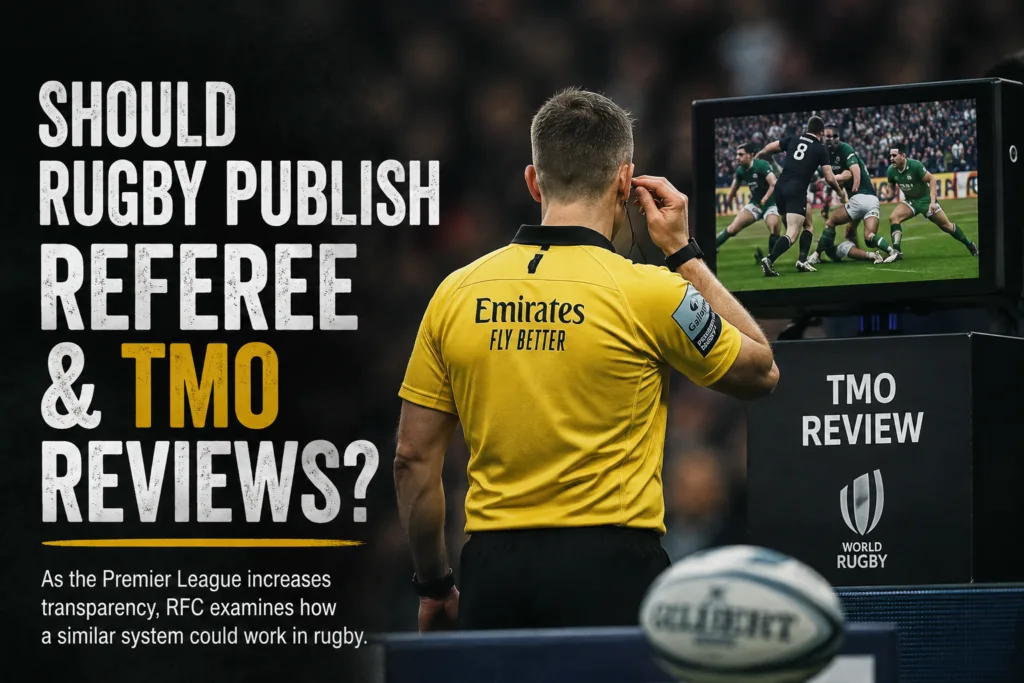
The Premier League is about to make independent assessments of major refereeing decisions public every week. Rugby reviews its elite officials too — and leading referee Ben O’Keeffe has called for more post-match explanation. Should supporters be allowed to see part of that process?
Rugby lets us hear major decisions being made in real time.
Soccer is about to show supporters how those decisions are judged afterward.
Beginning with the 2026–27 season, the Premier League will publish the findings of its independent Key Match Incidents Panel every week.
Rugby reviews its elite officials too.
Those evaluations largely remain private.
Is it time for rugby to do both?
What the Premier League Is Changing
The Premier League’s Key Match Incidents, or KMI, Panel isn’t new.
Established during the 2022–23 season, the five-member panel reviews major incidents and assesses on-field and VAR decisions.
What is changing is public access.
From the 2026–27 season, the findings will be published weekly as part of a wider push for transparency. The league will also share direct quotes from referees and VAR officials around major incidents, along with selected audio from referee-worn cameras.
For rugby, the important development isn’t VAR.
It’s the principle:
Supporters are being allowed to see how major officiating decisions are assessed after the match.
Rugby Is Already Transparent — Up to a Point
Rugby may actually be more transparent while a decision is being made.
When a referee asks a Television Match Official to examine possible foul play or a potential try, viewers can often hear officials work through the evidence.
Was there head contact? Was there mitigation? Was the ball grounded? Was the player in touch? Did the ball travel forward out of the hands?
Supporters hear the reasoning.
But once the final whistle blows, that transparency changes.
Elite referees are reviewed, analysed and coached. The argument for greater transparency therefore isn’t that rugby fails to evaluate its officials.
It does.
The question is whether supporters should see a narrow part of the outcome.
Ben O’Keeffe Has Already Raised the Question
This isn’t a completely new discussion for rugby — or for RFC.
Rugby Fan Central has previously examined Ben O’Keeffe’s call for referees to explain controversial decisions after matches. Speaking about the scrutiny officials face after major matches, O’Keeffe argued for giving referees greater opportunity to explain their decisions rather than allowing the public debate to continue without their perspective.
That matters because the argument for greater transparency isn’t simply coming from supporters frustrated with refereeing decisions.
It has come from inside elite officiating itself.
Allowing a referee to explain a decision and publishing an independent assessment aren’t the same thing. But they address the same problem:
The public debate continues after the final whistle while much of the officiating perspective disappears from view.
A KMI-style system could take O’Keeffe’s argument one step further.
Instead of leaving an individual referee to explain or defend a controversial call, the sport itself could provide an independent assessment.
What Could a Rugby Version Look Like?
There would need to be one fundamental rule:
Do not re-referee the match.
Rugby contains far more judgment and materiality than many of soccer’s major VAR decisions.
A Monday-morning panel deciding whether a tackler rolled quickly enough, whether a jackaler supported their body weight or which prop caused a scrum to collapse would quickly become unworkable.
Routine scrum penalties, breakdown decisions, advantage calls and other micro-decisions should therefore be excluded.
A Rugby KMI system should concentrate on a narrow group of significant incidents, such as:
- red-card and significant head-contact decisions;
- Foul Play Review Officer decisions;
- potential forward passes immediately preceding tries;
- touchline and grounding decisions connected to tries;
- significant knock-ons immediately before tries;
- penalty-try decisions;
- major foul play missed by the officiating team;
- other significant incidents involving formal TMO intervention.
The objective wouldn’t be to determine whether a referee produced a perfect 80-minute performance.
It would be to assess a handful of genuine Key Match Incidents.
The Bunker Changes Who Is Being Reviewed
Modern elite rugby has also moved beyond the traditional referee-and-TMO model.
The Foul Play Review Officer process — commonly associated with the Bunker — means some major foul-play decisions already receive an additional off-field review.
A post-match panel therefore wouldn’t simply be judging the referee.
The process could effectively become:
How a Rugby Review Process Could Work
Each stage answers a different question — from the live match decision through to a possible independent post-match assessment.
Makes the immediate decision required during play.
Reviews the incident using replay and the applicable protocol.
The final officiating outcome becomes part of the match record.
Assesses whether the final outcome was consistent with law, protocol and officiating standards.
Verdict, relevant law, reasoning and panel vote become public.
Publication of that specific KMI finding would be deferred until the disciplinary process is complete.
The referee makes the immediate match decision and the Foul Play Review Officer conducts the off-field review. A post-match panel would ask a different question:
Was the final outcome consistent with the law, protocol and officiating standards that should have been applied?
The system should therefore review the final decision-making process, not automatically assign responsibility to the referee standing on the field.
What Would Supporters Actually See?
It wouldn’t require a lengthy report.
A hypothetical entry might look like this:
RUGBY KMI REVIEW — HYPOTHETICAL EXAMPLE
RUGBY KMI REVIEW
54′ — Disallowed Try
Potential Throw Forward
The majority considered the ball to have left the passer’s hands in a backward direction. Its subsequent forward movement did not establish that the player had thrown or passed the ball forward.
This is a hypothetical example created by Rugby Fan Central solely to illustrate how a published Rugby KMI assessment could work. It does not represent an actual match incident or official review.
That’s essentially all supporters would need.
No confidential referee coaching reports.
No individual performance scores.
No league table of mistakes.
Just the incident, applicable law, verdict and reasoning.
And importantly, disagreement.
A 3–2 verdict tells supporters something that simply publishing “correct” or “incorrect” cannot:
Reasonable experts can look at the same rugby incident and disagree.
Rugby Already Has Post-Match Transparency — Just Not for This
Rugby isn’t unfamiliar with publishing what happens after the final whistle.
World Rugby regularly publishes disciplinary updates covering red cards, citings and misconduct proceedings.
That transparency can extend directly to disputes involving referees.
Following Italy’s Nations Championship defeat to New Zealand, head coach Gonzalo Quesada was sanctioned for comments criticizing match officials. He initially received a two-match automatic suspension under World Rugby’s Match Official Abuse Sanction Process before referring the case to an independent disciplinary committee.
The eventual outcome — a one-match suspension, public apology and formal warning — was made public.
That process addresses conduct toward officials, not whether the underlying officiating decision was correct. But the contrast is important:
Rugby can publicly explain why someone was disciplined for criticizing a referee while the formal assessment of the refereeing decision at the center of the controversy may remain private.
That doesn’t mean criticism should be unrestricted or abuse tolerated.
It raises a narrower question.
If transparency and consistency matter when protecting officials, could some of the same principles apply when explaining major officiating decisions?
What Happens When the Judiciary Is Involved?
There is one significant complication.
Imagine a player receives a red card on Saturday. A KMI Panel declares the decision incorrect on Monday, only for an independent disciplinary committee to subsequently suspend the player.
Rugby could appear to have two parts of its own system contradicting each other.
The roles would therefore need to be clearly separated.
KMI Panel: Was the match-officiating decision and process consistent with the applicable law and protocol?
Disciplinary process: Did the player commit an offence warranting sanction, and what should that sanction be?
There should also be a simple publication safeguard:
If a Key Match Incident is subject to an active citing, disciplinary hearing or appeal, publication of that specific KMI finding should wait until the disciplinary process is complete.
Other findings from the round could still be published normally.
Transparency Could Protect Referees Too
There is a genuine risk to all of this.
Referees already operate under intense scrutiny, and social media can turn legitimate disagreement into personal abuse.
RFC has previously covered World Rugby’s Match Official Abuse Sanction Process, introduced to provide a clearer framework for addressing public criticism of officials, particularly where comments may contribute to wider abuse.
A public KMI system could make matters worse if it became a weekly list of referee errors.
That’s why the guardrails matter:
No referee rankings. No individual performance scores. No weekly hunt for mistakes.
But secrecy doesn’t necessarily protect referees either.
Sometimes it leaves them isolated.
After a controversial decision, the referee’s name is public. The replay is public. The coach’s criticism may be public. The social-media reaction is certainly public.
The governing body’s subsequent assessment usually isn’t.
If rugby is asking coaches to exercise greater restraint when criticizing officials publicly, governing bodies arguably assume a greater responsibility to fill that information gap themselves.
A divided KMI verdict could be particularly powerful.
Instead of:
“The referee made an incompetent mistake.”
supporters might see:
“Five experienced reviewers examined the same incident and reached a 3–2 decision.”
That doesn’t excuse mistakes.
It demonstrates that some rugby decisions are genuinely difficult.
Transparency could humanize referees rather than simply expose them.
The Information Vacuum Won’t Stay Empty
When rugby doesn’t provide an authoritative explanation, coaches, pundits, former referees, supporters and social media fill the gap.
A formal review could provide a counterweight.
Sometimes it would conclude a decision was wrong. Sometimes it would explain why a heavily criticized decision was correct. And sometimes a divided panel would show there was never one obvious answer.
That could be valuable for supporters — and for referees.
Rugby Should Watch What Happens Next
There is no reason for rugby to copy the Premier League wholesale.
Soccer and rugby are different sports. Rugby’s blend of objective decisions, materiality and referee judgment requires a different model.
But the Premier League’s 2026–27 experiment provides a useful real-world test.
Does publishing KMI findings help supporters understand controversial decisions?
Does acknowledging errors increase or decrease confidence in officials?
Does publishing panel disagreement help explain genuinely difficult calls?
Does greater transparency reduce speculation, or simply create another round of controversy?
Rugby should pay attention to the answers.
A Logical Next Step, Not a Revolution
The proposal is ultimately incremental and proportionate.
Rugby already reviews its officials.
It already lets supporters hear referees and TMOs discuss major decisions.
It already uses specialist off-field foul-play review.
It already publishes disciplinary and misconduct outcomes after matches.
And referees themselves have called for greater opportunity to explain what happened after the final whistle.
The missing piece is narrower:
What did the sport conclude about the major officiating decision itself?
Answering that doesn’t require re-refereeing the breakdown or publishing referee scorecards.
Just take a small number of genuinely significant incidents and publish:
The relevant law.
The decision.
The independent assessment.
The reasoning.
And, when appropriate, the disagreement.
Rugby doesn’t need to choose between protecting referees and explaining their decisions.
Done properly, greater transparency could help achieve both.
The Premier League is about to test that principle in public. Rugby should watch closely, learn from what works and what doesn’t, and then decide whether a version designed for its own game should follow.