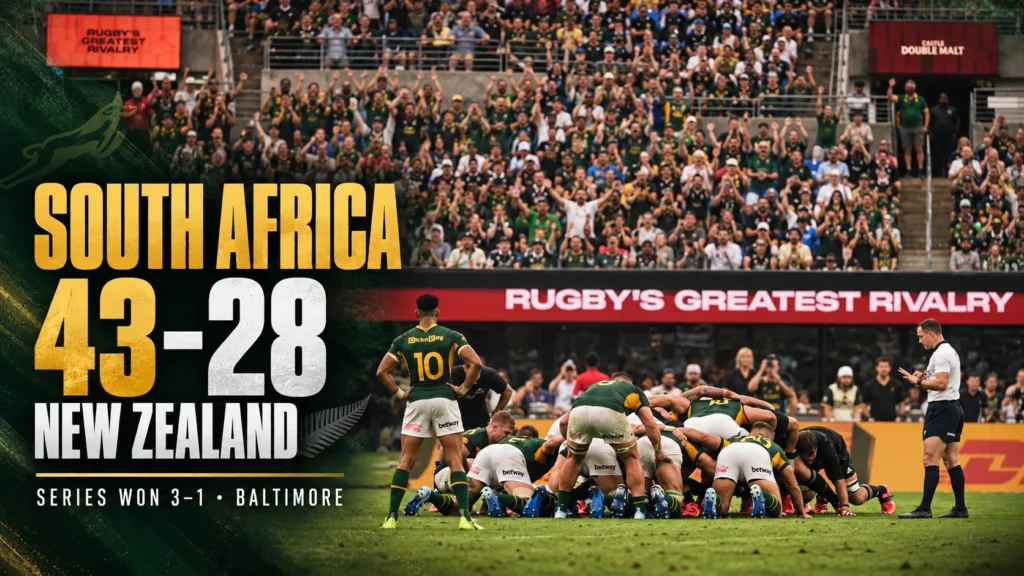
South Africa turned a historic night for American rugby into another championship celebration, defeating New Zealand 43–28 at M&T Bank Stadium in Baltimore to win Rugby’s Greatest Rivalry series three Tests to one.
The announced crowd of 68,173 was the largest ever for a rugby international played in the United States.
American fans received a glimpse of Test rugby at its most intense as the United States prepares to host the 2031 Men’s Rugby World Cup. The series finale produced 10 tries, repeated momentum swings, relentless physical collisions and one extraordinary breakaway score from Kurt-Lee Arendse.
South Africa led only 17–14 at halftime and remained under pressure deep into the second half. The Springboks finally separated themselves during the closing 10 minutes, scoring through Arendse and Cameron Hanekom to complete a third consecutive victory over New Zealand.
The result gave South Africa a 3–1 series victory after the All Blacks won the opening Test in Johannesburg. The Springboks responded by winning in Cape Town, Soweto and Baltimore.
South Africa vs. New Zealand: Baltimore Highlights
Watch the highlights as South Africa defeated New Zealand 43–28 to win Rugby’s Greatest Rivalry series 3–1.
Video highlights provided through YouTube.


By the Numbers
Baltimore Hosts an American Rugby Milestone
The crowd surpassed the previous U.S. record established when 62,300 spectators watched Ireland defeat New Zealand at Soldier Field in Chicago in 2016.
That made Baltimore more than a neutral location for the series finale. It became part of the story.
M&T Bank Stadium, normally the home of the NFL’s Baltimore Ravens, was filled with Springbok green, All Blacks jerseys, flags, singing and the distinctive sound of vuvuzelas. The atmosphere reflected the international reach of both teams while providing a preview of the audiences the United States hopes to attract for the 2031 World Cup.
Springbok captain Siya Kolisi said after the match that the support in Baltimore had been “super special” and expressed hope that the event would help rugby grow in the United States.
The attendance provided an encouraging sign. It showed that an elite international match, presented as a major sporting event and built around two recognizable teams, can command a substantial American audience.
All Blacks Strike First
South Africa opened the scoring with a Sacha Feinberg-Mngomezulu penalty in the fourth minute, but New Zealand produced the first try.
The All Blacks moved the ball quickly across the field before scrumhalf Cam Roigard delivered a long pass that found captain Codie Taylor near the goal line. Taylor crossed in the eighth minute, and Damian McKenzie converted to give New Zealand a 7–3 lead.
It was Taylor’s 24th Test try, moving him ahead of Dane Coles for the most tries scored by an All Blacks hooker.
South Africa responded through direct carries and sustained pressure. Damian de Allende forced his way over in the 15th minute, with Feinberg-Mngomezulu adding the conversion.
Morné van den Berg then extended the Springbok lead. The scrumhalf shaped as though he would pass from the base of a lineout maul before cutting through a gap and scoring in the 22nd minute. Another Feinberg-Mngomezulu conversion made it 17–7.
New Zealand refused to let South Africa pull away.
After Taylor helped initiate a lengthy attacking sequence from a lineout, the All Blacks retained possession through 32 phases. Will Jordan eventually entered the line and crossed beside the posts. McKenzie’s conversion reduced South Africa’s halftime lead to 17–14.
The three-point margin accurately reflected a first half in which neither team established lasting control.
Springbok Replacements Change the Match
South Africa made four replacements shortly after halftime, introducing Gerhard Steenekamp, Thomas du Toit, Lood de Jager and André Esterhuizen.
The impact was almost immediate.
A penalty gave South Africa an attacking lineout, and the Springbok maul carried Malcolm Marx across the line in the 49th minute. The conversion was missed, but the lead had grown to eight points.
Only minutes later, South Africa struck again.
Van den Berg attacked the short side before Feinberg-Mngomezulu accelerated into New Zealand territory. Esterhuizen carried the move into the All Blacks’ 22, and Pieter-Steph du Toit eventually powered over from close range.
Van den Berg converted to give South Africa a 29–14 advantage.
The two tries demonstrated the range of the Springbok attack. The first came through the traditional power of their lineout maul. The second began with pace and width before finishing through their forwards near the line.
New Zealand Mounts One More Challenge
The All Blacks found their way back into the match through Roigard and Ethan Blackadder.
Roigard broke through the South African defensive line following a New Zealand lineout and carried to within metres of the try line. Blackadder collected the ball at the next phase and drove through the final defender to score.
McKenzie converted, reducing the deficit to 29–21 with approximately 16 minutes remaining.
New Zealand suddenly had momentum. The All Blacks began finding space on the left and threatened to draw level.
Springbok coach Rassie Erasmus later acknowledged that he did not feel confident about the result until the closing stages.
“At minute 70, I thought it was still in the balance,” Erasmus said after the match. “Up until the last 10 minutes, I wasn’t sure we were going to win.”
Then Arendse produced the defining moment of the night.
Arendse’s Breakaway Settles the Series
New Zealand appeared to have another attacking opportunity when the ball came loose inside South African territory.
Arendse gathered it deep in his own half, stepped through the first wave of defenders and accelerated into open space. The wing crossed beneath the posts after a spectacular counterattack that covered more than half the field.
Following a review of the play, the try was confirmed. Manie Libbok converted, moving South Africa 36–21 ahead in the 72nd minute.
The numbers underline Arendse’s influence. According to RFC’s match data, he led all players with 169 metres carried, four clean breaks and nine defenders beaten. No other player in the match carried for more than 77 metres.
His try changed the emotional direction of the contest. New Zealand had been pressing for a possible comeback; seconds later, the All Blacks were again 15 points behind.
Hanekom then sealed the result. South Africa pressured New Zealand near its own line, recovered possession and sent the replacement loose forward over from close range. Libbok converted to make it 43–21.
Beauden Barrett scored beneath the posts in the final minute, and McKenzie added his fourth conversion, but the series had already been decided.
Van den Berg Directs the Springboks
Arendse delivered the match’s most memorable moment, but Van den Berg was named Player of the Match after an influential performance at scrumhalf.
He scored seven points, made 82 passes, kicked eight times from hand and played a central role in South Africa’s fourth try. He also won an important breakdown penalty early in the second half when New Zealand was attempting to build pressure.
His control helped South Africa play with greater variety. The Springboks remained dangerous through their scrum and maul, but they also attacked space and generated significantly more metres with the ball.
South Africa finished with 687 metres carried from 142 carries. New Zealand recorded 430 metres from 136 carries. The Springboks also held narrow advantages in possession and territory, both at 51%.
The teams each beat 32 defenders, but South Africa produced 11 clean breaks to New Zealand’s nine and repeatedly converted its openings into points.
A Series Built on a Springbok Response
New Zealand began the four-Test series with a convincing 33–16 victory at Emirates Airline Park. At that point, the All Blacks appeared capable of controlling the tour.
South Africa’s response defined the series.
The Springboks won the second Test 33–26 in Cape Town and edged the third 29–24 at FNB Stadium. Their 43-point performance in Baltimore completed the turnaround and gave them three consecutive wins over their greatest rivals.
For New Zealand, the tour ended with four Test tries in Baltimore but another defeat. Taylor, Jordan, Blackadder and Barrett all scored, while Roigard repeatedly threatened around the breakdown.
The All Blacks nevertheless struggled to match South Africa’s ability to turn opportunities into points. Their official match report described the Baltimore performance as their least productive of the series in terms of opportunities created.
South Africa, meanwhile, demonstrated that its game has expanded beyond a dependence on set-piece pressure. The Springboks combined their traditional forward strength with counterattacking speed and recorded 257 more carrying metres than New Zealand.
What the Baltimore Match Means for American Rugby
The long-term significance of the game will depend on what follows it.
A crowd of 68,173 proves that major international rugby can draw in the United States, particularly when the event includes globally recognized teams and carries genuine competitive importance. Baltimore was not hosting an exhibition. The series trophy remained undecided, and both sides selected teams capable of winning it.
That distinction matters as American rugby prepares for 2031.
The United States will need more than occasional large crowds. It will need regular access to meaningful matches, stronger domestic pathways and a way to turn people attracted by major events into long-term supporters.
But the Baltimore Test demonstrated what is possible.
Two of rugby’s most famous teams filled an NFL stadium, produced a memorable contest and placed the United States at the center of the international rugby conversation for one night.
For South Africa, it ended with another trophy.
For American rugby, it may be remembered as something closer to a beginning.
Scoring Summary
South Africa
43 points- Tries
- Damian de Allende, Morné van den Berg, Malcolm Marx, Pieter-Steph du Toit, Kurt-Lee Arendse and Cameron Hanekom
- Conversions
- Sacha Feinberg-Mngomezulu 2, Morné van den Berg 1 and Manie Libbok 2
- Penalty
- Sacha Feinberg-Mngomezulu 1
New Zealand
28 points- Tries
- Codie Taylor, Will Jordan, Ethan Blackadder and Beauden Barrett
- Conversions
- Damian McKenzie 4
- Halftime
- South Africa 17–14 New Zealand
- Venue
- M&T Bank Stadium Baltimore, Maryland
- Attendance
- 68,173
- Player of the Match
- Morné van den Berg
Continue Exploring