New research is examining whether head impacts in women’s rugby need to be understood differently from those in the men’s game.
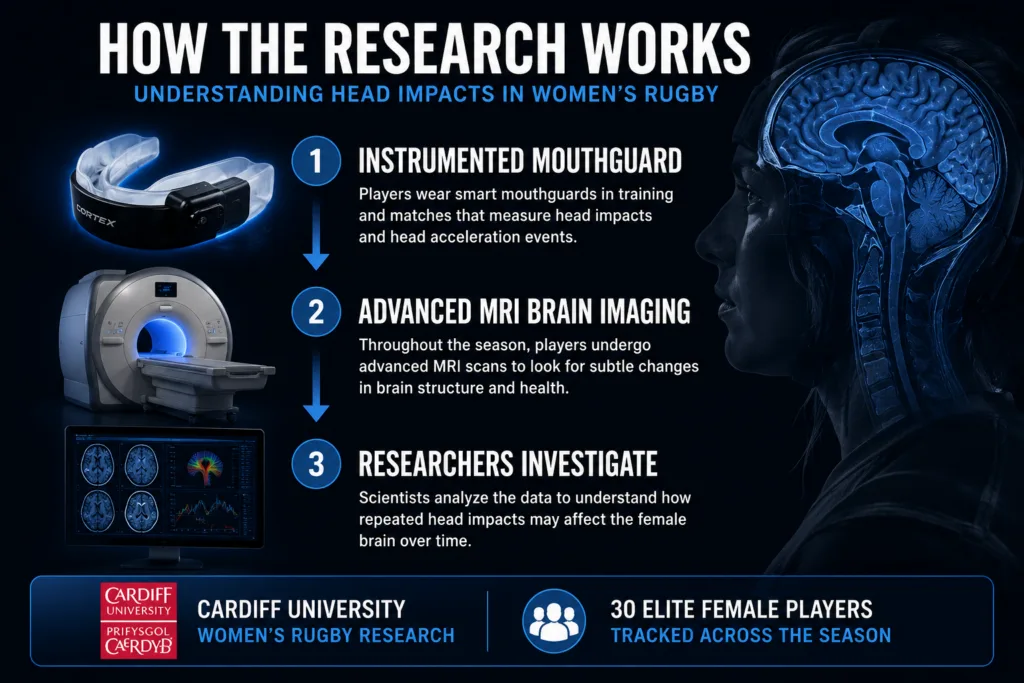
Cardiff University researchers are combining instrumented mouthguards with advanced brain imaging to investigate whether head impacts in women’s rugby need to be understood differently from those in the men’s game.
Cardiff University researchers are tracking 30 female rugby players with instrumented mouthguards this season, while a smaller group undergoes repeated advanced MRI brain scans, as part of a study examining what repeated head impacts mean for the female brain.
The project combines measurements taken on the field with brain imaging and computational modelling, with the longer-term goal of building better female-specific evidence for brain-health guidance in rugby.
The research does not start from the assumption that rugby’s existing concussion protocols are unsafe for women or that female players necessarily require different rules.
Instead, it asks a fundamental question: does the same measured head impact carry the same biological significance for a woman as it does for a man?
Former Wales international Elinor Snowsill summarized the wider issue when speaking to BBC Sport Wales:
“We are not just mini versions of men.”
Watch: Tackling the Gender Gap in Sport Research
Why women may be different
Research has identified possible differences in concussion susceptibility, symptoms and recovery between male and female athletes.
Evidence cited in reporting on the Cardiff project suggests female athletes can be more susceptible to concussion and may experience longer recovery periods. Different symptom patterns have also been reported, including prolonged headaches, mental fatigue and difficulty concentrating.
Exactly why remains uncertain. Potential explanations include physiological and anatomical differences, neck strength, training history and differences in the way men’s and women’s rugby is played.
Women are not absent from existing rugby research. One peer-reviewed study used instrumented mouthguards with 92 male and 72 female elite rugby players, collecting data across 406 player-match observations.
What makes the Cardiff project particularly interesting is the attempt to go beyond recording impacts and connect those measurements with advanced imaging of the female brain.
How rugby currently protects players
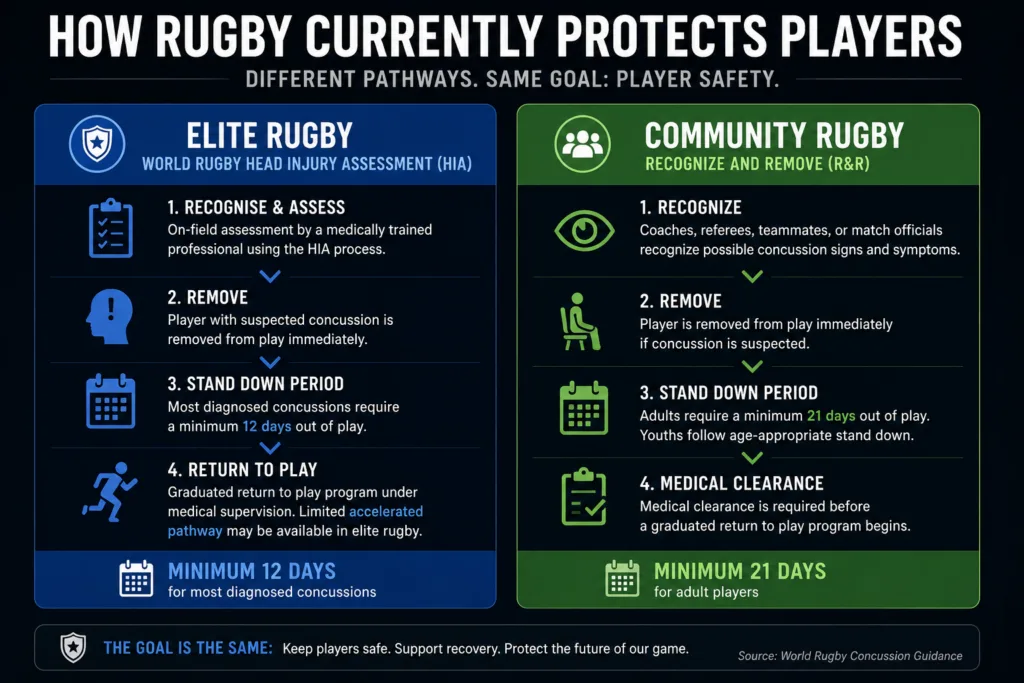
At the elite level, World Rugby uses a multi-stage Head Injury Assessment process that begins with identifying potentially concerning incidents during a match and continues with assessments after the game and during recovery.
Instrumented mouthguards, or iMGs, are increasingly part of that process. The sensors measure linear and angular movement of the head, and an alert above the applicable clinical threshold can be one of the reasons a player undergoes an HIA1 assessment.
The mouthguard does not diagnose concussion. It provides information alongside direct observation, video review and medical assessment.
Importantly, World Rugby already requires female players to be included in on-field validation of the technology. Its specification calls for data from 30 male and 30 female player-matches to establish whether devices accurately identify head acceleration events.
Laboratory validation uses a headform attached to a Hybrid III 50th-percentile male neck, but that test is designed to determine whether the sensor measures head movement accurately, not how much impact a male or female brain can safely tolerate.
That distinction matters: engineering validation can establish whether a device accurately measures an impact; clinical research must establish what that measurement means for the person wearing it.
That is where the Cardiff research could add important new evidence.
World Rugby’s protocols also differ between elite and community rugby.
Most elite players diagnosed with concussion have a minimum return-to-play period of 12 days, although a limited group meeting specific criteria can potentially follow an accelerated pathway.
For community rugby, World Rugby uses Recognize and Remove. Its guidance, which explicitly applies to male and female players, provides for a minimum 21-day return-to-play period for adults outside the elite HIA pathway, subject to appropriate rehabilitation and medical clearance.
In the United States, USA Rugby follows World Rugby Regulation 10 and uses the same Recognize and Remove principle for community rugby.
Technology cannot solve everything
Better sensors and brain imaging can improve rugby’s understanding of head impacts, but concussion management still has a human element.
Former Wales centre Alecs Donovan told BBC Sport Wales that she continued playing after suffering a concussion that was not recognized at the time.
“It wasn’t the coaches or the medical team that knew I was concussed because I carried on playing.”
Days later, while working as a medical representative, a doctor noticed how she was feeling and suggested she might be concussed.
Snowsill similarly recalled players being reluctant to report possible concussions because they knew it could mean leaving the field.
That issue applies far beyond elite rugby.
USA Rugby’s concussion education includes the Stanford-linked CrashCourse program developed by TeachAids, with an emphasis on recognizing symptoms, reporting injuries and understanding why a player should not simply remain in the game.
Technology may become better at identifying potentially dangerous impacts, but it cannot entirely replace players, teammates, coaches and medical staff recognizing when something is wrong — and being willing to act.
Could women’s concussion protocols change?
Cardiff’s researchers first need evidence.
The study does not prove that women need separate concussion protocols. World Rugby already includes female players in its instrumented-mouthguard validation, and existing research has generated substantial head-impact data from female rugby players.
The unanswered question is more specific:
Are the measurements and risks identified by rugby’s existing systems always clinically equivalent for women and men?
If Cardiff’s research finds meaningful differences in how female brains respond to head impacts, that could eventually support different thresholds, assessment guidance or other female-specific measures.
It could instead strengthen the case for increasingly individualized concussion management rather than separate protocols for men and women.
For now, rugby is becoming increasingly capable of measuring what happens to a player’s head.
The challenge is understanding exactly what those measurements mean.
Women’s rugby does not need science to assume female players respond exactly like men. Nor does it need science to assume they are fundamentally different.
It needs enough female-specific evidence to find out.
RUGBY FAN CENTRAL
Latest Stories
KEEP READING.
RUGBY NEVER STOPS.
The latest from Rugby Fan Central — new stories,
match coverage and analysis from across the game.
We use cookies and similar technologies to keep Rugby Fan Central working, understand how visitors use the site, and improve your experience. With your permission, we may also use technologies for analytics, embedded content, and marketing. You can accept, deny, or manage your preferences at any time.
Functional
Always active
Required for the website to work properly and securely.
Preferences
The technical storage or access is necessary for the legitimate purpose of storing preferences that are not requested by the subscriber or user.
Statistics
The technical storage or access that is used exclusively for statistical purposes.Helps us understand how visitors use RFC so we can improve the site.
Marketing
Used for advertising, promotional measurement, and certain third-party content where applicable.