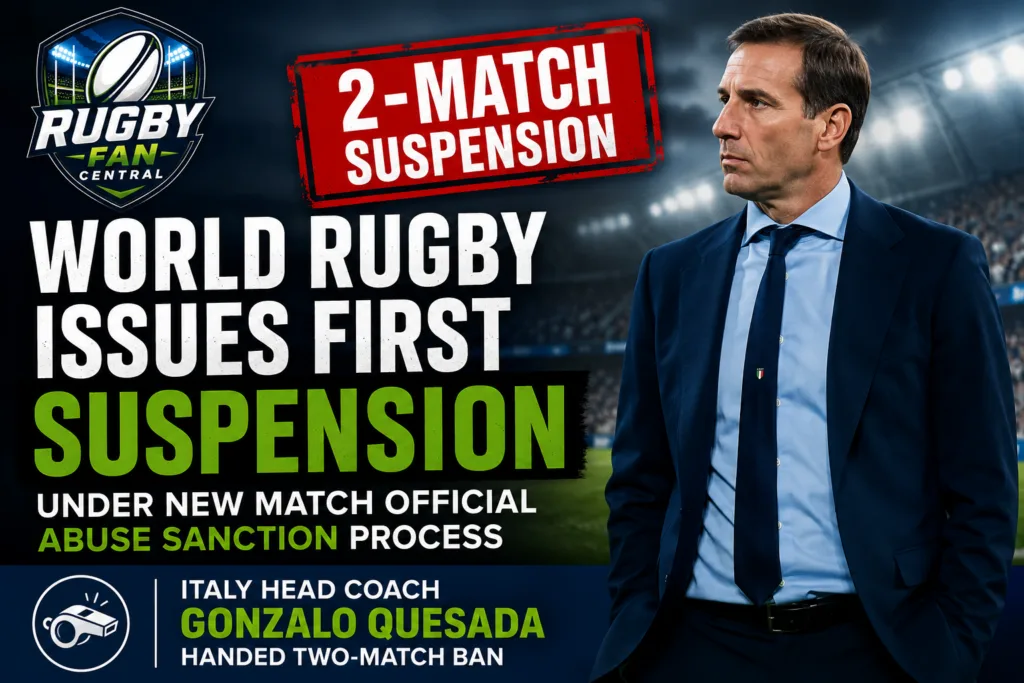
World Rugby has handed down the first suspension under its newly introduced Match Official Abuse Sanction Process, with Italy head coach Gonzalo Quesada receiving an automatic two-match ban following comments about match officiating after Italy’s Nations Championship match against New Zealand.
The decision marks the first public test of a disciplinary framework introduced in July 2026 that is designed to curb abuse directed at rugby’s match officials. It also sends a clear message that World Rugby intends to actively enforce the new policy from the outset rather than treating it as a guideline.
First Major Test of the New Framework
Under the sanction, Quesada is prohibited from all match-day activities for two matches, including being present inside the stadium.
World Rugby confirmed the suspension was issued automatically under the provisions of the Match Official Abuse Sanction Process after comments made during a post-match broadcast interview following Italy’s match against New Zealand on 11 July.
Quesada retains the right to appeal the sanction before a full judicial committee.
Why World Rugby Introduced the Policy
The Match Official Abuse Sanction Process was approved during World Rugby’s recent Shape of the Game forum and came into effect this July across international competitions involving World Rugby-appointed match officials.
The framework applies to competitions including:
- World Rugby Nations Cup
- Nations Championship
- World Rugby Junior World Championship
- WXV Global Series
- WXV Challenger
According to World Rugby, the policy was introduced in response to the increasing abuse and threats directed towards referees, assistant referees and Television Match Officials (TMOs).
The governing body also pointed to findings from its social media protection programme, which has operated since 2023. The programme found that much of the abuse aimed at match officials begins after inaccurate or inflammatory public comments made by coaches or other influential figures within the game.
How the Sanction Process Works
The new framework operates alongside World Rugby’s existing misconduct regulations.
An independent panel reviews comments made by coaches and team personnel to determine whether they undermine public confidence in match officials.
Among the issues considered are allegations that an official acted with bias, prejudice, improper motive, external influence or deliberate intent to influence the outcome of a match.
The panel also considers the context surrounding the comments, including:
- The nature and reach of the remarks.
- The timing of the comments.
- The role of the individual making them.
- Whether the comments contributed to abuse directed at match officials.
Possible outcomes range from no further action and formal guidance through to warnings or automatic sanctions, depending on the severity of the conduct.
A Significant Shift for International Rugby
Criticism of refereeing decisions has long been part of post-match rugby discussions, particularly after high-profile Test matches.
However, World Rugby has now established a dedicated process that specifically targets comments considered capable of undermining confidence in match officials.
The Quesada case therefore represents more than a disciplinary decision against one coach. It establishes an early benchmark for how the governing body intends to enforce the new framework going forward.
How consistently these sanctions are applied across all international teams and competitions will likely determine how the policy is viewed by coaches, players and supporters in the years ahead.
RFC Analysis
Protecting match officials has become one of World Rugby’s highest priorities in recent years, and this decision demonstrates that the organisation is prepared to back that commitment with meaningful sanctions.
The real significance of this case is not simply that Gonzalo Quesada has been suspended. Rather, it is that the new Match Official Abuse Sanction Process has now moved from policy to practice.
Future cases will inevitably be judged against this first decision, making consistency in enforcement critical. Coaches will undoubtedly continue to question refereeing decisions, but the boundaries around how those concerns are expressed publicly have become considerably clearer.
Whether supporters agree with the policy or not, the Quesada case is likely to be remembered as the moment World Rugby drew a new line in the ongoing effort to protect match officials from abuse.
Related Reading: Rugby Fan Central previously examined the growing issue of abuse directed at match officials during the 2025 Rugby World Cup and the calls across the sport for stronger protections for referees.