Understanding the New Era of Women’s Rugby
Part 6 of 7

Will the WXV Global Series Succeed?
By The Rugby Fan Central Team
Every major change in international sport is ultimately judged by one question.
Did it leave the game stronger than it found it?
That is now the challenge facing the WXV Global Series.
World Rugby has replaced the original WXV tournament model with a new international structure that gives national unions greater responsibility for hosting elite Test matches while creating a fixed three-year competition cycle through 2028.
The scale of the project is significant.
Eighteen national teams will participate across the WXV Global Series and WXV Global Series Challenger, with more than 100 international matches planned during the three-year cycle.
The vision is ambitious.
Whether it succeeds will depend on far more than what happens on the field.
A Calendar the Game Can Build Around
For many years, one of the biggest challenges facing women’s international rugby was the lack of a consistent annual schedule.
Long gaps between Test matches made it difficult for unions to maintain momentum, for supporters to follow their teams and for broadcasters and commercial partners to build sustained interest.
The WXV Global Series is designed to provide greater certainty.
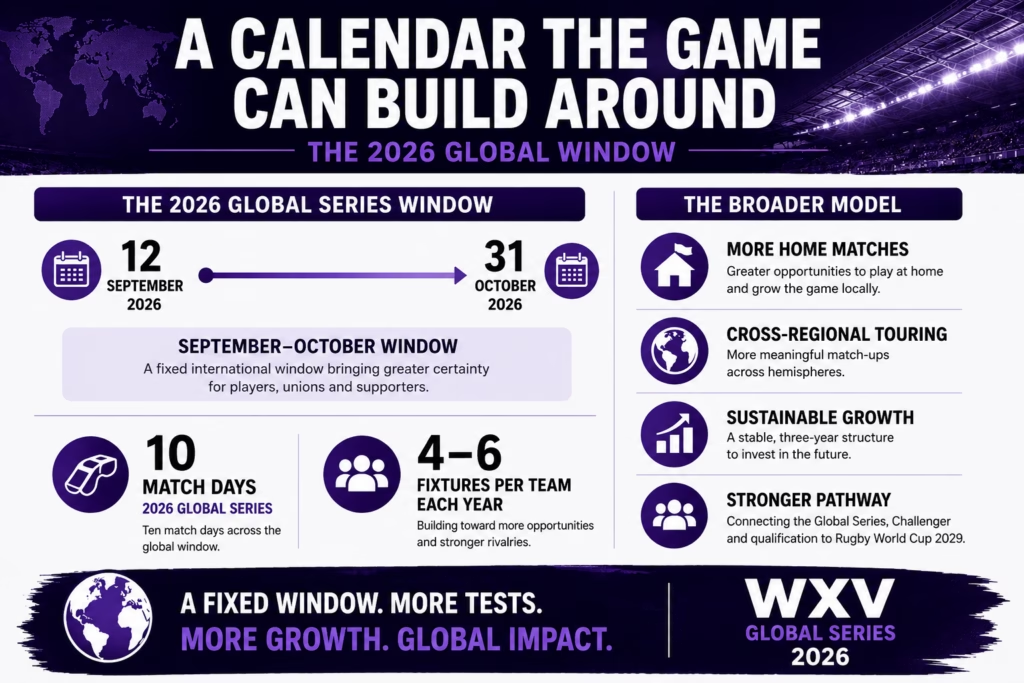
In 2026, the top 12 nations will compete across an eight-week global window running from September 12 through October 31, with 10 match days spread across September and October.
Those teams — Australia, Canada, England, France, Ireland, Italy, Japan, New Zealand, Scotland, South Africa, USA and Wales — form the top tier for the inaugural 2026–2028 cycle.
Under the wider three-year model, teams are expected to play between four and six fixtures annually during the September–October international window.
That means unions can plan further ahead.
Venues can be booked earlier. Tours can be structured more effectively. Commercial partners can build campaigns around known international windows. Supporters can begin to recognise September and October as a regular period for elite women’s Test rugby.
That consistency provides a foundation the sport has rarely enjoyed.
Better Rugby Starts with Better Preparation
One of the less obvious tests of the new format will be its effect on player welfare and high-performance planning.
The original WXV competitions brought teams together in centrally hosted tournament environments, where three matches were generally played during a relatively short period.
The WXV Global Series introduces a different model for the top 12.
Instead of travelling to one central tournament, teams will compete through a home-and-away, cross-regional touring structure.
That creates new opportunities, but also new challenges.
International rugby will still involve significant travel. Teams from Europe, North America, Africa, Asia and Oceania will continue crossing multiple time zones during international windows.
The question is whether the greater calendar certainty allows coaches and performance staff to plan travel, training, recovery and player workloads more effectively.
As the women’s game continues to professionalise, those details matter.
A successful international calendar cannot simply create more matches.
It must create an environment in which the world’s best players can consistently perform at their best.
Home Tests with Bigger Ambitions
Perhaps the most important change is the return of more international rugby to home markets.
Under the new model, unions in the top 12 can host WXV Global Series fixtures rather than sending their teams to a single central tournament.
They also retain domestic commercial rights to their home fixtures.
That creates opportunities extending far beyond home-field advantage.
Unions can develop their own ticketing strategies, sponsorship packages, community programmes and match-day experiences around women’s international rugby.
They can also begin building stronger relationships between national teams and local supporters.
The 2026 schedule provides the first real test.
The opening weekend alone includes England hosting Australia, Scotland facing Canada in Edinburgh and France playing New Zealand in Lyon.
Across the eight-week window, matches will stretch from Europe and North America to Australia and New Zealand.
The opportunity is clear.
The question is what unions do with it.
Success should not simply be measured by whether a match takes place in a home stadium.
It should be measured by whether those fixtures attract larger crowds, generate stronger commercial support and become events that supporters actively anticipate.
With Women’s Rugby World Cup 2029 approaching, home Test rugby provides unions with three years to build that audience.

The Greatest Test: Competitive Balance
No issue surrounding the new structure has generated more debate than the decision to fix the competition’s two tiers for the inaugural cycle.
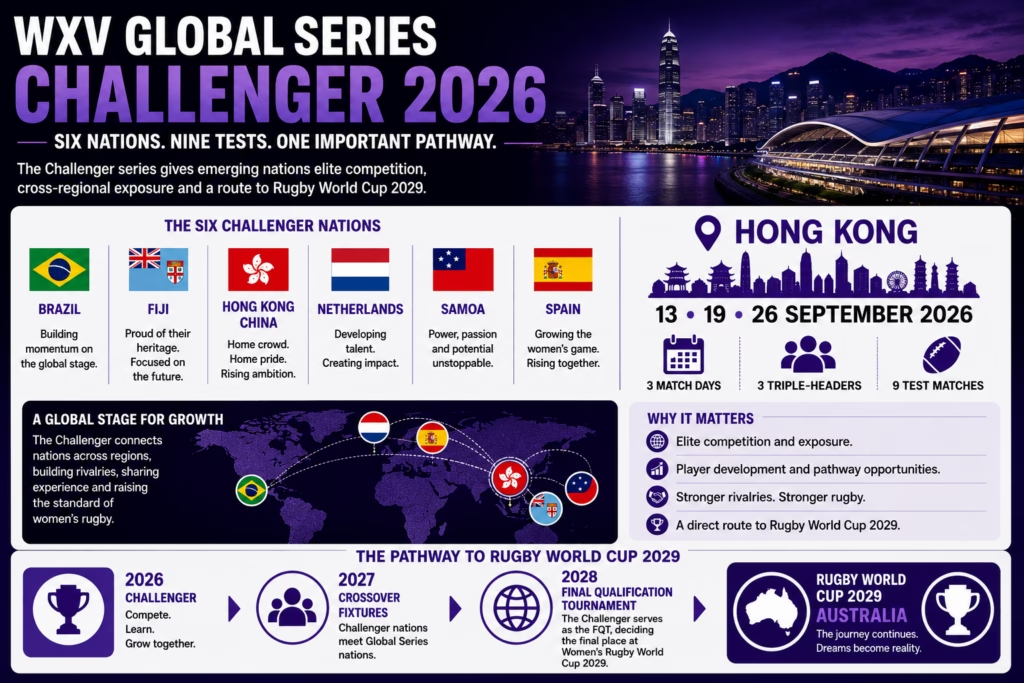
The world’s top 12 nations occupy the WXV Global Series, while Brazil, Fiji, Hong Kong China, the Netherlands, Samoa and Spain make up the WXV Global Series Challenger.
Those positions were determined by rankings following WXV 2024 and remain fixed through 2028.
Supporters of the model argue that three years of stability gives unions the confidence to invest in players, coaching, scheduling and commercial growth without the uncertainty of annual promotion and relegation.
Critics can reasonably ask what happens if a Challenger nation improves rapidly enough to compete with teams in the top 12.
There is, however, an important bridge between the two levels.
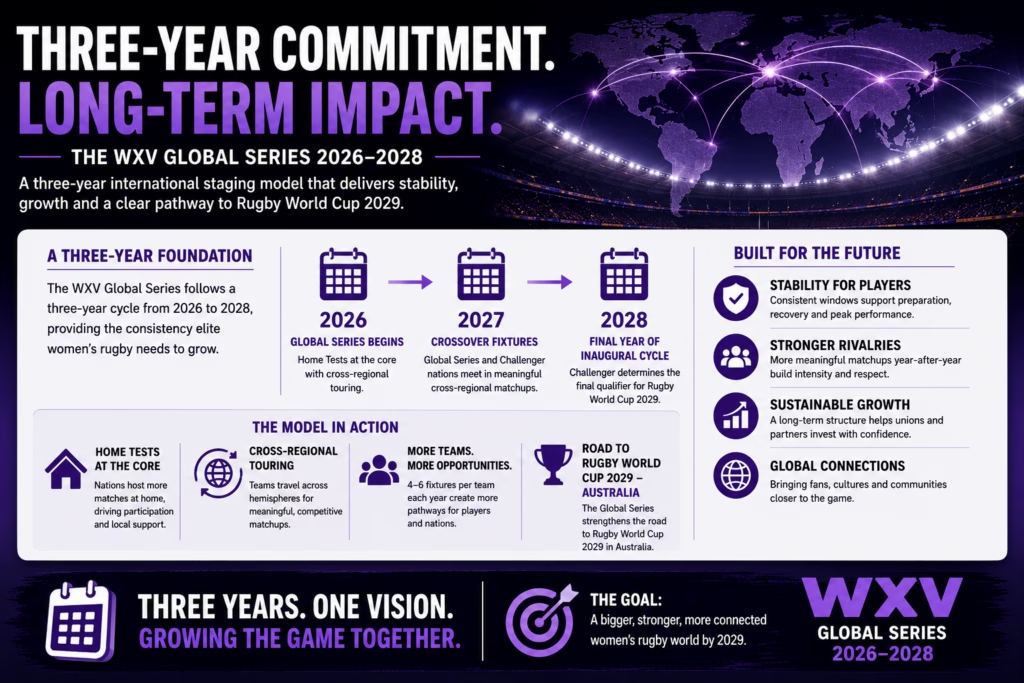
In 2027, crossover fixtures are planned between Global Series and Challenger nations around the inaugural British & Irish Lions Women’s Tour of New Zealand.
Those matches could become one of the most revealing tests of the entire structure.
If Challenger nations are competitive against established Global Series teams, the argument for greater movement between the levels after 2028 will become stronger.
If a significant competitive gap remains, the three-year stability model may appear more justified.
By the end of the inaugural cycle, World Rugby will have considerably more evidence about whether fixed tiers help emerging nations develop or simply preserve the existing hierarchy.
Challenger Has a Major Role to Play
The WXV Global Series Challenger should not be treated as an afterthought.
Its success may be just as important to the future of the system as the top competition.
For 2026, Brazil, Fiji, Hong Kong China, the Netherlands, Samoa and Spain will travel to Hong Kong for a centrally hosted competition at Kai Tak Youth Sports Ground.
Nine Test matches will be played across three triple-header match days on September 13, 19 and 26.
Unlike the home-and-away model used by the top 12, the Challenger remains centrally hosted and funded by World Rugby, helping reduce some of the financial barriers facing developing unions.
Its importance grows as the cycle progresses.
The 2028 WXV Global Series Challenger will serve as the Final Qualification Tournament for Women’s Rugby World Cup 2029, with the winner claiming the final place at the tournament in Australia.
That gives the Challenger a clear competitive purpose.
It is not simply a second division.
For at least one nation, it will become the final road to the Rugby World Cup.
A Commercial Test as Well as a Rugby Test
The WXV Global Series is also an experiment in how women’s international rugby can become more commercially sustainable.
Under the original WXV model, World Rugby operated centrally hosted competitions.
The new structure shifts more responsibility to individual unions for the top tier, with those unions retaining domestic commercial rights to their home fixtures.
That creates opportunity.
A union that successfully builds an audience around its women’s national team can benefit directly from the commercial value of those matches and potentially reinvest that revenue into its programme and player pathways.
But decentralisation also creates a challenge.
The WXV Global Series still needs to feel like one recognisable international competition even though its matches are being staged across different countries, venues and markets.
World Rugby has already taken an important step toward creating that common identity.
Mitsubishi Electric has expanded its partnership with World Rugby to become presenting partner of both the WXV Global Series and WXV Global Series Challenger through the inaugural cycle.
That provides the competition with a global commercial partner linking both levels of the structure.
The next challenge is visibility.
Supporters need to know when matches are being played, where they can watch them and why those matches matter within the wider competition.
A global series only becomes truly global if supporters can follow it.
Broadcasting Could Decide How Global the Series Really Is
This may become one of the most important off-field tests.
A schedule containing more than 100 international matches across three years represents a major increase in meaningful women’s Test rugby.
But creating matches and creating an audience for those matches are not the same thing.
The decentralised structure means fixtures will take place across numerous countries and markets rather than inside one centrally hosted tournament.
That makes accessibility critical.
Can a supporter in the United States easily find the USA Women’s Eagles?
Can someone in Europe follow matches taking place in New Zealand or Australia?
Can supporters discover Challenger fixtures involving Fiji, Brazil, Spain or Samoa?
And can a casual rugby supporter understand that all of those matches are connected to the same WXV Global Series structure?
World Rugby has said further broadcast and fan-engagement information will be confirmed around the competition.
How successfully those arrangements connect the different home markets may ultimately determine whether WXV becomes a recognisable global product rather than simply a collection of international Test matches played during the same window.
The Road to Australia 2029
WXV also sits inside a much larger objective.
Women’s Rugby World Cup 2029 in Australia will expand the importance of the international calendar throughout this cycle.
Australia qualifies automatically as host, while England, Canada, New Zealand and France secured their places through their top-four finishes at Women’s Rugby World Cup 2025.
Eight additional teams will qualify through regional competitions in 2027.
The two highest-ranked non-qualified nations in the World Rugby Women’s Rankings at the end of the 2027 international window will also qualify.
That leaves one final place.
It will be decided through the 2028 WXV Global Series Challenger, which will function as the Final Qualification Tournament.
That means results throughout this cycle matter.
For established nations, WXV provides preparation and high-level competition ahead of Australia 2029.
For emerging nations, the system is part of the qualification pathway itself.
How Should Success Be Measured?
By the end of 2028, the WXV Global Series should be judged against more than the results on the scoreboard.
There will be enough evidence to ask some important questions.
- Are more supporters attending women’s Test matches?
- Are more international matches consistently available to television and streaming audiences?
- Are unions successfully turning home Tests into commercially valuable events?
- Are players receiving better preparation, recovery and high-performance support?
- Are Challenger nations becoming more competitive with the established top 12?
- Have the 2027 crossover fixtures demonstrated that the pathway between the two levels is working?
- Has greater calendar certainty encouraged unions to invest more heavily in their women’s programmes?
- Has WXV developed an identity supporters recognise and understand?
There is another measurement that may be even more important.
What happens after 2028?
If unions want more home Tests, broadcasters want more matches, commercial partners want to remain involved and emerging nations have become stronger, that will say more about the success of the system than any marketing campaign.
The first three years are effectively the proof of concept.
Final Whistle
The WXV Global Series is more than a new tournament.
It is an attempt to change the way elite women’s international rugby operates.
Eighteen nations.
Two competition levels.
More than 100 international matches across three years.
Home-and-away cross-regional touring for the world’s top 12.
A World Rugby-funded Challenger competition for six emerging nations.
Crossover fixtures in 2027.
And a pathway running directly toward Women’s Rugby World Cup 2029.
The structure is now in place.
The question is what rugby does with it.
Its success will not be determined by a single match, a single season or even a single Rugby World Cup.
It will be judged by whether these three years produce stronger national programmes, larger audiences, healthier commercial partnerships, better-supported players and more competitive international rugby.
By the time Women’s Rugby World Cup 2029 begins in Australia, rugby should have its answer.
If the WXV Global Series delivers on those ambitions, it won’t simply have changed the calendar.
It will have helped redefine the future of the women’s game.
Coming Tomorrow
WXV Explained – Part 7 of 7
Beyond 2029: The Future of Women’s Rugby
The WXV Global Series is only the beginning.
In the final article of the series, we look beyond the inaugural cycle to explore how the next decade could reshape women’s rugby — from professional leagues and global competitions to emerging nations, investment and the long-term vision for the sport.
WXV Explained Series
✅ Part 1: Why the WXV Global Series Was Created
✅ Part 2: How the WXV Global Series Works
✅ Part 3: Inside the WXV Global Series Challenger
✅ Part 4: Why Are the Rankings Fixed?
✅Part 5: How the WXV Global Series Supports Women’s Rugby World Cup 2029 Qualification
✅ Part 6: What the WXV Global Series Means for Women’s Rugby
✅ Part 7: The Future of the WXV Global Series