Understanding the New Era of Women’s Rugby
Part 1 of 7

Why the WXV Global Series Was Created
By The Rugby Fan Central Team
Women’s rugby has never had more momentum.
Record crowds, growing television audiences and increased investment in professional programmes have driven the sport to new heights. The success of Women’s Rugby World Cup 2025 confirmed that interest in elite women’s rugby continues to grow around the world.
The challenge for World Rugby was what came next.
How could that momentum be maintained between Rugby World Cups? How could more nations play meaningful Test rugby every year? How could national unions build sustainable women’s programmes while giving supporters more opportunities to watch their teams compete at home?
World Rugby’s answer is the WXV Global Series—a new three-year international framework designed to provide greater certainty, more meaningful fixtures and a clearer pathway towards Women’s Rugby World Cup 2029.
Across this seven-part series, Rugby Fan Central explains why the competition was created, how it works and what it could mean for the future of women’s international rugby.
We begin with the question at the heart of it all.
Why was the WXV Global Series created?
Building on the Success of WXV
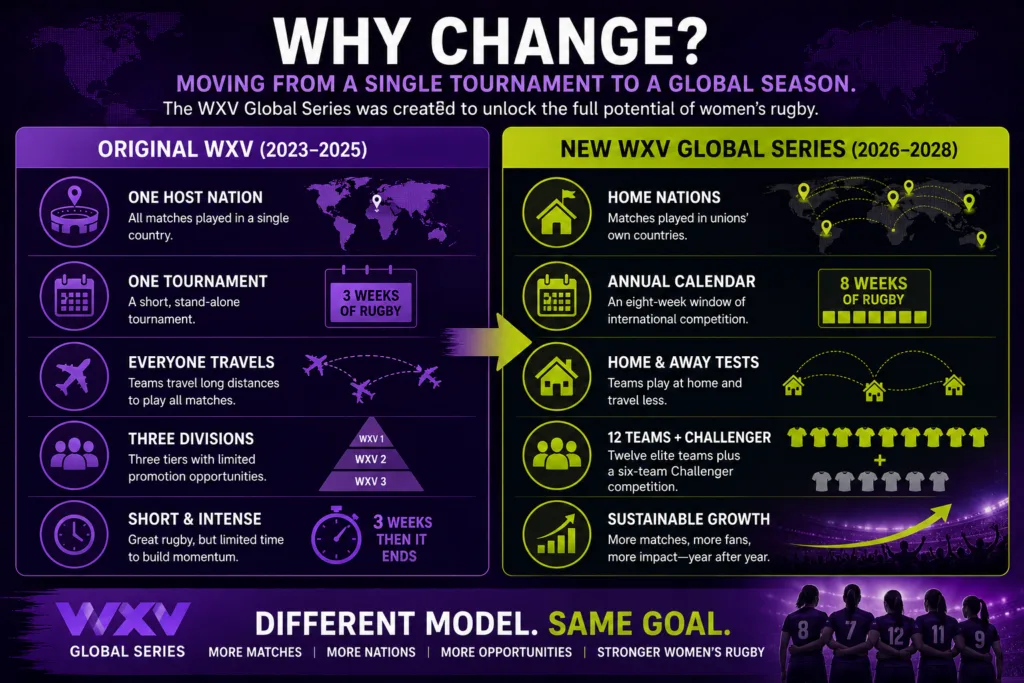
When WXV launched in 2023, it achieved its primary objective by creating an annual global competition featuring the world’s leading women’s teams outside of the Rugby World Cup.
For the first time, the world’s best nations had a structured annual competition designed specifically for the women’s international game. Standards improved, meaningful Test matches became more frequent and the competition helped build momentum leading into Women’s Rugby World Cup 2025.
However, as the game continued to grow, the original format also revealed its limitations.
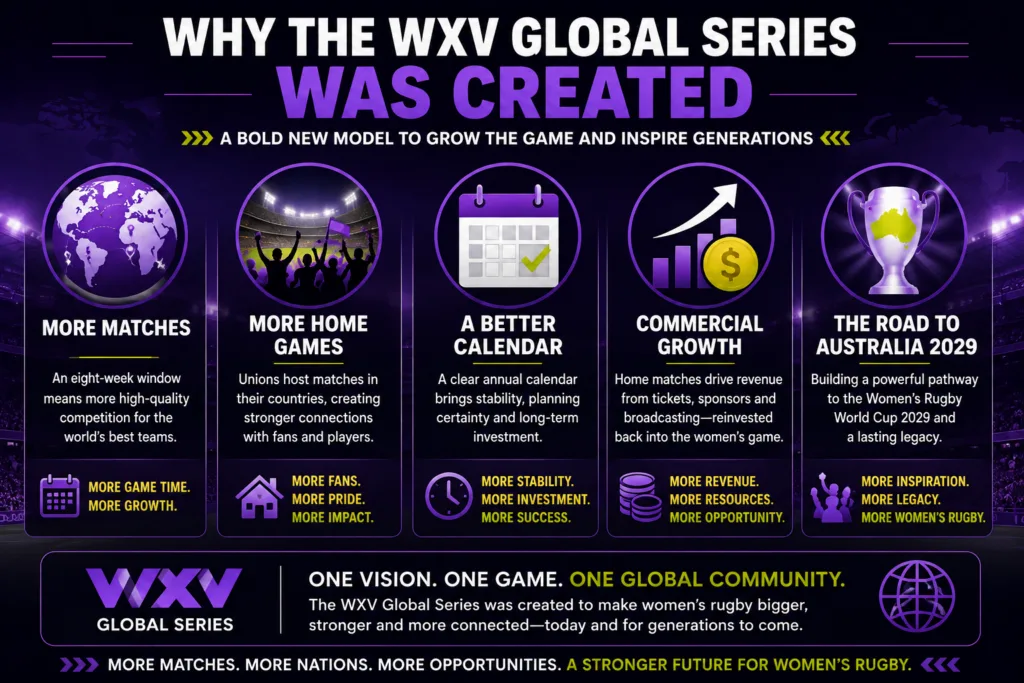
Because every tournament was hosted in a single country, supporters in nations such as the USA, Canada, England, France and Ireland rarely had the opportunity to watch their teams play meaningful autumn Test matches at home. While the centralised model simplified tournament operations, it offered fewer opportunities for unions to build local audiences, attract commercial partners and grow the women’s game within their own markets.
World Rugby believed the next stage of growth required a different approach.
A Global Calendar Instead of a Single Tournament
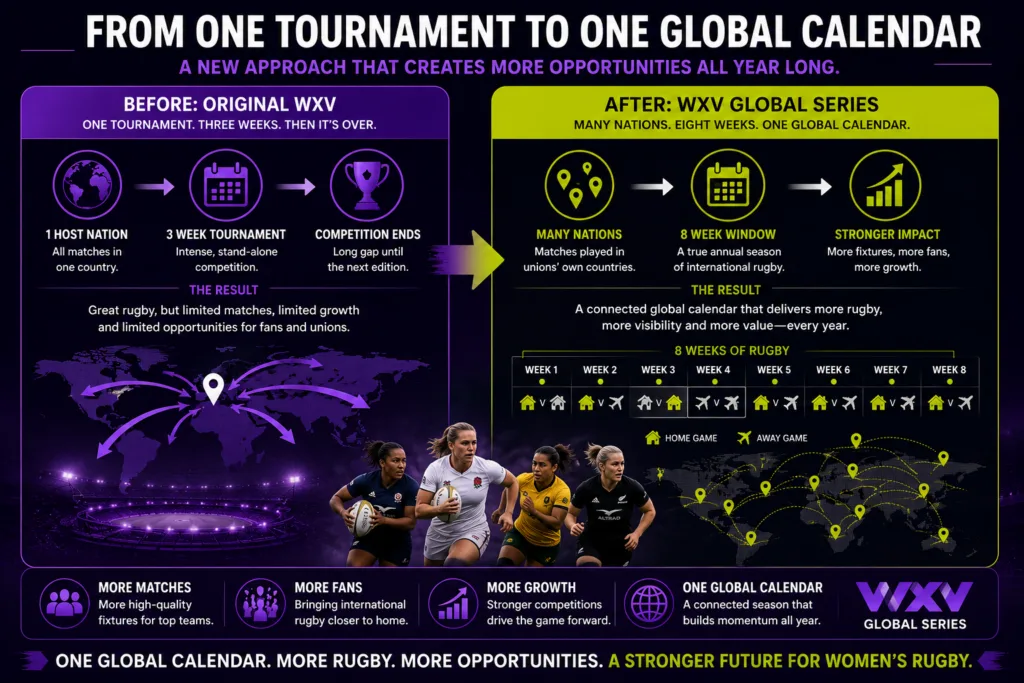
Rather than gathering every team at a single host tournament each autumn, the WXV Global Series introduces a structured international calendar running from 2026 to 2028.
Across the three-year cycle, more than 100 international matches are expected to be played, giving players regular opportunities to compete against world-class opposition while providing coaches, supporters and national unions with greater certainty than ever before.
Instead of isolated tours and occasional Test windows, women’s international rugby now has a dedicated international season built around elite competition.
The emphasis shifts from one annual tournament to a connected international calendar designed to support long-term growth.
Why Two Competitions?
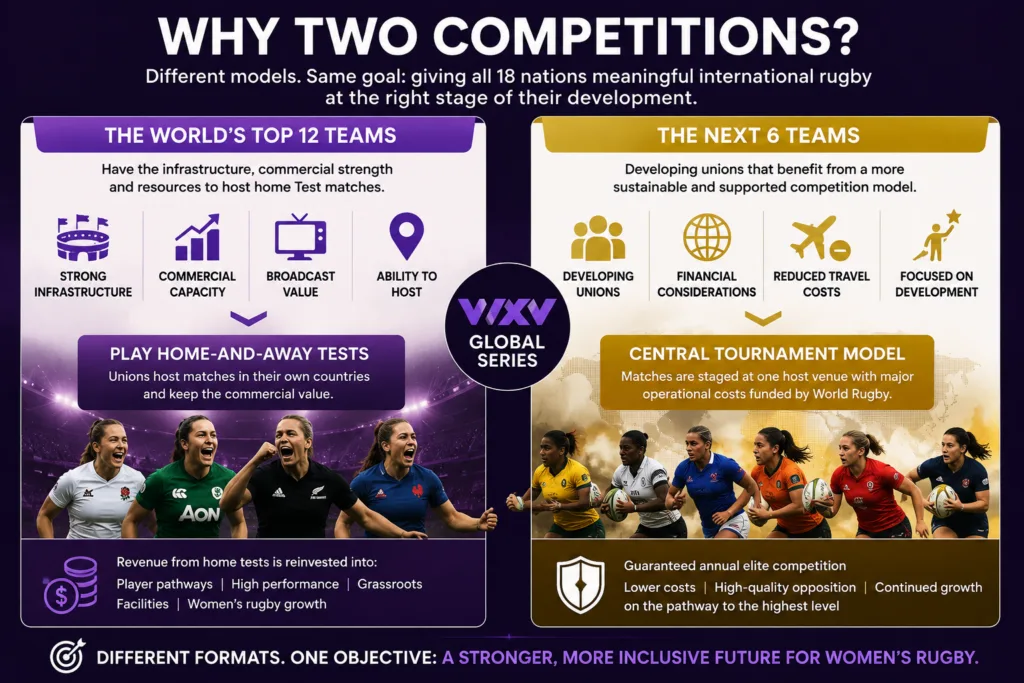
At first glance, dividing 18 teams into two competitions may seem complicated.
In reality, it reflects the different circumstances facing national unions.
The WXV Global Series features the world’s top 12 teams, whose unions generally have the infrastructure, financial resources and commercial capacity to host home Test matches.
The WXV Global Series Challenger serves the next six ranked nations. Rather than asking those unions to finance multiple international tours, World Rugby will stage the competition at a central venue and fund many of the major operational costs. The model reduces financial barriers while guaranteeing annual elite competition for developing unions.
Different formats—but one objective: ensuring all 18 participating nations receive meaningful international rugby appropriate to their stage of development.
More Than Rugby
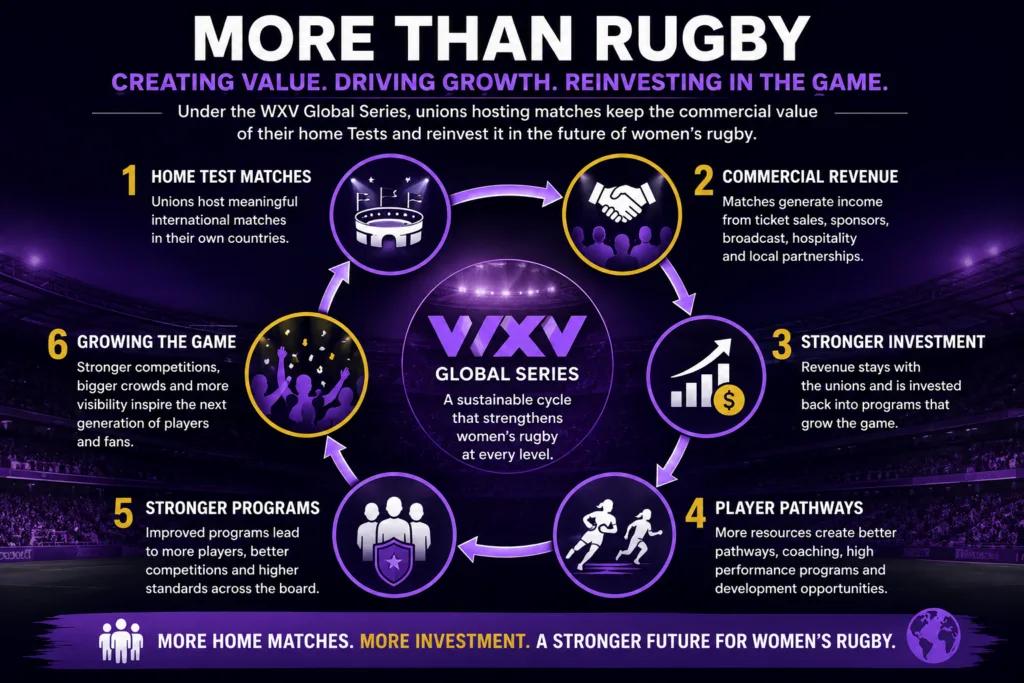
One of the biggest changes happens away from the field.
Under the new model, unions hosting WXV Global Series fixtures retain the commercial value of their home Tests. That creates opportunities to grow ticket sales, attract sponsors, develop hospitality programmes and strengthen domestic broadcast agreements.
Rather than concentrating those opportunities at a single tournament host, the WXV Global Series allows individual unions to reinvest the revenue generated by home internationals back into player pathways, coaching, high-performance programmes and the continued growth of the women’s game.
For many unions, those long-term commercial opportunities may prove just as significant as the rugby itself.
The Road to Australia 2029
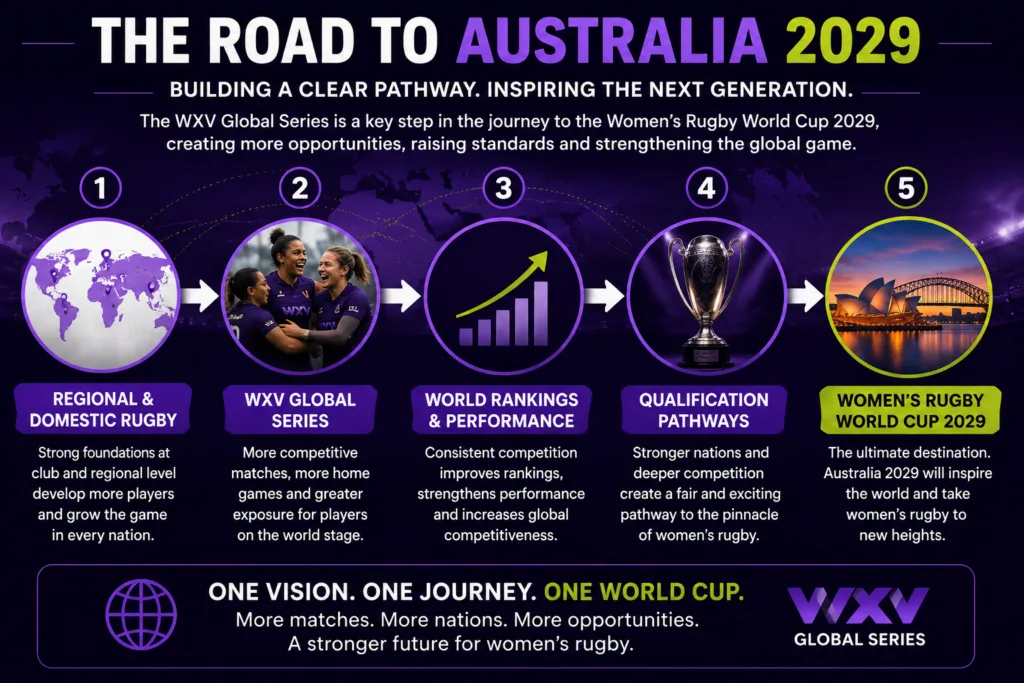
The WXV Global Series is not simply another tournament.
It forms a central pillar of the qualification pathway to Women’s Rugby World Cup 2029.
Regular international competition gives established teams consistent elite opposition while ensuring emerging nations continue to gain valuable Test experience between Rugby World Cups. Alongside regional qualification tournaments and the World Rugby Rankings, the new structure creates a clearer pathway for nations hoping to reach Australia in 2029.
The objective is straightforward: strengthen the overall standard of women’s international rugby through consistent, meaningful competition.
Final Whistle
The original WXV proved there was an appetite for an annual global women’s competition.
The WXV Global Series represents the next stage of that evolution. Rather than focusing on a single tournament each autumn, the new model creates a structured international calendar designed to provide greater certainty, more meaningful fixtures, stronger commercial opportunities and a clearer pathway towards Women’s Rugby World Cup 2029.
Whether it achieves everything World Rugby hopes will only become clear over the next three seasons.
What is already certain is that women’s international rugby has entered a new era. The conversation is no longer simply about staging another tournament—it’s about creating a sustainable international calendar that gives players, unions and supporters more opportunities than ever before.
And that may prove to be the WXV Global Series’ greatest legacy.
Continue the Series
WXV Explained – Part 2 of 7
How the WXV Global Series Works
Now that you’ve explored why World Rugby introduced the WXV Global Series, it’s time to understand how the new competition actually works.
In Part 2, we explain:
- 🌍 How the new home-and-away format operates across multiple countries
- 🏆 Why the competition is divided into the WXV Global Series and the WXV Global Series Challenger
- 📅 How the dedicated September–October international window provides greater certainty for players, unions and supporters
- 🏉 How the new structure creates a sustainable annual calendar on the road to Women’s Rugby World Cup 2029
WXV Explained Series
✅ Part 1: Why the WXV Global Series Was Created
✅ Part 2: How the WXV Global Series Works
✅ Part 3: Inside the WXV Global Series Challenger
✅ Part 4: Why Are the Rankings Fixed?
✅Part 5: How the WXV Global Series Supports Women’s Rugby World Cup 2029 Qualification
✅ Part 6: What the WXV Global Series Means for Women’s Rugby
✅Part 7: The Future of the WXV Global Series