Understanding the New Era of Women’s Rugby
Part 7 of 7

Beyond 2029: The Future of Women’s Rugb
By The Rugby Fan Central Team
Every generation of rugby has its defining moments.
The launch of the Rugby World Cup transformed the international game. Professionalism reshaped how athletes trained and competed. The Olympic return of rugby sevens introduced the sport to new audiences around the world.
The WXV Global Series may prove to be another of those moments.
Not simply because it introduces a new competition structure, but because it attempts to solve one of the biggest challenges women’s rugby has faced for decades: creating a sustainable international calendar that allows players, unions and fans to build towards something bigger than a single Rugby World Cup.
Whether it succeeds will help shape the sport well beyond Australia 2029.
A Connected Global Season
For much of its history, women’s international rugby has been defined by isolated moments.
Regional championships, occasional tours and Rugby World Cups created unforgettable memories, but they rarely formed part of a consistent global rhythm.
The WXV Global Series is designed to change that.
For the top 12 nations, the inaugural 2026 competition will operate across an eight-week global window from 12 September through 31 October, with teams playing cross-regional fixtures at home and abroad. World Rugby says more than 100 internationals will be played across the wider 2026–2028 cycle.
The Challenger provides the other half of that structure. Fiji, Hong Kong China, the Netherlands, Samoa, Spain and Brazil will contest the 2026 tournament in Hong Kong across three triple-header matchdays on 13, 19 and 26 September.
Together, the two competitions create a clearer annual rhythm around which unions, players, domestic competitions and fans can plan.
That consistency has the potential to transform international rugby from a collection of events into a recognisable annual season.
Building Careers, Not Just Calendars
Perhaps the most important change will never appear on a fixture list.
A predictable international calendar does not guarantee professional contracts.
But it gives unions, sponsors and domestic competitions greater certainty around which longer-term investment decisions can be made.
For many international players, representing their country has historically meant balancing elite rugby with careers, university studies or other employment.
The future success of the women’s game should increasingly be measured by how many athletes can prepare and compete in genuinely professional environments.
The WXV Global Series cannot achieve that on its own.
But greater certainty around international fixtures creates better conditions for unions to build high-performance programmes, attract commercial investment and make longer-term commitments to players.
Strong Domestic Competitions Remain Essential
International rugby can only be as strong as the domestic game beneath it.
Around the world, established competitions continue to raise professional standards. Premiership Women’s Rugby in England, Super Rugby Aupiki in New Zealand, Super Rugby Women’s in Australia, Elite 1 Féminine in France, the Celtic Challenge and Women’s Elite Rugby in the United States are all strengthening the pathway from domestic rugby to the international stage.
At the same time, emerging rugby nations need their own sustainable pathways.
Those programmes may receive less international attention, but they are essential if the WXV Global Series Challenger is eventually to produce more nations capable of consistently challenging the world’s leading teams.
The international calendar can create opportunity.
Domestic systems ultimately determine how effectively nations can use it.
More Than a World Cup Every Four Years
Women’s Rugby World Cups will always remain the pinnacle of the international game.
The challenge has been sustaining attention between tournaments.
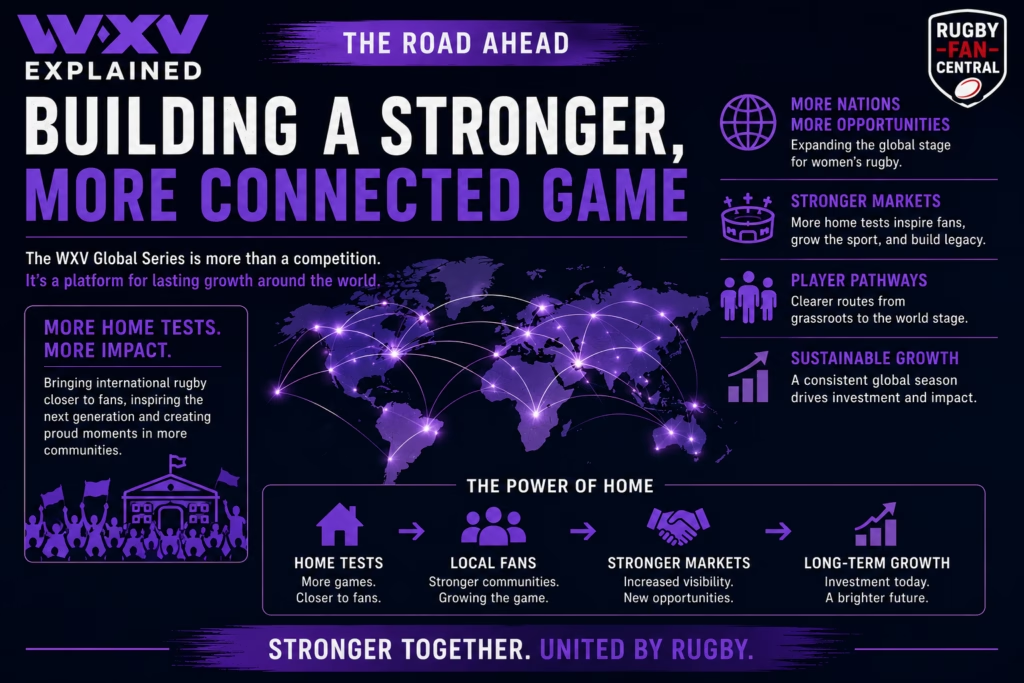
The WXV Global Series provides annual cross-regional fixtures and home Tests that allow fans to follow the development of their national teams across multiple seasons rather than reconnecting every four years.
It also creates something women’s rugby increasingly needs: inventory.
Regular international fixtures give broadcasters content to show, sponsors events to support, venues matches to sell and fans dates to put on their calendars.
World Rugby’s expanded partnership with Mitsubishi Electric Europe, covering both the Global Series and Challenger through the inaugural cycle, provides an early example of the commercial opportunities the new structure is intended to create.
If that annual rhythm produces stronger audiences and greater visibility, the benefits could extend well beyond WXV itself.
The Road to Australia 2029
The next Women’s Rugby World Cup is not separate from this new structure.
It is deeply connected to it.
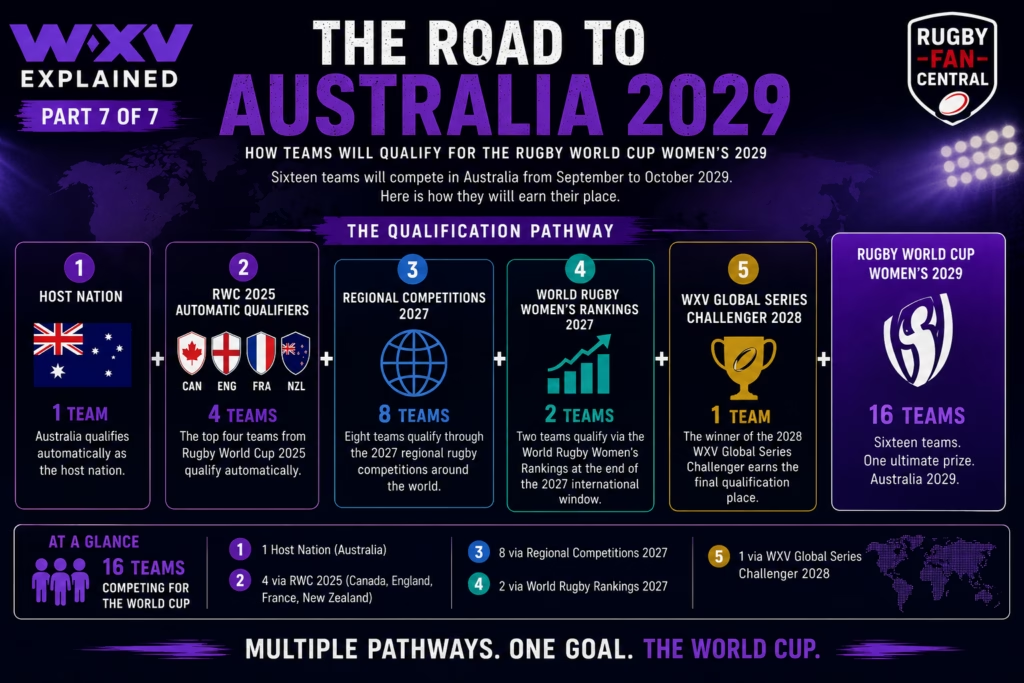
Australia qualifies automatically as host, while England, Canada, New Zealand and France have already qualified through their top-four finishes at Women’s Rugby World Cup 2025.
Eight further places will be determined through regional competitions in 2027. The two highest-ranked non-qualified nations at the end of the 2027 international window will also qualify.
That leaves one final place.
It will be decided through the 2028 WXV Global Series Challenger, which will serve as the Final Qualification Tournament.
That gives the Challenger stakes extending far beyond the competition itself.
For at least one nation, the road to Australia will ultimately run directly through WXV.
2027 Will Test the Structure
There is another important stage before then.
The inaugural British & Irish Lions Women’s Tour to New Zealand will reshape the 2027 international calendar.
World Rugby has confirmed that nations not involved in that tour will play crossover fixtures, including matches between Global Series and Challenger teams.
That creates an important opportunity.
The participating groups are fixed through the 2026–2028 cycle, so there is no annual promotion or relegation between the Global Series and Challenger during this period.
The 2027 crossover fixtures therefore offer one of the clearest opportunities during the inaugural cycle to see how Challenger nations measure themselves against teams from the top 12.
Those matches could provide valuable evidence about how competitive the two groups really are — and what the structure might need to become after 2028.
Innovation Beyond the Field
The future of women’s rugby will not be shaped by competition structures alone.
Sports science, performance analysis, athlete welfare and medical support continue to change how elite players prepare for international rugby.
WXV itself will contribute to that process.
World Rugby has extended its trial of the women’s-specific size 4.5 ball into the 15s game through the WXV Global Series, with player feedback, injury surveillance and game data forming part of the evaluation.
At the same time, streaming platforms, digital media and social channels continue to transform how fans discover, watch and engage with women’s rugby.
The challenge for World Rugby and its member unions will be ensuring that innovation away from the field keeps pace with the ambition shown on it.
The Next Challenge
The next three years will provide the first real test of whether the new structure works.
Did home Tests build larger audiences?
Did unions create greater commercial value from hosting matches?
Did the Challenger provide developing nations with the competition they need?
Did the gap between established and emerging nations begin to narrow?
Did players gain stronger professional environments?
Did broadcasters make international women’s rugby easier to find and watch?
And did more fans begin following women’s international rugby throughout the year rather than primarily during a Rugby World Cup?
Those questions matter because the current structure is not necessarily the final destination.
The Global Series and Challenger groups are fixed for the inaugural 2026–2028 cycle. What comes after that will be one of the most important decisions World Rugby and the participating unions face as the women’s international calendar continues to develop.

Final Whistle
The WXV Global Series is not the end of women’s rugby’s story.
It is the beginning of its next chapter.
Its success will not ultimately be measured simply by standings, trophies or even Rugby World Cup results.
It will be measured by whether home Tests create stronger rugby markets, whether unions build sustainable professional programmes, whether emerging nations become more competitive, whether players gain better career opportunities and whether fans begin following women’s international rugby year after year.
The first three-year cycle will provide the evidence.
Those answers — not simply who lifts the trophies — will determine whether the WXV Global Series has genuinely changed women’s rugby.
Australia 2029 is an important destination.
But the real ambition is to build a game strong enough that 2029 is not the finish line at all.
Join the Conversation
Over seven parts, Rugby Fan Central has explored why WXV changed, how the Global Series works, the role of the Challenger, why the rankings are fixed, what the new structure means for the USA Women’s Eagles, how its success should be measured and where women’s rugby could go next.
Now we’d like to hear from you.
Do you think the WXV Global Series is the right model for the future of women’s international rugby?
What would you keep — and what would you change?
Share your thoughts and join the conversation with Rugby Fan Central as the inaugural WXV Global Series begins.
WXV Explained Series
✅ Part 1: Why the WXV Global Series Was Created
✅ Part 2: How the WXV Global Series Works
✅ Part 3: Inside the WXV Global Series Challenger
✅ Part 4: Why Are the Rankings Fixed?
✅Part 5: How the WXV Global Series Supports Women’s Rugby World Cup 2029 Qualification
✅ Part 6: What the WXV Global Series Means for Women’s Rugby
✅Part 7: The Future of the WXV Global Series