Understanding the New Era of Women’s Rugby
Part 3 of 7

Inside the WXV Global Series Challenger
By The Rugby Fan Central Team
In Part 2 of our WXV Explained series, we explored how the WXV Global Series is structured, with 18 national teams divided across two competitions.
Now it’s time to take a closer look at the second half of that structure.
While the WXV Global Series features the world’s top 12 women’s rugby nations, the WXV Global Series Challengerprovides an annual international competition for the next six ranked teams.
Far from being a secondary tournament, the Challenger is a central pillar of World Rugby’s long-term strategy for growing the women’s game, providing meaningful Test rugby, reducing financial barriers and creating a clear pathway towards Women’s Rugby World Cup 2029.
Why Create a Challenger?
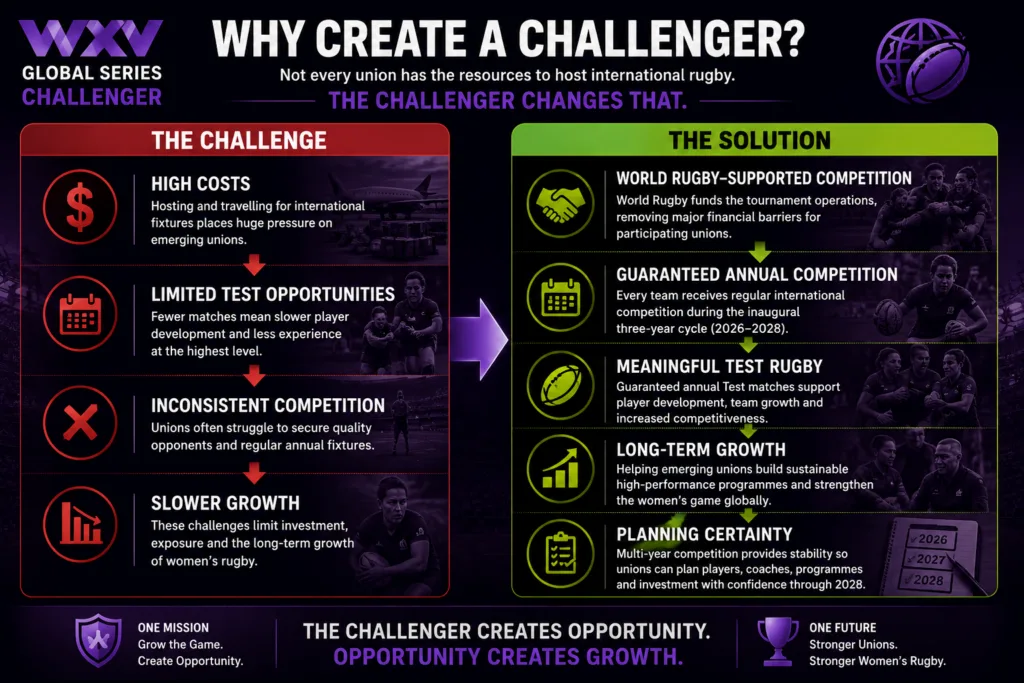
Not every national union has the same financial resources, player depth or commercial infrastructure as the world’s leading rugby nations.
Asking every developing union to organise annual home-and-away international tours would place significant pressure on budgets while limiting opportunities to play meaningful Test rugby.
Instead, World Rugby has created a competition that is fully funded by the governing body, removing many of the financial barriers that have traditionally limited international opportunities for emerging teams.
The result is a competition that guarantees annual elite Test rugby while allowing unions to plan their programmes with confidence throughout the inaugural three-year cycle from 2026 to 2028.
Rather than asking emerging unions to meet the same hosting requirements as the world’s largest rugby nations, the Challenger provides a sustainable model that keeps those teams competing regularly at the highest possible level.
Who Competes?
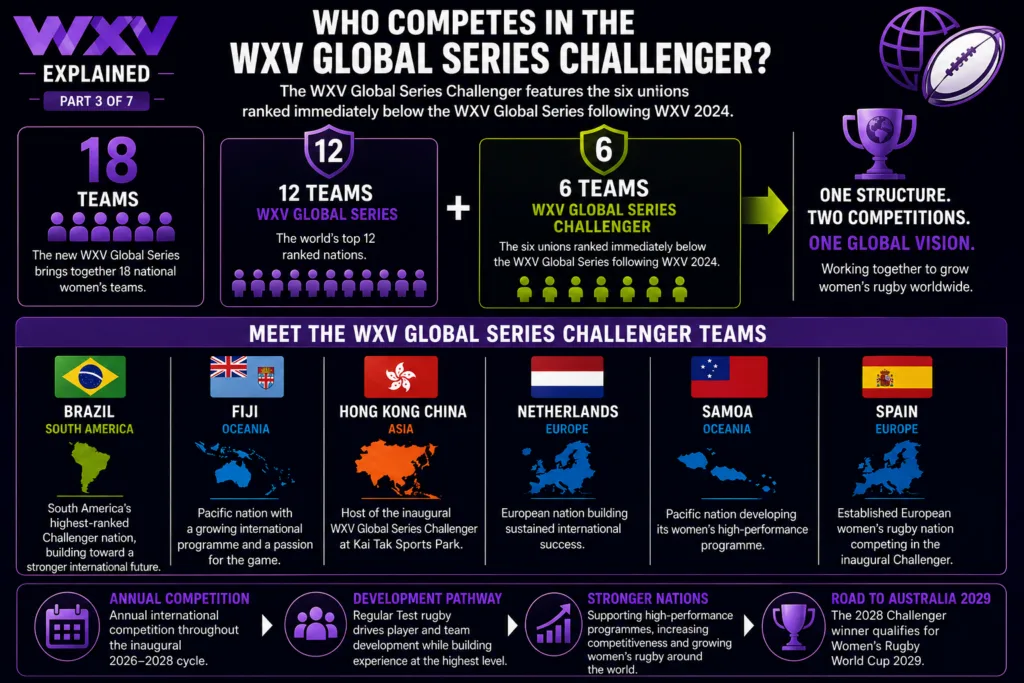
The Challenger features the six unions ranked immediately below the WXV Global Series following the conclusion of WXV 2024.
Those teams are:
- Brazil
- Fiji
- Hong Kong China
- Netherlands
- Samoa
- Spain
Representing South America, Europe, Asia and the Pacific Islands, these six unions will remain together throughout the inaugural 2026–2028 cycle, giving every nation certainty of competition over the next three seasons.
Why Hong Kong?
Unlike the touring model used by the WXV Global Series, the Challenger is played at a single destination.
The inaugural tournament will be hosted at Kai Tak Youth Sports Ground in Hong Kong as part of the wider Kai Tak Sports Park precinct.
Bringing every team together in one location allows World Rugby to centralise tournament operations, reduce travel costs and deliver a high-quality international competition that would be difficult for many participating unions to stage independently.
The central-host model also creates a festival atmosphere, with supporters able to experience multiple international Test matches across each matchday while giving players access to consistent facilities, medical support and high-performance environments throughout the tournament.
A Festival of International Rugby
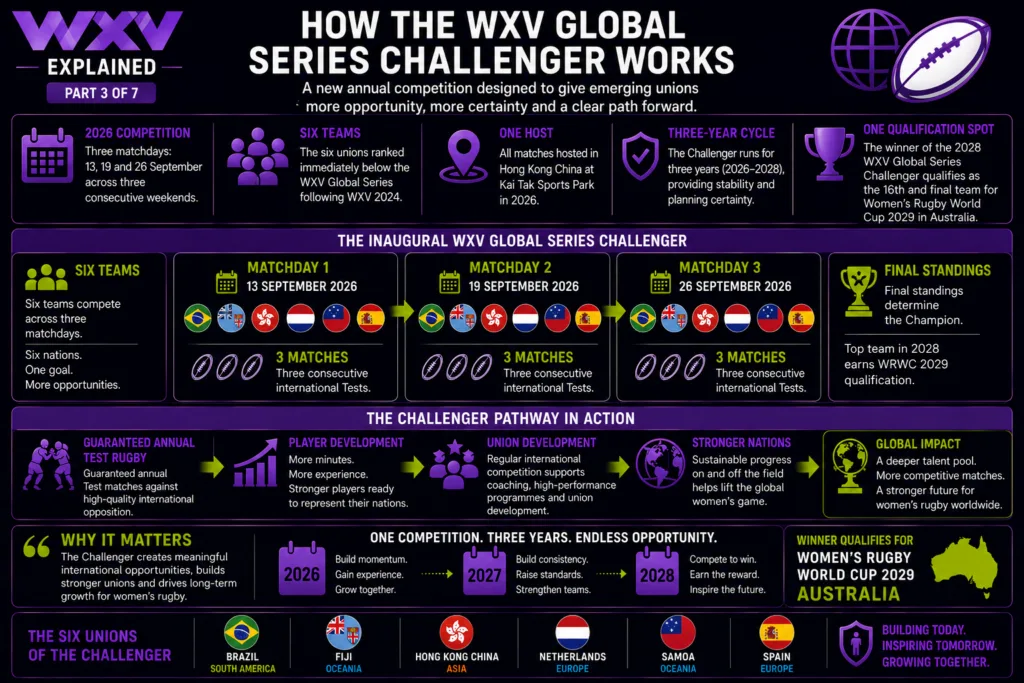
The inaugural Challenger will be played across 13, 19 and 26 September 2026, with each matchday featuring three consecutive international Test matches.
Rather than spreading fixtures across multiple countries, the tournament adopts a festival-style format that allows supporters to watch three international Tests on a single day while creating a unique atmosphere for players, coaches and fans alike.
It is a very different experience from the touring model used by the WXV Global Series, but one specifically designed to maximise meaningful competition while keeping costs manageable for every participating union.
More Than a Tournament
The Challenger is about much more than deciding a champion.
The six participating unions are guaranteed annual international competition throughout the inaugural cycle, giving players, coaches and administrators the certainty needed to plan:
- High-performance programmes
- Player development pathways
- Coaching programmes
- Long-term investment
- International scheduling
That stability has often been difficult for emerging nations to achieve.
World Rugby will also continue using the competition to evaluate innovations within the women’s game, including the expanded trial of the women’s-specific Size 4.5 Gilbert ball following its introduction during the HSBC SVNS Series.
The competition therefore serves two purposes: supporting the growth of emerging unions while helping shape the future of elite women’s rugby.
The Final Road to Australia
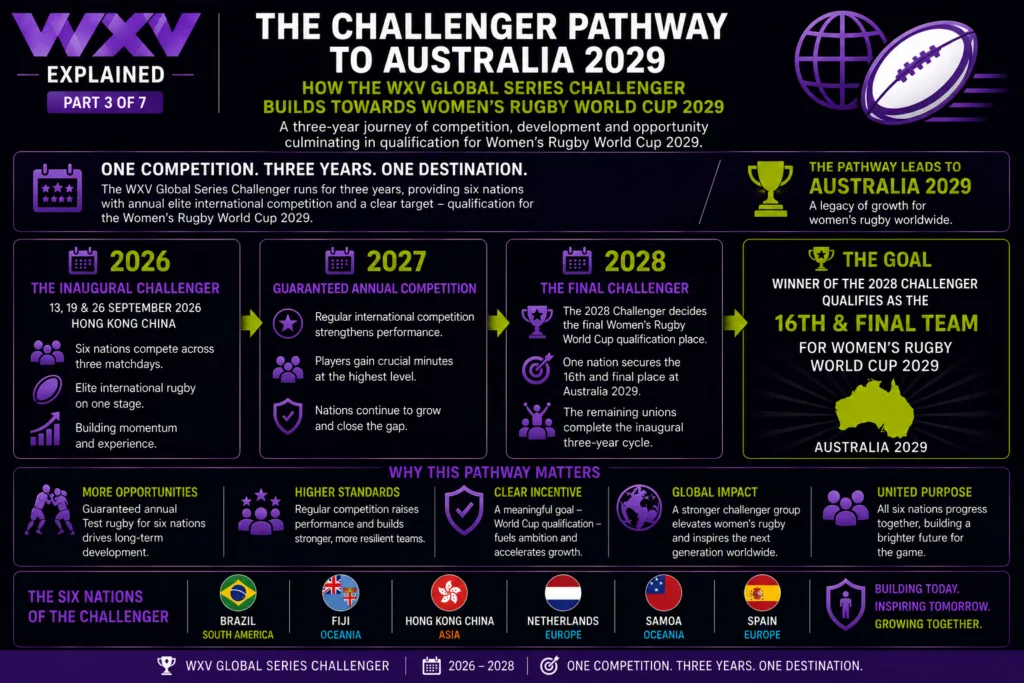
The stakes become even higher in 2028.
World Rugby has confirmed that the WXV Global Series Challenger 2028 will serve as the Final Qualification Tournament for Women’s Rugby World Cup 2029.
The winning nation will secure the 16th and final qualification place in Australia, giving every match added significance as teams compete for one of the biggest prizes in international rugby.
For the six participating nations, the Challenger is more than an annual competition—it is a genuine pathway to rugby’s biggest stage.
Final Whistle
The WXV Global Series Challenger is much more than a second-tier competition.
It guarantees meaningful annual Test rugby for six emerging nations, removes many of the financial barriers that have traditionally limited international competition and provides a clear pathway towards Women’s Rugby World Cup 2029.
Every established rugby nation was once an emerging one.
By investing in Brazil, Fiji, Hong Kong China, Netherlands, Samoa and Spain through a fully funded international competition, World Rugby is strengthening not only those six unions, but also the future depth, competitiveness and global reach of the women’s game itself.
The Challenger may not receive the same attention as the WXV Global Series, but it could prove just as important to the long-term growth of international women’s rugby.
Continue the Series
WXV Explained – Part 4 of 7
Why Are the Rankings Fixed?
If the Challenger teams are locked into the competition through 2028, how does progression actually work?
In Part 4, we explain why World Rugby froze the rankings following WXV 2024, how the three-year competition cycle provides stability for participating unions, and what happens when the inaugural cycle concludes on the road to Women’s Rugby World Cup 2029.
WXV Explained Series
✅ Part 1: Why the WXV Global Series Was Created
✅ Part 2: How the WXV Global Series Works
✅ Part 3: Inside the WXV Global Series Challenger
✅ Part 4: Why Are the Rankings Fixed?
✅Part 5: How the WXV Global Series Supports Women’s Rugby World Cup 2029 Qualification
✅ Part 6: What the WXV Global Series Means for Women’s Rugby
✅Part 7: The Future of the WXV Global Series