Understanding the New Era of Women’s Rugby
Part 4 of 7
Why Is There No Promotion and Relegation?
By The Rugby Fan Central Team
One of the biggest talking points surrounding the new WXV Global Series is that its 18 participating nations are already locked in through 2028.
Unlike many international competitions, there will be no annual promotion or relegation between the WXV Global Series and the WXV Global Series Challenger during the inaugural three-year cycle.
For many supporters, that immediately raises an obvious question.
Why would World Rugby lock in the teams for three seasons?
The answer begins by looking at how the original WXV competition worked.
From WXV to the Global Series
The original WXV competitions in 2023 and 2024 followed a different model.
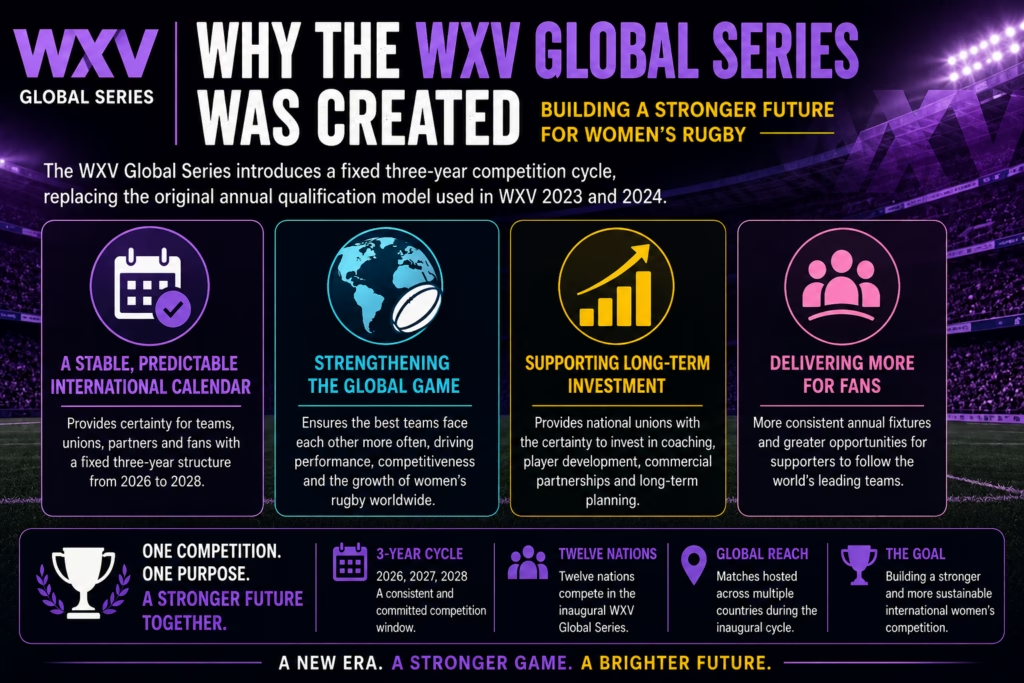
Teams qualified annually through regional competitions, with promotion and relegation creating movement between divisions from one season to the next. That rewarded on-field performance but also meant national unions had relatively little certainty when planning international schedules, commercial partnerships and long-term investment.
The WXV Global Series takes a different approach.
Rather than rebuilding the competition every year, World Rugby established a fixed three-year cycle after the conclusion of WXV 2024. The final standings from that tournament determined which nations would compete in the inaugural WXV Global Series and the WXV Global Series Challenger from 2026 through 2028.
Why Lock the Teams?
The WXV Global Series features the top 12 nations, while the WXV Global Series Challenger includes the next six.
Those places were determined following WXV 2024 and will remain unchanged throughout the inaugural cycle, regardless of movements in the World Rugby Rankings.
World Rugby’s objective is to provide participating unions with a predictable international calendar. With three seasons guaranteed, unions can make longer-term decisions around coaching, player development, commercial partnerships, scheduling and supporter engagement without uncertainty over annual qualification.
The governing body believes that stability will help strengthen the women’s international game before considering future structural changes.
Isn’t That Unfair?
Some supporters argue that annual promotion and relegation would create a more merit-based competition.
A nation making rapid progress could reasonably expect the opportunity to earn promotion before 2029, while a team that struggles over several seasons might normally expect to lose its place.
World Rugby has taken a different approach.
Its view is that establishing a stable international competition first will encourage greater investment from unions, sponsors and broadcasters while giving teams the certainty needed to build long-term high-performance programmes.
Whether that balance between stability and sporting merit proves successful will only become clear once the inaugural cycle has been completed.
Competition Still Matters
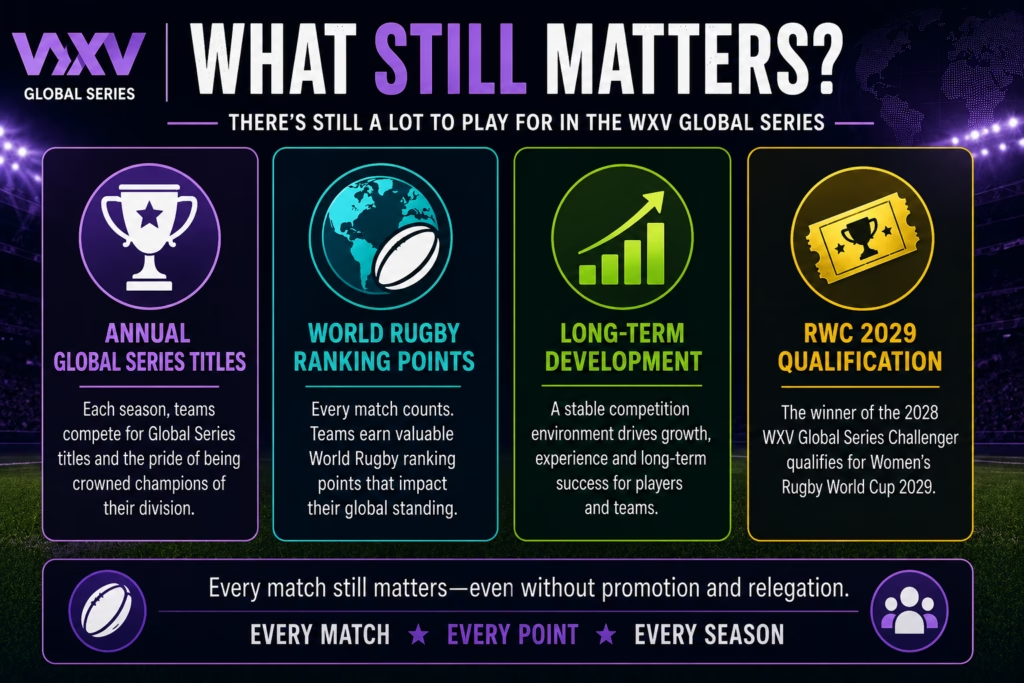
Although there is no promotion or relegation during the 2026–2028 cycle, every match still carries significant importance.
Teams in the WXV Global Series will compete annually against many of the world’s strongest nations, providing consistent elite-level competition as they prepare for Women’s Rugby World Cup 2029.
For nations in the WXV Global Series Challenger, the stakes become even higher in 2028.
World Rugby has confirmed that the 2028 Challenger tournament will serve as the Final Qualification Tournament for Women’s Rugby World Cup 2029. The winning nation will secure the 16th and final qualification place in Australia.
Results will also continue to influence the World Rugby Rankings, even though those rankings will not affect WXV participation during the inaugural cycle.
Every match therefore remains meaningful—whether for tournament success, world ranking points, player development or Rugby World Cup qualification.
Looking Beyond 2028
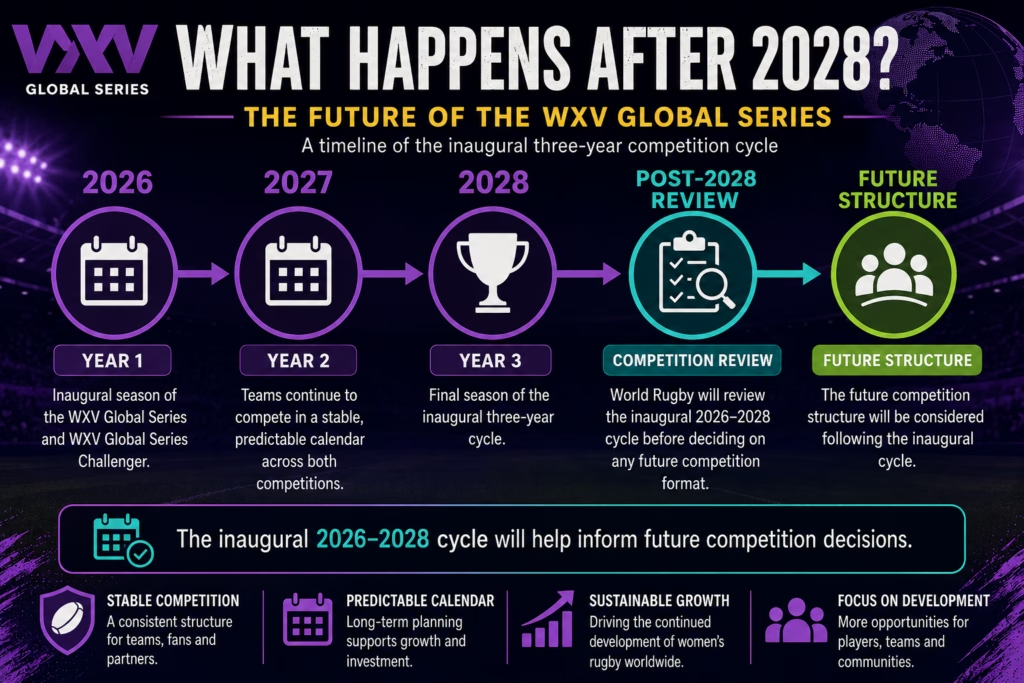
The inaugural three-year cycle is designed to establish the WXV Global Series rather than define its permanent structure.
Once the 2026–2028 cycle concludes, World Rugby will be able to evaluate whether the fixed-team model has achieved its objectives of delivering a more stable international calendar, stronger commercial opportunities and greater competitive consistency.
Only then will decisions be made about how the competition evolves beyond 2028.
Promotion and relegation could return in a future format, but no changes have been announced.
Final Whistle
Locking the participating teams for three seasons is one of the boldest decisions World Rugby has made in reshaping women’s international rugby.
Some supporters would have preferred annual promotion and relegation to reward on-field performance every season. Others believe a period of stability is essential if unions are to invest confidently in players, coaching, commercial partnerships and long-term planning.
World Rugby has chosen the second approach for the inaugural cycle.
Whether that decision proves successful will ultimately depend on whether the added stability produces stronger national programmes, closer competition and continued growth across the women’s game.
The real verdict will come after the 2028 season, when World Rugby—and rugby supporters around the world—will be able to judge whether the new model has delivered the stronger, more sustainable international competition it was designed to create.
Coming Tomorrow
WXV Explained – Part 5 of 7
What Does the WXV Global Series Mean for the USA Women’s Eagles?
The United States is one of the 12 nations guaranteed a place in the WXV Global Series through 2028. In Part 5, we’ll examine what the new calendar means for the Eagles, the quality of opposition they can expect, and why the next three seasons could play a pivotal role in their preparation for Women’s Rugby World Cup 2029.
WXV Explained Series
✅ Part 1: Why the WXV Global Series Was Created
✅ Part 2: How the WXV Global Series Works
✅ Part 3: Inside the WXV Global Series Challenger
✅ Part 4: Why Are the Rankings Fixed?
✅Part 5: How the WXV Global Series Supports Women’s Rugby World Cup 2029 Qualification
✅ Part 6: What the WXV Global Series Means for Women’s Rugby
✅Part 7: The Future of the WXV Global Series