

WXV Explained
Understanding the New Era of Women’s Rugby
Part 2 of 7

How the WXV Global Series Works
By The Rugby Fan Central Team
In Part 1 of our series, we explored why World Rugby created the WXV Global Series.
Now it’s time to understand how it works.
At first glance, the new competition can appear more complicated than the original WXV tournament. Instead of every team traveling to one host nation, matches are now played across multiple countries over an eight-week international window.
The objective is simple: create a more sustainable international calendar while giving players, supporters and national unions more opportunities than ever before.
A Dedicated International Window
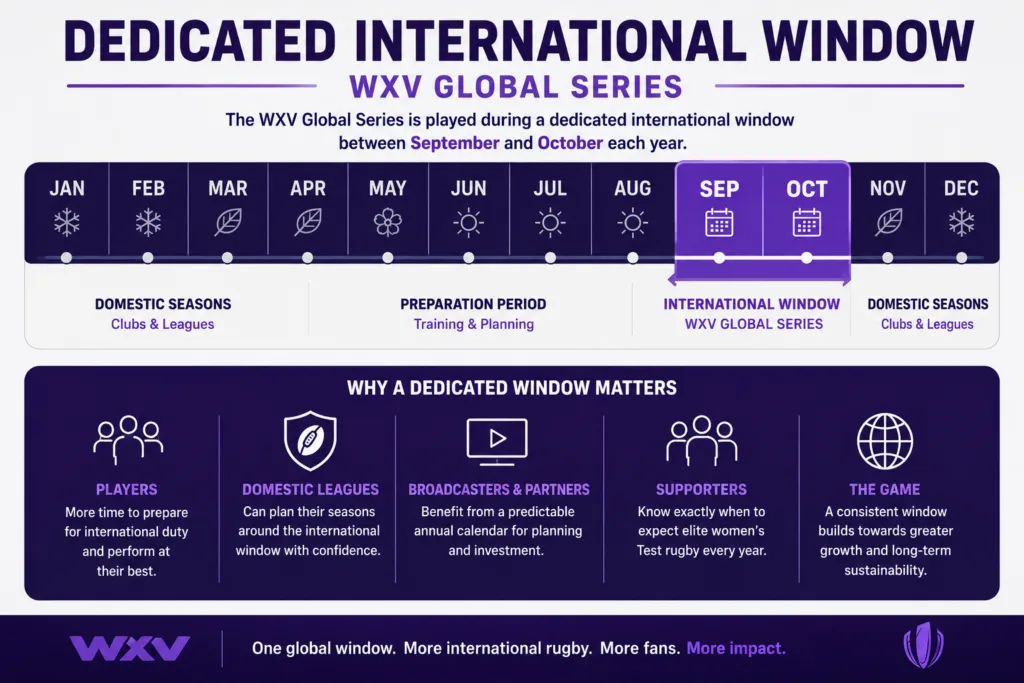
One of the biggest changes is not the format—it’s the calendar.
The WXV Global Series is played during a dedicated international window between September and October, replacing the previous single-host tournament with a structured annual season for women’s Test rugby.
Rather than organising standalone tours or occasional autumn internationals, unions now know exactly when international rugby will take place each year.
That certainty benefits everyone involved.
Players can prepare for international duty well in advance. Domestic competitions can build their schedules around the international window. Broadcasters and commercial partners gain a predictable calendar, while supporters know when to expect elite women’s Test rugby every season.
Two Competitions, One Global Series
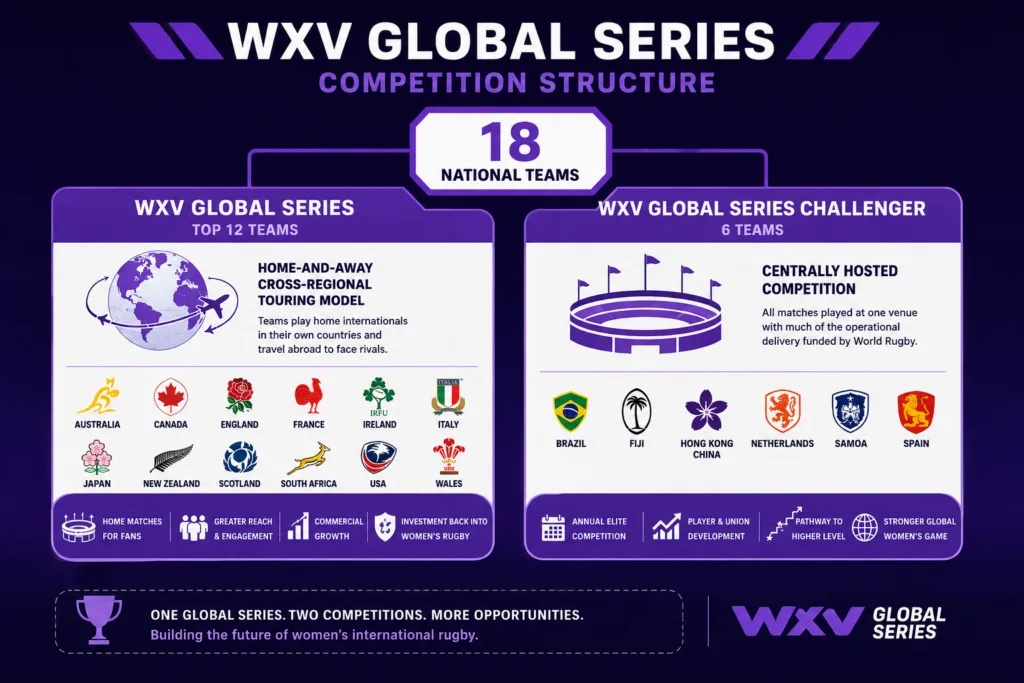
The WXV Global Series features 18 national teams, divided into two competitions.
WXV Global Series
The world’s top 12 ranked nations compete in a home-and-away cross-regional touring model.
Those teams are:
- Australia
- Canada
- England
- France
- Ireland
- Italy
- Japan
- New Zealand
- Scotland
- South Africa
- USA
- Wales
These unions have the infrastructure, stadiums and commercial capacity to host major international Test matches.
WXV Global Series Challenger
The next six ranked nations compete in the centrally hosted Challenger competition.
Those teams are:
- Brazil
- Fiji
- Hong Kong China
- Netherlands
- Samoa
- Spain
Rather than traveling across multiple countries, they compete at a single venue while World Rugby funds much of the competition’s operational delivery.
We’ll examine the Challenger in detail in Part 3.
Home-and-Away Rugby Returns

Perhaps the biggest change for supporters is where matches are played.
Instead of traveling to one tournament host, teams now play home internationals across the rugby world.
That means supporters in countries such as:
- USA
- Canada
- England
- France
- Ireland
- Scotland
- Australia
- New Zealand
- South Africa
- Japan
- Italy
- Wales
will once again have opportunities to watch meaningful women’s Test rugby on home soil.
The opening season provides several high-profile examples, including:
- England hosting Australia
- Scotland hosting Canada
- France hosting New Zealand
- USA hosting Italy in Nashville
Those fixtures would have previously taken place at a single tournament venue.
Why Only 12 Teams?
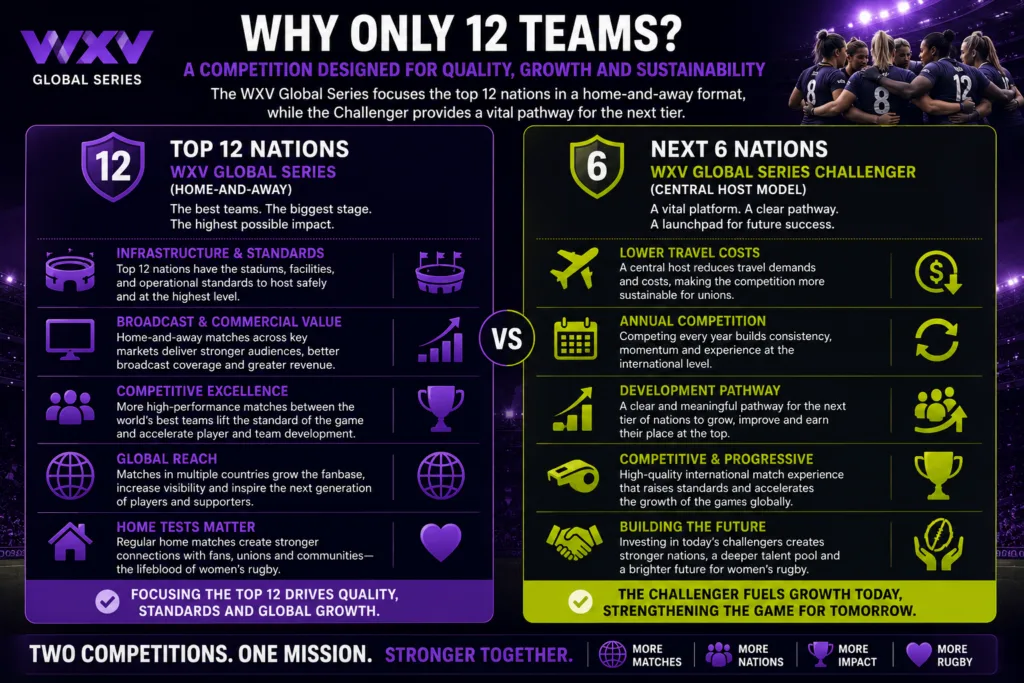
Some supporters have asked why only twelve nations take part in the touring competition.
The answer is practical.
Hosting international Test rugby requires significant investment.
Stadium hire, travel, accommodation, broadcasting, event management and commercial delivery all require resources.
World Rugby believes the top twelve unions are currently best placed to stage home internationals while generating commercial returns that can be reinvested into the women’s game.
The remaining six nations continue to receive annual elite competition through the Challenger without facing the financial burden of hosting multiple Test matches.
A Three-Year Competition Cycle
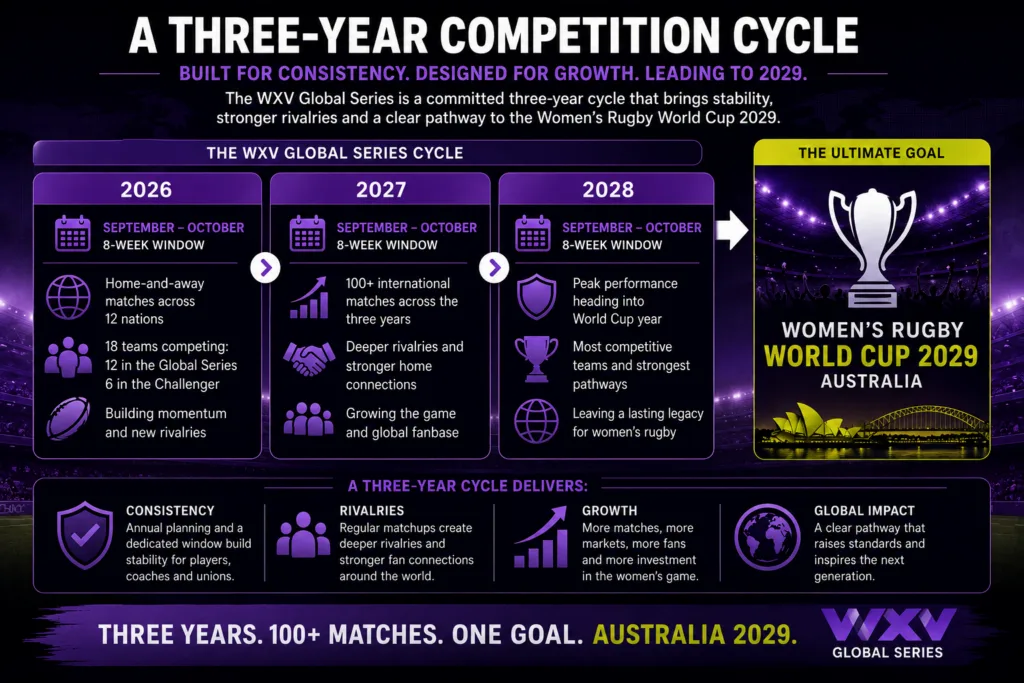
Rather than redesigning the competition every season, the WXV Global Series has been established as a three-year cycle running from 2026 through 2028.
Across that period:
- More than 100 international matches will be played.
- Teams will continue building rivalries.
- National unions gain greater planning certainty.
- Women’s Rugby World Cup 2029 qualification continues to develop.
The longer cycle allows unions to plan beyond a single season while giving supporters a competition they can follow year after year.
What Happens in 2027?
The 2027 season introduces one important variation.
Because the inaugural British & Irish Lions Women’s Tour of New Zealand takes place that year, unions not involved in the tour will instead play crossover fixtures.
Those matches ensure the international calendar remains active while maintaining competitive opportunities across the women’s game.
The Bigger Picture
The WXV Global Series is about far more than changing where matches are played.
It creates:
- A dedicated international season.
- Greater certainty for unions.
- More home Test matches.
- Increased commercial opportunities.
- Better long-term planning.
- More consistent elite competition.
Instead of building towards one tournament every autumn, women’s international rugby now operates within a structured global calendar.
That shift may ultimately prove to be the competition’s biggest innovation.
WXV Global Series at a Glance

| Feature | Details |
|---|---|
| Teams | 18 national teams |
| Top Competition | 12 teams |
| Challenger | 6 teams |
| Window | September–October |
| Format | Home-and-away touring + central Challenger |
| Cycle | 2026–2028 |
| Matches | Over 100 internationals |
| Purpose | Build towards Women’s Rugby World Cup 2029 |
Final Whistle
The WXV Global Series doesn’t simply replace one tournament with another.
It replaces a tournament with an international framework.
For supporters, that means more opportunities to watch their national teams at home. For unions, it provides greater certainty and new commercial opportunities. For players, it creates a more consistent pathway through the international game.
Most importantly, it gives women’s rugby a dedicated annual calendar that can continue to evolve well beyond 2029.
Coming Next
WXV Explained – Part 3 of 7
What Is the WXV Global Series Challenger?
We’ll explain why World Rugby created a separate Challenger competition, why Hong Kong was selected as the inaugural host, how the six-team tournament works and why it remains a vital part of the pathway to Women’s Rugby World Cup 2029.
WXV Explained Series
✅ Part 1: Why the WXV Global Series Was Created
✅ Part 2: How the WXV Global Series Works
✅ Part 3: Inside the WXV Global Series Challenger
✅ Part 4: Why Are the Rankings Fixed?
✅Part 5: How the WXV Global Series Supports Women’s Rugby World Cup 2029 Qualification
✅ Part 6: What the WXV Global Series Means for Women’s Rugby